
Manipulative Apology Patterns: 11 Examples and What to Say

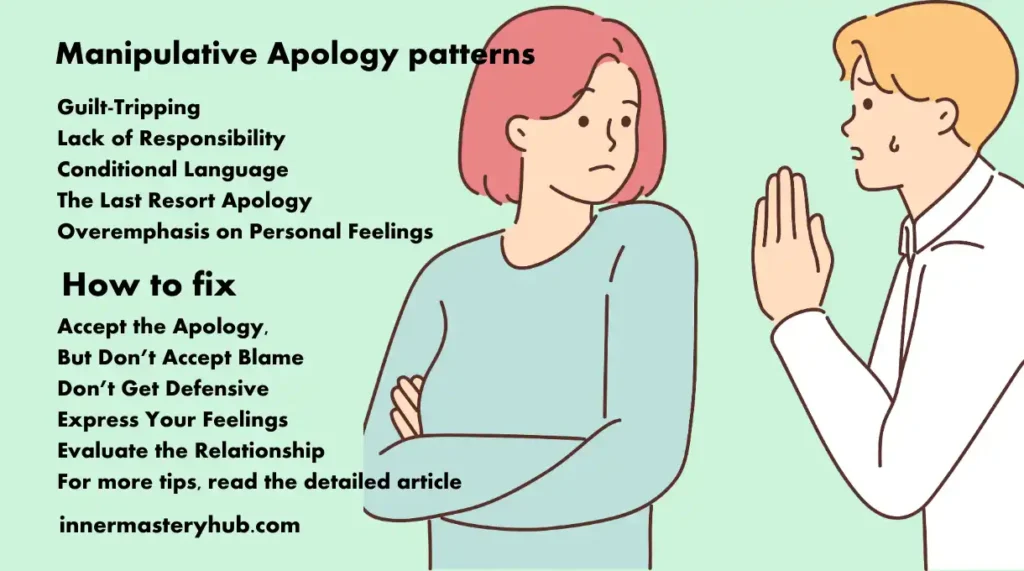
Manipulative apology patterns appear when someone says “sorry” but still avoids owning their behaviour. They may blame you, make the incident seem unimportant, or use excuses to explain why they acted that way. Instead of addressing what hurt you, they focus on your reaction and leave the original issue unresolved.
What Are Manipulative Apology Patterns?
A poorly worded apology does not always mean someone is trying to manipulate you. People can become defensive when they feel criticised, struggle to admit a mistake, or say something they later realise was unfair.
The difference becomes easier to notice when you look at what happens after the apology.
You say:
“That comment hurt me.”
They reply:
“I’m sorry, but you were being difficult too.”
Now you’re explaining why you were upset, defending your tone, or reminding them what happened. The comment that hurt you has barely been discussed.
Another common response is:
“I’m sorry you took it that way.”
You may notice that the person hasn’t addressed what they said. Instead, the focus has shifted to your reaction. You might even start wondering whether you misunderstood the situation.
This is worth noticing, especially when the same exchange happens repeatedly. You can also recognise similar patterns in mind games in relationships, where attention shifts away from the original behaviour.
Research by Lewicki, Polin, and Lount found that taking responsibility, acknowledging the harm, and offering to make amends are important parts of an effective apology.[1] In everyday life, you can look for these things in a simple way: does the person acknowledge what they did, or do you end up defending yourself instead?
What Are the Most Common Manipulative Apology Patterns?
A person can say “I’m sorry” without fully accepting responsibility for what happened. Sometimes the apology comes with an excuse, a reminder of what you did wrong, or pressure to forgive before you’ve had time to process the situation.
You might notice that you started the conversation because something hurt you, but ended up defending your reaction instead. The original issue gets very little attention, while you are left trying to explain why it mattered.
Research by Schumann examined defensive responses people may use after hurting someone, including excuses, justifications, blame, minimising the harm, and denial.[2] These responses can help explain some of the patterns below, although the study did not classify them as manipulative apologies.
1. The Conditional Apology
“I’m sorry if I hurt you.”
Notice the word “if.” It can make your experience sound uncertain, as though the hurt still needs to be proved.
You might say, “What you said about me in front of everyone was embarrassing.”
They reply, “Well, I’m sorry if you felt embarrassed.”
Now the conversation is about your reaction rather than the comment itself.
A more accountable apology would sound like:
“I’m sorry I made that comment about you in front of everyone. I can see why it embarrassed you.”
2. The Blame-Shift Apology
“I’m sorry I shouted, but you pushed me too far.”
This apology admits what happened but quickly brings your behaviour into it. You may have played a part in the disagreement, but that doesn’t make you responsible for someone else’s decision to shout.
For example, you raise your voice during an argument, and the other person uses that moment to avoid discussing what they said earlier.
A clearer response would be:
“I was upset, but shouting at you wasn’t right. I’m sorry.”
Both people can discuss their behaviour, but each person needs to take responsibility for their own actions.
3. The Minimising Apology
“I already said sorry. Why are you still upset?”
You may have accepted the apology but still feel uncomfortable about what happened. Perhaps the person has not answered your question, corrected something they said, or explained how they intend to avoid repeating it.
When they keep bringing up the fact that they apologised, you may feel pressured to act as though everything is fine.
A more considerate response would be:
“I know I apologised, but I understand that you’re still upset. I want to hear what I haven’t understood.”
An apology does not require you to forgive someone immediately or pretend the issue has disappeared.
4. The “You Misunderstood Me” Apology
“I’m sorry you misunderstood what I meant.”
You tell someone that their words hurt you. Instead of discussing what they said, they focus on your interpretation.
For example:
You: “That joke made me feel small in front of everyone.”
Them: “You know I was only joking. You always take things the wrong way.”
There may genuinely be a difference between what someone intended and how their words came across. But explaining an intention should not prevent them from hearing your concern.
A more thoughtful response would be:
“I didn’t mean to embarrass you, but I can see how that joke came across badly. I’m sorry I said it.”
You can read more about this difference in intent versus impact.
5. The Justification Apology
“I’m sorry I insulted you, but I was angry.”
The person explains why they behaved that way, but the explanation starts to sound like an excuse.
You may understand that they were stressed, tired, or frustrated. Still, those feelings don’t remove the need to take responsibility for hurtful words.
A more honest apology would be:
“I was angry about what happened, but I shouldn’t have called you names. I’m sorry.”
There is room to discuss what caused the argument without treating hurtful behaviour as acceptable.
6. The Role-Reversal Apology
You say:
“It hurt when you shared something I told you privately.”
They reply:
“I can’t believe you think I’d deliberately betray you. After everything I’ve done for you?”
You may find yourself reassuring them that you don’t think they’re a bad person. Meanwhile, the original concern about your private information remains unanswered.
This kind of response can resemble playing the victim, particularly when the person repeatedly makes your complaint about their own hurt feelings.
A direct apology would be:
“I shouldn’t have shared something you told me privately. You trusted me, and I broke that trust.”
7. The Self-Pity Apology
“Fine. I’m obviously a horrible person.”
You raise one behaviour that bothered you, but the other person responds by criticising themselves.
For example, you say, “I didn’t like the way you spoke to me yesterday.”
They answer, “I’m always the bad one, aren’t I? Nothing I do is ever good enough.”
You may feel uncomfortable and rush to say that you don’t think they’re a bad person. Your original concern then gets lost.
A more useful response would be:
“I shouldn’t have spoken to you that way. I understand why it upset you.”
Taking responsibility for one action does not require someone to describe themselves as a terrible person.
8. The Forced-Forgiveness Apology
“I’ve apologised. What more do you want?”
Here, the apology is treated as the end of the discussion. You may still need time, an explanation, or a behaviour change, but the other person seems frustrated that you haven’t moved on.
For example, someone makes an insulting comment about you in front of friends. They apologise later but become annoyed when you ask them not to repeat it.
A more respectful response would be:
“I understand that saying sorry doesn’t mean you have to feel okay straight away. I’ll give you time.”
You are allowed to decide when you’re ready to forgive. An apology does not create an obligation to do so.
9. The Vague Apology
“Sorry about everything.”
You may hear this after an argument, but you’re not sure what the person is actually taking responsibility for.
Imagine someone reads your private messages without permission. When you raise the issue, they say, “I’m sorry for everything that happened.”
You ask, “Are you apologising for reading my messages?”
They reply, “I already said sorry. Why are you making this difficult?”
The problem is that the apology never clearly addresses the action.
A more specific apology would be:
“I’m sorry I read your private messages without asking. I shouldn’t have done that.”
Specific words make it easier to understand what the person is acknowledging.
10. The Public Apology That Changes in Private
In front of other people, someone says:
“What I said was wrong. I apologise.”
Later, when you discuss the same incident privately, their response changes:
“I only apologised because everyone was upset. Why are you bringing it up again?”
This can leave you wondering whether they understood why the comment was hurtful or simply wanted the situation to end in front of others.
A public apology may be appropriate when the original behaviour happened publicly. But it should not become a reason to dismiss the person who was hurt when they still need to discuss it privately.
What matters is whether the person can acknowledge the behaviour without an audience.
11. The Repeated Apology Without Change
“I’m sorry I shouted. I promise it won’t happen again.”
You accept the apology, but during the next disagreement, the same thing happens. Afterward, you hear another promise.
This time, you may find it harder to trust the words because you’ve heard them before.
The concern is no longer just about one argument. It is about the repeated gap between what the person promises and what they do.
A more responsible response would be:
“I’ve apologised for shouting before, but I’ve repeated it. I need to work on how I handle disagreements. If I feel myself getting too angry, I’ll take a break rather than continue shouting.”
You don’t have to decide whether someone is sincere based on their words alone. Give more weight to whether their behaviour changes over time. If the same behaviour continues, you can recognise the warning signs of an unhealthy relationship and consider what boundaries you need.

How Repeated Blame-Shifting Can Affect Trust
When someone repeatedly avoids responsibility, you may start choosing your words more carefully around them. You think about how to raise a concern without starting another argument. Sometimes, you decide not to mention what bothered you at all.
This hesitation can affect everyday communication. You may notice yourself doing things such as:
- Keeping concerns to yourself: You stay quiet because previous conversations ended with you defending your feelings.
- Questioning your reactions: You wonder whether you are being unfair, asking for too much, or making a small issue bigger than it needs to be.
- Avoiding difficult conversations: You put off discussing problems because you expect another disagreement.
- Finding it harder to trust apologies: You hear someone say they will do better, but remember how often the same promise has been broken.
- Feeling emotionally tired: You spend more time thinking about how to explain yourself than dealing with the original problem.
For example, you may stop sharing personal concerns with a partner because previous conversations turned into arguments about your attitude. You still want to talk openly, but you are no longer sure how the other person will respond.
Over time, this can make a relationship feel less comfortable. You may be physically present and still find yourself holding back important thoughts.
If you recognise this pattern, it may help to understand emotional dysregulation in adults and how repeated difficult interactions can affect the way you express and manage your feelings.
The important question is not whether you can avoid every disagreement. It is whether both people can discuss a problem without one person having to silence their concerns to keep the peace.
Why Do Some People Become Defensive When Apologising?
Not everyone who gives a defensive apology is deliberately trying to manipulate someone. Sometimes, people find it difficult to admit that their actions have hurt another person.
You may notice different reasons behind this behaviour:
1. They feel criticised.
Some people hear a complaint as a personal attack. Instead of listening to what you are saying, they immediately explain why they acted that way.
2. They feel ashamed of their behaviour.
Admitting a mistake can be uncomfortable. A person may start making excuses or defending themselves because they do not know how to handle that discomfort.
3. They focus more on their intentions than on your experience.
They may think, “I didn’t mean to hurt anyone, so why am I being blamed?” They struggle to accept that their words can have an effect they never intended.
4. They have difficulty accepting responsibility.
Some people are used to explaining their actions rather than acknowledging their part in a disagreement. They may bring up your mistakes whenever you raise one of theirs.
5. They want the uncomfortable conversation to end.
An apology can become a quick way to stop an argument. They say what they think you want to hear but make little effort to understand what needs to change.
Research by Schumann examined defensive responses after interpersonal harm, including excuses, justifications, and blame. Her findings offer useful insight into why people may defend themselves instead of responding fully to the person they have hurt.[2]
However, these explanations do not establish someone’s intentions. A person may become defensive once and later recognise their mistake. It is more useful to look at whether they can listen, take responsibility, and make a genuine effort to handle future disagreements differently.
You can also explore why some people play the victim to understand how conversations sometimes shift from the original concern to the other person’s feelings.
How to Respond to a Manipulative Apology
You do not need to argue over every word someone uses in an apology. You can keep your response focused on the behaviour, explain what you need, and decide how much further you want to engage.
Here are five ways to respond in everyday situations.
1. Bring the conversation back to the original issue
When someone keeps bringing up unrelated mistakes, you may find yourself discussing several things without resolving the problem you originally raised.
You can say:
“We can discuss my part in this as well, but I also want us to address what happened here.”
This allows both people to take responsibility without using one person’s mistake to dismiss the other’s concern.
2. Ask for a specific apology
If someone gives a general apology but avoids naming their behaviour, ask them to be clear.
You can say:
“I appreciate that you’re apologising. Can you tell me what you understand was hurtful about what happened?”
This gives the other person an opportunity to show whether they understand your concern rather than simply trying to end the discussion.
3. Make it clear that you need time
Sometimes, a person expects you to return to normal immediately after they apologise. You may not be ready, and you do not have to pretend otherwise.
You can say:
“I’ve heard your apology, but I need some time before I feel comfortable moving forward.”
This is a reasonable way to express your feelings without turning the conversation into another argument.
4. Explain what needs to change
When the same behaviour keeps happening, another promise may not be enough. Explain what you need to see in future interactions.
You can say:
“I don’t want us to keep having the same conversation. I need to see this behaviour change, not just hear another promise.”
This makes your concern clear and gives the other person a better idea of what taking responsibility looks like.
5. Step away when the conversation becomes unproductive
You may try to explain your concern several times, but the discussion keeps becoming personal. Continuing at that point may leave both people more frustrated.
You can say:
“We’re not getting anywhere with this conversation right now. I’d rather take a break and talk when we can both listen.”
If the person continues to dismiss your concerns or refuses to respect that boundary, you can choose not to continue the discussion.
This is not about punishing someone or refusing to communicate. It is about recognising when a conversation is no longer useful.
A final point about responding
You cannot make another person accept responsibility by finding the perfect words. You can explain what bothered you, state what you expect, and decide what you are willing to accept in the relationship.
Pay attention to whether future conversations become more respectful and whether the behaviour actually changes. That gives you more useful information than another promise alone.
How to Tell Whether an Apology Is Followed by Real Change
A person may sound genuinely sorry during an argument, but the real question is what happens afterward. Do they acknowledge what they did, make an effort to repair the harm, and handle similar situations differently?
You don’t need to expect someone to become perfect overnight. People can make mistakes while learning to communicate better. However, if the same behaviour keeps returning and every apology ends with another promise, it is reasonable to question whether anything is changing.
Research offers some useful guidance here.
A 2016 study by Lewicki, Polin, and Lount examined six components of effective apologies. The researchers found that apologies containing more of these components were generally rated as more effective. Acknowledging responsibility, explaining what happened, and offering to repair the harm were among the most important elements.[1]
A separate 2017 systematic review and meta-analysis by Yuan, Dong, and Li examined 18 studies involving 4,731 participants. The findings showed that apologies had a positive effect on repairing trust, although the effect depended partly on the type of trust violation.[3]
These findings support an important distinction: saying sorry can help repair a relationship, but an apology is not the same as repaired trust. That is why it helps to look at what follows the conversation.
The REPAIR Checklist: Six Things to Look for in an Apology
You can use this checklist to reflect on whether an apology includes the elements needed for meaningful repair.
R – Responsibility
Does the person acknowledge what they did without making your behaviour the main subject?
For example, “I shouldn’t have shared that information” accepts responsibility. “I’m sorry, but you shouldn’t have told me in the first place” shifts attention elsewhere.
E – Empathy
Do they try to understand how their actions affected you? They may see the situation differently, but they can still listen without dismissing your experience.
P – Precision
Is the apology clear about what happened? “I’m sorry for speaking disrespectfully during our conversation” is more specific than “Sorry for everything.”
A – Amends
Are they willing to put things right where possible? This might mean correcting something they said, replacing something they damaged, or respecting a boundary they previously ignored.
I – Improvement
Do you notice an effort to handle similar situations differently? For example, someone who regularly interrupts you may begin allowing you to finish speaking, even when they disagree.
R – Repetition
What happens when another disagreement occurs? One mistake does not tell you everything about a person, but repeated behaviour after several apologies deserves attention.
The REPAIR checklist is an editorial reflection tool, not a scientifically validated psychological test. It draws on established apology research, particularly the work of Lewicki and colleagues[1]. It can help you assess what you observe, but it cannot establish whether someone is sincere or deliberately manipulative.
You don’t need to judge an apology by its emotional delivery. Consider whether the person understands the problem, takes responsibility, and makes a genuine effort to address it.
Conclusion
Manipulative apology patterns become concerning when blame, excuses, and pressure to forgive repeatedly replace responsibility. You can acknowledge someone’s apology without immediately trusting their promises or ignoring what happened.
Research suggests that apologies can help repair trust, but rebuilding a relationship also takes time and effort. Notice whether the person listens to your concerns, respects your boundaries, and makes changes in their behaviour.
You deserve relationships where mistakes can be discussed openly, responsibility is shared fairly, and your feelings do not have to be defended every time you raise a concern.
FAQs
What Is a Manipulative Apology Pattern?
A manipulative apology pattern is a way of saying sorry while avoiding full responsibility for what happened. The person may make excuses, shift blame, or expect you to forgive them without addressing the problem.
For example:
“I’m sorry I lost my temper, but you know how stressful things have been for me.”
The person mentions their stress but doesn’t fully address how they treated you. One defensive apology doesn’t automatically mean manipulation, but repeated blame-shifting is worth noticing.
How Can You Tell Whether an Apology Is Sincere?
A meaningful apology clearly acknowledges the behaviour and shows a willingness to put things right.
Compare these two responses:
“I’m sorry things got out of hand.”
“I’m sorry I shared your personal information without asking. I shouldn’t have done that.”
The second response names the action instead of treating it as something that simply happened. You can also look at what follows. Does the person respect your privacy afterward, or do you find yourself having the same conversation again?
How Should You Respond to a Manipulative Apology?
You can respond by calmly explaining what you want the person to address, rather than getting drawn into unrelated arguments.
For example, if someone says:
“I’m sorry I ignored your calls, but you expect too much from me.”
You could reply:
“We can talk about how often we communicate, but I also want to discuss why you ignored my calls without letting me know.”
This keeps both concerns open for discussion without allowing one to replace the other. You can also take a break if the conversation becomes disrespectful.
Is “I’m Sorry You Feel That Way” a Real Apology?
Not necessarily. The phrase acknowledges your feelings but does not clearly identify what the speaker is apologising for.
For example:
“I’m sorry you felt excluded.”
This tells you how the other person views your reaction.
Compare it with:
“I’m sorry I left you out of the discussion. I should have included you.”
The second response identifies the person’s own action. However, context matters: someone can use the first phrase sincerely, but on its own, it does not tell you whether they understand or accept responsibility for what happened.
- Lewicki, R. J., Polin, B., & Lount, R. B., Jr. (2016). An exploration of the structure of effective apologies. Negotiation and Conflict Management Research, 9(2), 177–196. https://doi.org/10.1111/ncmr.12073 ↩︎
- Schumann, K. (2014). An affirmed self and a better apology: The effect of self-affirmation on transgressors’ responses to victims. Journal of Experimental Social Psychology, 54, 89–96. https://doi.org/10.1016/j.jesp.2014.04.013 ↩︎
- Yuan, B., Dong, Y., & Li, W. (2017). The trust repair effect of apology: A systematic review and meta-analysis. Advances in Psychological Science, 25(7), 1103–1113. https://doi.org/10.3724/SP.J.1042.2017.01103 ↩︎

Written By Mehwish Qurayshi
Mehwish Qurayshi is a Trauma-Informed Emotional Wellness Counsellor trained through NICABM’s Treating Trauma Master Series, which includes NBCC-approved education in Trauma Treatment and Emotional Wellness & Emotional Intelligence – Sourcecode Academia. She has over five years of experience providing emotional wellness counselling, helping individuals heal from trauma, regulate emotions, and build healthy relationships.