
Deep Emotional Patterns Of Toxic Empathy When Caring Becomes Chaotic
Title
Toxic empathy is an emotional pattern where you over-identify with others’ feelings to the point that it harms your own well-being. It often leads to emotional exhaustion, blurred boundaries, and internal conflict because you prioritize others’ pain while neglecting your own emotional regulation.
Everyone appreciates being able to relate to people and share in their pleasures and sorrows. This empathy reserve, however, can occasionally overflow, leaving us emotionally tired and worn out. The bad side of compassion is toxic empathy.
At first, it feels like emotional strength. You easily connect with others, sense what they feel, and respond with compassion. But over time, something shifts when you absorb more than you process. You give more than you restore. Your emotional regulation starts to weaken, even though your intention remains pure.
The real struggle isn’t that you care too much; it’s that your empathy has become unfiltered.
And naturally, this creates an internal loop: you feel → you interpret → you absorb → you carry.
Why Does Toxic Empathy Feel So Natural Yet So Draining?
Toxic empathy feels natural because it develops as a learned emotional response, especially in environments where understanding others is essential for safety or connection. However, it becomes draining because your brain struggles to separate your emotions from others’.
You’re not “too sensitive rather your mind is trying to protect the connection.
When someone expresses pain, your brain quickly interprets it as something to fix. This activates emotional mirroring, a real psychological process where you internally recreate others’ feelings.
According to research published in Frontiers in Psychology, empathy activates neural circuits similar to those involved in experiencing pain yourself1.
So what happens?
- You hear pain → your brain mirrors it
- You interpret it as a responsibility
- You feel emotional weight
- You carry it beyond the moment
And because this feels like kindness, you don’t question it.
What Is the Difference Between Healthy Empathy and Toxic Empathy?
Healthy empathy allows you to understand others’ emotions without losing your own boundaries. Toxic empathy blurs that boundary, causing you to absorb emotions and neglect your own needs.
Healthy Empathy:
- You feel with someone
- You stay aware of your own state
- You respond, not absorb
Toxic Empathy:
- You feel like someone
- You lose emotional separation
- You internalize their pain
“Empathy becomes toxic when connection replaces identity.”
What’s Actually Happening Inside You? (The Hidden Emotional Loop)
Toxic empathy follows a subconscious loop: a trigger activates emotional interpretation, which leads to internalized emotion and eventually emotional consequences like burnout or resentment.
The Inner Process
You notice someone struggling when your mind instantly tries to fill in the gaps: They need help. I should be there.
But while doing that, you also start to feel what they feel. Your body tightens, your thoughts shift, and you begin carrying their emotional state.
Over time:
- You say yes when you want to rest
- You listen even when you feel overwhelmed
- You give even when you feel empty
And because you’re focused outward, you lose track of what’s happening inward.
This is where emotional regulation breaks down, not because you lack strength, but because you’re overextended.
Why Do People Develop Toxic Empathy?
Toxic empathy develops from early emotional conditioning, such as needing to manage others’ emotions for safety, approval, or connection.
Psychological Roots
Many people with toxic empathy learned early that:
- Being understanding = being accepted
- Others’ emotions = your responsibility
- Conflict = something to fix quickly
Research in the Journal of Personality and Social Psychology shows that great empathic concern without regulation increases emotional distress rather than compassion2.
So while empathy is valuable, unregulated empathy becomes overwhelming.
What Are the Signs of Toxic Empathy?
Common signs include emotional exhaustion, difficulty setting boundaries, feeling responsible for others’ feelings, and losing your own emotional clarity.
Key Signs to Notice
- You feel drained after emotional conversations
- You struggle to say no without guilt
- You constantly think about others’ problems
- You feel responsible for fixing emotions
- You neglect your own needs
These signs don’t mean you’re weak. They mean your emotional system is overloaded.
What Mistakes Do People Make Without Realizing It?
People often mistake over-giving for kindness, emotional absorption for connection, and self-neglect for selflessness.
Common Misunderstandings
- “If I don’t help, I’m selfish.”
- “If I feel it deeply, I must act on it.”
- “Their pain matters more than mine.”
But while these beliefs feel compassionate, they quietly create imbalance.
Because empathy without limits turns into emotional dependency, not just for others, but within yourself.
What’s the difference between sympathy and empathy?
While compassion is the capacity to understand someone else’s point of view without being personally affected by it, empathy is more closely related to the phrase “being in another’s shoes” or experiencing the emotions of the person you are empathizing with.
The three elements of empathy are empathic, emotional, and cognitive. We experience empathy through others’ thoughts, feelings, and bodily actions, in simpler terms.
Some signs you may be experiencing toxic empathy
Signs of Toxic Empathy
- Feeling exhausted after socializing, even with people you love.
- Experiencing bodily side effects after absorbing challenging emotions, such as headaches, nausea, or exhaustion.
- Emotional stress is causing difficulty concentrating on duties.
- Seeing that you need more time alone than normal to refuel emotionally.
- Embracing every opportunity, even if it saps your energy or causes pain.
- Having the sense that you must solve other people’s issues, even if they haven’t sought assistance.
- Associated with the Meaning, Symptoms, Impact, and Recovery of Childhood Emotional Neglect
Managing toxic empathy
If any of the following indications apply, use empathic protection measures to deal with toxic empathy before it spreads. Protect yourself from poisonous empathy. Even if you haven’t observed healthy empathy, be proactive, so you have a plan.

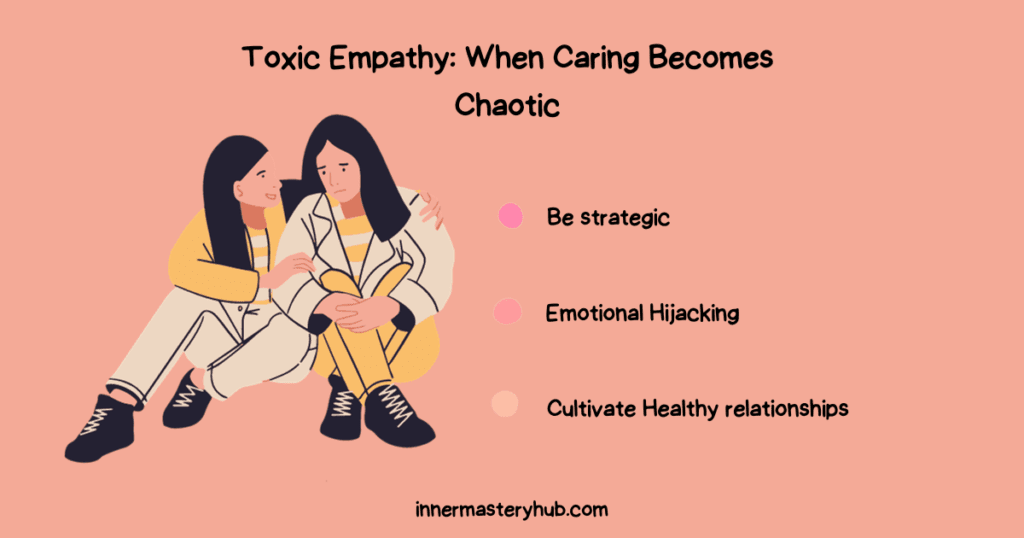
Cultivate Healthy relationships
Clear limits are essential for healthy relationships and avoiding toxic empathy. Openly set boundaries and expectations to respect others’ needs. Spend time on self-care and relaxing hobbies. To provide help without feeling overwhelmed, it’s essential to preserve your emotional regulation and mental health.
Say no assertively when necessary. It’s not selfish, but a good method to conserve energy and avoid burnout. Pay attention to your feelings and recognize when you take on others’ emotions too much. Mindfulness helps you stay present and emotionally detached when needed.
Promote open communication in relationships. Encourage honesty and allow both sides to share their concerns. Determine which relationships enrich your life and prioritize them. If a relationship is exhausting or unhealthy, consider setting limits or reconsidering it.
Emotional Hijacking
Emotional hijacking is the process by which your emotions and feelings are subjugated to another individual’s. Emotional hijacking during a releasing session can occur to individuals with a high empathic quotient and a tendency toward toxic empathy. They can mimic and absorb one another’s annoyances.
Develop empathy without absorbing others’ emotions. Recognize others’ feelings without taking them personally and maintain emotional distance. To protect your mental health, set boundaries and discuss them with others.
In emotional situations, step back before responding. Take the time to process your feelings and consider others’ opinions. Impulses can lead to emotional hijacking, so stop and pause.
Be strategic
First, recognize your
Practice cognitive empathy, which is understanding and sharing another person’s thoughts, opinions, and feelings without actually experiencing them. It requires perspective-taking and intellectual processing.
Balancing compassion and self-preservation is key to strategic empathy and avoiding toxic empathy. First, recognize your emotional triggers and vulnerabilities. This knowledge will help you handle difficult situations by deepening your understanding of your emotions.
How Does Toxic Empathy Affect Mental Health?
Toxic empathy can lead to anxiety, emotional burnout, compassion fatigue, and identity confusion.
Studies on compassion fatigue show that prolonged emotional exposure without regulation leads to psychological distress3.
Effects include:
- Chronic stress
- Emotional numbness
- Increased anxiety
- Reduced self-awareness
Because you’re always tuned into others, your own emotional signals become harder to hear.
Can Toxic Empathy Be Unlearned or Rebalanced?
Toxic empathy can be rebalanced by shifting from emotional absorption to emotional awareness, but the change begins with understanding rather than forcing control. rather than
The goal isn’t to stop caring, it’s to change how you care.
Instead of feeling everything deeply and carrying it, awareness allows you to stay connected without losing yourself.
The Quiet Shift You Need to See
Toxic empathy isn’t about caring too much; it’s about caring without boundaries.
You were never wrong for feeling deeply. But somewhere along the way, empathy turned into responsibility.
And that’s the shift:
You don’t need to feel less.
You need to separate feeling from carrying.
Because true empathy doesn’t cost you your peace.
FAQs
How do you treat toxic empathy?
Set healthy boundaries, prioritize self-care, separate emotionally, and seek support to combat toxic empathy. Healthy relationships must strike a balance between compassion and self-preservation.
What is hyper-empathy syndrome?
Although not officially recognized in psychology, the term “hyper-empathy syndrome” refers to an exceptionally compassionate person. His sensitivity enables him to empathize with others’ feelings. Emotional weariness may become toxic from people’s strong absorption and experience of others’ emotions.
What is toxic empathy?
Toxic empathy is when you absorb others’ emotions so deeply that it harms your mental health. Instead of understanding feelings, you internalize them, leading to stress, burnout, and emotional confusion.
How do you overcome toxic empathy?
What causes toxic empathy?
Low self-esteem, unresolved emotional problems, or a lack of personal boundaries can all lead to struggling with toxic empathy. Emotional weariness and weakened well-being might result from taking on too much of other people’s feelings.
What is empathy deficit disorder?
The name “Empathy Deficit Disorder” is not accepted in clinical practice. It alludes to a perceived lack of empathy in particular people or social situations, such as narcissists.
How is toxic empathy different from being kind?
Kindness involves helping while maintaining boundaries. Toxic empathy removes those boundaries, making you feel responsible for others’ emotions and neglecting your own well-being.
Why do I feel others’ emotions so strongly?
This comes from heightened emotional sensitivity or from learned behavior in which you adapted to others’ emotions for connection or safety.
What is emotional regulation in empathy?
Emotional regulation is your ability to manage and separate your feelings from others’, allowing empathy without emotional overload.
Is toxic empathy linked to trauma?
In many cases, yes. People who experienced emotional instability may develop heightened empathy as a coping mechanism.
.
- Decety, J., & Lamm, C. (2006). Empathy and the brain. Frontiers in Psychology. https://doi.org/10.3389/fpsyg.2006.00003 ↩︎
- Eisenberg, N. et al. (2010). Empathy-related responding. Journal of Personality and Social Psychology. https://doi.org/10.1037/a0018932 ↩︎
- Figley, C. R. (1995). Compassion fatigue. Brunner/Mazel. ↩︎
Written By Mehwish Qurayshi
Mehwish Qurayshi is a Trauma-Informed Emotional Wellness Counsellor trained through NICABM’s Treating Trauma Master Series, which includes NBCC-approved education in Trauma Treatment and Emotional Wellness & Emotional Intelligence – Sourcecode Academia. She has over five years of experience providing emotional wellness counselling, helping individuals heal from trauma, regulate emotions, and build healthy relationships.