
Stop Chasing People: 10 Emotional Shifts That Break the Cycle
What does “stop chasing people” mean?
It means ending the habit of seeking validation, attention, or love from people who are emotionally unavailable or inconsistent. Instead, you shift your focus inward, regulate your emotions, and allow relationships to become mutual rather than forced.
Have you ever had the impression that you should stop chasing those who don’t appear to appreciate your efforts, like you’re on a treadmill? Chasing people may be emotionally and physically taxing, whether in your personal life, friendships, or even business relationships. You may experience exhaustion and issues with self-worth as a result.
But what if there was a more effective method?
While it looks like you’re trying to keep someone close, what’s really happening is an internal loop:
You feel a trigger → you interpret it as rejection → you feel anxiety → you act to reduce that discomfort. And naturally, that action becomes chasing.
This isn’t just about relationships. It’s about emotional regulation, self-worth, and the way your mind interprets connection.
Are you prepared to end your pursuits and start drawing the right people into your life?
What Does It Mean to Stop Chasing People?
Stopping chasing people means ending the emotional pattern of pursuing those who don’t reciprocate. It’s about choosing self-respect over validation and allowing connection to flow naturally instead of forcing it.
Chasing someone’s attention, acceptance, or companionship in a social or romantic context is called “chasing people.” You may need to make a consistent effort to get attention or interact with someone who might not be as interested in you.
Most people think chasing is about love. But it’s actually about fear of loss and emotional discomfort.
When someone pulls away, your brain interprets it as danger. According to attachment theory, this activates anxiety-driven behavior1.
Chasing is the violent seeking of another person’s attention or affection in a social or romantic setting, often to the point of being extraordinarily persistent or desperate. This behavior may not be well-received if the other person is uninterested or if the pursuit becomes bothersome.
Remember that respect and shared interests form the foundation of healthy relationships. A person may need to reassess the parameters of the relationship and determine whether it is truly fulfilling for both sides if they feel the desire to pursue or chase someone who is not reciprocating.
Any connection needs to be based on permission, communication, understanding, and respect for others’ boundaries.
Signs That You Should Stop Chasing People
The following are indications that you may be pursuing someone:
- You get nervous or concerned when you don’t hear back from them.
- You wonder what they’re doing and often think about them.
- Even when their actions are damaging, you defend them.
- You experience a never-ending competition for their attention.
- You believe that you are unworthy of them.
Why Do You Keep Chasing People Who Don’t Choose You?
You chase people because your mind associates inconsistency with emotional significance. This pattern stems from past experiences in which attention was unpredictable, making you work harder for connection.
The cycle looks like this:
- Someone becomes distant
- You interpret it as rejection
- You feel anxiety or insecurity
- You try harder to reconnect
- They pull away more
- Your anxiety increases
This creates what psychologists call a reinforcement loop, similar to variable reward systems2.
Because the attention is inconsistent, your brain values it more.
What Is the Biggest Misunderstanding About Chasing People?
The biggest misunderstanding is believing that chasing shows love. In reality, it reflects emotional dependence and fear of abandonment, not genuine connection.
You think:
“If I care more, they’ll stay.”
But the truth is:
Healthy relationships don’t require chasing; they require mutual effort.
Chasing shifts the dynamic:
- You become the pursuer
- They become the withdrawer
- The balance disappears
And while you feel more invested, they feel less pressure to show up.
What Happens Inside You When You Chase Someone?
Chasing activates stress responses in your brain, increasing anxiety and lowering self-worth over time.
You notice a delay in response.
Your mind quickly interprets it:
“They’re losing interest.”
That thought creates emotion, tightness, restlessness, and a sense of urgency.
To escape that discomfort, you act:
You text again. You explain yourself. You try to “fix” things.
But instead of relief, you often feel worse.
Because now, your self-worth is tied to their reply.
Research shows that rejection activates the same brain regions as physical pain3.
So your reaction isn’t weakness, it’s biology.
But staying in that loop turns temporary discomfort into long-term emotional exhaustion.
Why Does Chasing People Lower Your Self-Worth?
Chasing people repeatedly sends a message to your subconscious that your needs are less important than theirs, weakening your sense of value.
Every time you overextend:
- You ignore your own boundaries
- You prioritize their attention over your peace
- You reinforce the belief: “I have to earn love.”
Over time, this becomes identity.
And you don’t just chase people, you chase validation.
What Mistakes Keep You Stuck in This Pattern?
Common mistakes include over-explaining, ignoring red flags, confusing attention with affection, and believing effort alone can fix an imbalance.
Key Patterns People Repeat
- Sending long messages to “clarify” feelings
- Giving more to prove worth
- Staying available at all times
- Justifying inconsistent behavior
- Hoping they will change
While these actions feel like love, they stem from emotional Survival rather than genuine connection.
What Does Emotional Regulation Have to Do With This?
Emotional regulation helps you pause between feeling triggered and reacting, preventing impulsive chasing behavior.
Without regulation, your emotions control your actions.
But when you learn to sit with discomfort:
- You don’t react immediately
- You observe the feeling instead of obeying it
- You create space between thought and action
This is supported by research on emotional intelligence (Gross, 1998), which shows that regulated responses improve relationship outcomes4.
What Changes When You Finally Stop Chasing People?
When you stop chasing, relationships either become mutual or naturally fade, creating space for healthier connections.
At first, it feels like a loss.
But over time, something shifts:
- You feel calmer
- You stop overthinking
- You regain control over your emotions
And most importantly, you stop trying to convince people to choose you because you start choosing yourself.

How to Stop Chasing People and Attract Healthy Relationships
Imagine sowing a seed in a garden. You give it water and sunlight and watch it grow with patience. You don’t push the petals to open or pull at the sprouts. Like a garden, relationships require time to blossom naturally.
1. Give Up the Constant Pursuit
It can be oppressive for both of us to be overly eager or continually chase someone. It is comparable to attempting to run a marathon; you become fatigued well before you have completed half of the race. The relationship can develop comfortably when you let up on the never-ending chase.
2. Let Relationships Develop Organically
Relationships are like a tale that is being told. With every chapter, the people and storyline become more apparent. Attempting to fast-forward or manipulate the storyline often results in misinterpretations or missed opportunities for genuine communication. Let things happen naturally and relish the ride.
3. Allow People to Breathe
In a relationship, space acts as the breathing room. Relationships require personal space for individuals to flourish as well. A stronger bond is created when one person can be themselves, pursue their hobbies, and socialize. It demonstrates regard for their uniqueness.
4. Healthy Relationships Grow Organically
Tightly-kept gardens are similar to healthy relationships. They need to be nurtured, given time, and allowed to grow organically. You cannot push a relationship’s emotional depth or intimacy to bloom, just as you cannot force a flower to bloom. Have faith in the process, and you will see something lovely come to life.
5. Stop Interpreting Silence as Rejection
Not every delay or distance means you’re being rejected. Your brain fills gaps with worst-case meanings. But silence is neutral. When you stop assuming rejection, your emotional reaction becomes clear, and the need to chase naturally reduces.
6. Let Discomfort Exist Without Fixing It
The urge to chase fades when you stop trying to fix uncomfortable feelings immediately.
That restless feeling in your chest? It passes. But if you always act on it, your brain never learns that you’re safe without chasing.
7. Accept What Their Effort Is Showing
Pay attention to what people do, not what they say. If someone is inconsistent, distant, or unavailable, that is the answer. Chasing begins when you ignore reality and hold onto potential instead.
8. Shift From “How Do I Keep Them?” to “Do They Meet Me?”
Stop focusing on being chosen. Start asking if they’re right for you. This flips the dynamic.
Instead of trying to earn attention, you evaluate connection. And naturally, chasing loses its purpose.
9. Build a Life That Doesn’t Revolve Around One Person
The more your life feels full, the less you feel the need to chase. When your focus is only on one connection, every small change feels intense. But when your life has meaning beyond them, your emotional balance becomes stronger.
10. Notice the Trigger Before the Reaction
You stop chasing when you become aware of the exact moment you feel the urge to reach out again. When someone delays replying or acts distant, your mind quickly creates a story. That story creates anxiety. And that anxiety pushes you to act. But when you pause and notice the trigger, you interrupt the pattern before it turns into chasing.
You chase when you feel emotionally unsafe, and you stop when you learn to feel safe within yourself.
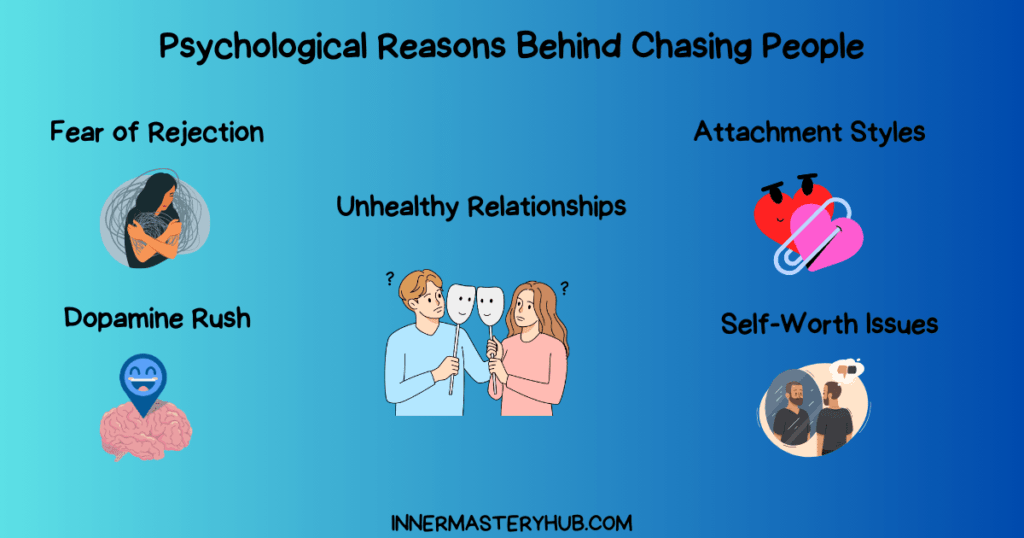
Psychological Reasons Behind Chasing People
Pursuing people in romantic and platonic relationships can be perplexing and emotionally taxing. The urge to date someone who doesn’t feel the same way about us may seem illogical, yet it might be based on deeply seated psychological concepts. Let’s examine the psychology behind pursuing people and explore strategies for breaking this vicious cycle.
Dopamine Rush. Chasing someone causes the release of dopamine, a neurotransmitter linked to pleasure and reward, particularly when combined with the uncertainty of the result. This creates a dopamine loop, reinforcing the action by making the chase seem addictive.
Fear of Rejection. The fear of rejection may be the driving force behind chasing someone. We believe we have greater control over the outcome and may spare ourselves the hurt of rejection if we take the initiative to pursue the relationship.
Attachment Styles. Our relationship behavior can be influenced by the attachment styles we form during early childhood. Anxious attachment style people may be more prone to pursue someone because they feel the need for continuous comfort, and due to a fear of abandonment.
Self-Worth Issues. Pursuing someone can help us feel better about ourselves. We could think that we are more valued and deserving of love if we are desired by someone else.
Unhealthy Relationships. Chasing results in unbalanced and superficially connected relationships. These partnerships may be emotionally taxing and eventually disappointing.
Why it’s beneficial to stop chasing people
Chasing people can be draining and ultimately unproductive in both romantic and platonic relationships. Here are some reasons to embrace the power of attraction rather than chase after things:
Reduces anxiety and stress: Chasing someone who doesn’t feel the same way about you can be a never-ending source of tension and worry. Giving up the chase releases emotional and mental energy, allowing you to focus on the positive aspects of your life.
Enhances self-esteem: Pursuing a romantic partner may lead to low self-esteem and feelings of inadequacy. By focusing on your development, you can improve your self-love and Confidence, which will make you a more attractive person.
Enhances emotional resilience: By learning to accept rejection and move on, you can become more emotionally resilient and better equipped to face life’s inevitable ups and downs.
Attracts the right crowd: Chasing leads to unbalanced, toxic partnerships. Building solid and satisfying relationships begins with prioritizing your health and attracting individuals who value your uniqueness.
Encourages boundaries and respect for one another: Chasing can be coercive and dominating. Letting go makes a genuine relationship built on mutual respect and sound boundaries possible.
Promotes independence and self-reliance: Pursuing a goal can result in codependency. By prioritizing your fulfillment and pleasure, you become a stronger, more self-reliant person, better suited for wholesome relationships.
Embrace the Journey
It takes an expedition of self-discovery and personal development to break free from the chase. Although it requires time and work, the benefits are enormous.
You give yourself the best chance of forming meaningful and rewarding connections when you prioritize your well-being and cultivate positive relationships with others. Never forget that you should be appreciated and loved for who you are, not for who you want to be.
From now on, with Confidence
You can build more substantial and satisfying connections by understanding the psychology of chasing people and taking action to break this cycle.
Recall that prioritizing your needs and self-love is the cornerstone to attracting the right kind of people into your life. Embrace the process of self-discovery and allow yourself to experience happiness from an authentic connection built on respect and understanding.
Stopping chasing people isn’t about becoming cold or distant. It’s about understanding what’s happening inside you when someone pulls away. It’s about seeing that the urge to chase isn’t love, it’s discomfort asking for relief.
And once you recognize that, everything shifts.
You stop reacting, you start observing, you begin to trust yourself more than their response.
And slowly, the need to chase fades.
FAQs
Why is it hard to stop chasing people?
It’s hard because chasing temporarily reduces emotional discomfort. Your brain learns this pattern and repeats it. Over time, it becomes automatic behavior driven by anxiety rather than conscious choice.
How do I know if I’m chasing someone?
You may be chasing if you initiate most contact, feel anxious when they don’t respond, overthink interactions, and don’t adjust your behavior to keep their attention.
What causes chasing behavior in relationships?
It stems from attachment patterns formed in early relationships, especially inconsistent emotional availability from caregivers or past partners.
Can stopping chasing make someone come back?
Sometimes. But the goal isn’t to get them back, it’s to restore balance. If they return, it’s because the dynamic changed, not because you forced it.
Does chasing mean I’m insecure?
Not necessarily, but it can reflect emotional dependence or fear of rejection. It’s a learned response, not a fixed trait.
What should I do instead of chasing?
Focus on emotional awareness. Notice the urge, understand the trigger, and allow the feeling without reacting immediately.
Why do I chase people who treat me poorly?
Because your mind associates unpredictability with importance, it creates a loop in which inconsistency feels emotionally significant.
How does chasing affect mental health?
It increases anxiety, lowers self-esteem, and creates emotional exhaustion due to constant uncertainty and overthinking.
- Bowlby, J. (1988). A Secure Base: Parent-Child Attachment and Healthy Human Development ↩︎
- Skinner, B. F. (1953). Science and Human Behavior ↩︎
- Eisenberger, N. I., et al. (2003). Does rejection hurt? An fMRI study of social exclusion https://www.science.org/doi/10.1126/science.1089134 ↩︎
- Gross, J. J. (1998). The emerging field of emotion regulation ↩︎
Written By Mehwish Qurayshi
Mehwish Qurayshi is a Trauma-Informed Emotional Wellness Counsellor trained through NICABM’s Treating Trauma Master Series, which includes NBCC-approved education in Trauma Treatment and Emotional Wellness & Emotional Intelligence – Sourcecode Academia. She has over five years of experience providing emotional wellness counselling, helping individuals heal from trauma, regulate emotions, and build healthy relationships.