
9 Circle of Control Examples for Better Emotional Regulation
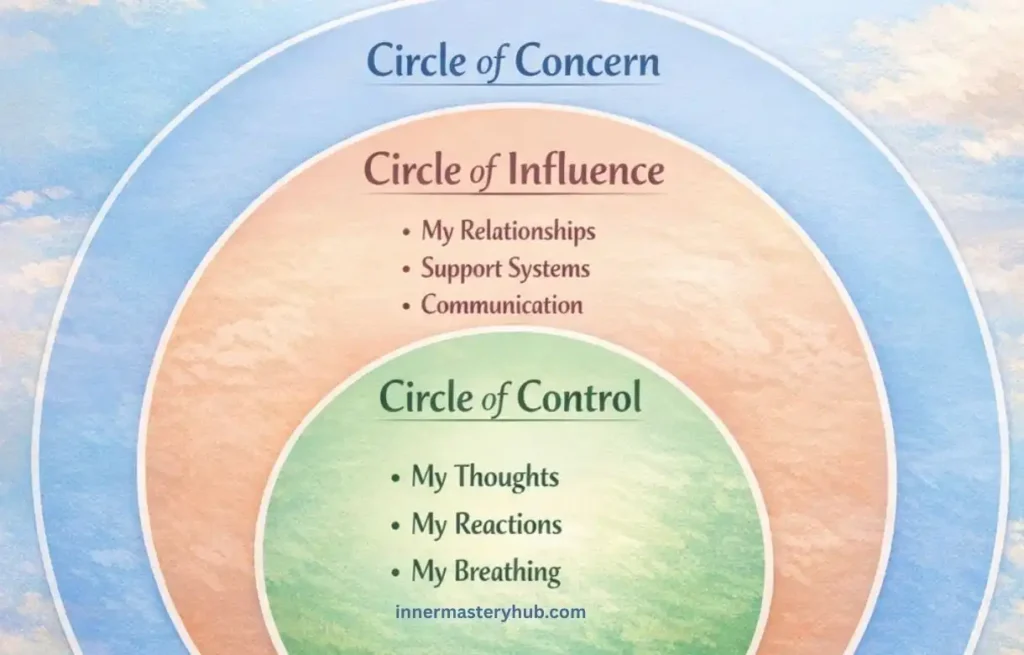
Circle of control examples for emotional regulation show that focusing on controllable responses instead of outcomes reduces anxiety, improves emotional awareness, and prevents overthinking.
Examples of the circle of control for emotional regulation show how you can reduce worry and overthinking by focusing on your own thoughts, choices, and actions rather than uncontrollable consequences. Although comprehending the Circle of Control is crucial, putting it into practice in day-to-day circumstances is what brings about long-lasting emotional transformation.
This page provides real-world examples of how the Circle of Control operates. These situations will help you focus on what you can control and let go of what you cannot, whether you’re coping with interpersonal conflict, criticism, uncertainty, or waiting for results.
If you’re new to this concept, start with our complete guide to the Circle of Control vs. Circle of Influence, which explains the psychology behind the framework and how it supports emotional regulation.
What are Circle of Control Examples for Emotional Regulation?
Circle of control examples for emotional regulation show how anxiety can be reduced by concentrating on your thoughts, behaviors, and reactions. You are in charge of your response, not the results. This reduces overthinking and develops emotional awareness.
You can better understand the causes of emotional pressure and how attention shifting redirects it by looking at the examples. If you’d like to apply this framework to your own life, try using a circle of control worksheet to organize your thoughts.
Circle of Control Examples from Daily Life
Before exploring these examples, learn the full framework in our Circle of Control vs. Circle of Influence guide.
Example 1: Someone Doesn’t Reply to Your Message
You can choose how you interpret their quietness, but you have no control over when someone responds. Anxiety is decreased, and emotional control is increased when you concentrate on your goal rather than their reaction.
Your mind starts predicting outcomes when someone doesn’t reply to your message. This is where understanding the circle of control examples can help you without getting stuck in an overthinking loop.
When your mind works fast, a lack of response seems to be a problem for it. You begin anticipating responses. However, the response falls inside your circle of influence. Your courteous and lucid communication is a part of control. Emotional strain reduces once you regain control.
Try filling out a circle of control worksheet to practice separating control, influence, and concern.
Example 2: Receiving Criticism at Work
Criticism is beyond your control, but how you respond to it is not. Emotional regulation improves, and emotional reactivity decreases when self-knowledge is strenghtened in its place over self-defense.
Interpretation begins when someone criticises you. When your mind makes judgments, it intensifies your feelings. It also attempts to manipulate your perception. However, perception is a part of your influence. That’s how Control takes over and owns your transparency and introspection.
Example 3: Relationship Conflict
You cannot control another person’s feelings, but you can control how you communicate with them. Emotional regulation improves when you start with clarity rather than trying to change the outcome.
Conflict creates a sense of urgency. You try to fix everything. But emotional outcomes depend on both people. Your tone, boundaries, and honesty remain in your control. This reduces emotional overwhelm.
Example 4: Overthinking a Past Conversation
You cannot control how someone interprets your words, but you can control your intention. Returning to intention reduces overthinking and emotional tension.
Your mind replays details. You adjust your tone mentally. You try to fix the past. But interpretation belongs to influence. You intend to control. The shift reduces rumination.
Example 5: Waiting for Results
You cannot control results, but you can control preparation and response. Emotional regulation improves when your attention shifts from outcome to effort.
Waiting creates uncertainty. Your mind predicts failure, and your emotions increase. But outcomes depend on many factors. Your effort belongs to control. This can calm your anxiety.
Example 6: Social Anxiety Situation
You cannot control others’ opinions, but you can control your presence. Focusing on authenticity improves emotional regulation.
Social settings trigger self-monitoring. When you try to control impressions, this increases anxiety. Others’ opinions can easily influence. But your authenticity belongs to control. This reduces pressure.
Example 7: Unexpected Change
Change is beyond your control, but adaptability is under your control. When your focus is on the reaction, your emotional regulation improves.
Uncertainty is a result of change. Emotion increases when your mind looks for consistency. However, change itself is a problem, and as examples show, you have power over how you respond to it. This increases emotional adaptability.
Example 8: Feeling Rejected
Acceptance is beyond your control, but how you see yourself is not. If you can separate outcomes from self-worth, it is a sign of good emotional regulation.
Interpretation into different scenarios is triggered by some fear. When you consider yourself to be a failure. However, influence is the source of acceptance. Your understanding of yourself is one of the things that you can manage. This viewpoint lessens future emotional suffering.
Example 9: Future Worry
Although you have no control over the future, you do influence the present. When focus is shifted to the present, emotional regulation improves.
Thinking about the future causes anxiety as your mind anticipates unpredictability. Future developments, though, are worrisome. However, you influence the current activity. This viewpoint calms feelings.
Common Mistakes People Make
People often:
- try to control others’ reactions
- over-explain to prevent misunderstanding
- predict outcomes
- replay conversations
- assume responsibility for emotions
These move their attention outside their control and increase emotional stress.
Conclusion
Your locus of control, or how much control you think you have over life events, affects your capacity to concentrate on what you can control. Examples of the circle of control for emotional regulation show a simple shift in mindset. Emotional overload occurs when you try to control uncertainty. In this confusion, returning to your thoughts, actions, and responses relieves emotional pressure. You start to comprehend your inner self in a better way that changes your emotional experience
Ready to understand the psychology behind this model? Read our complete guide to the Circle of Control vs. Circle of Influence.
People also ask
What are examples of the circle of control for emotional regulation?
Examples of the circle of control for emotional regulation show circumstances where worry is lessened by concentrating on your responses rather than the results. Waiting for responses, responding to criticism, and addressing conflict are a few examples. Emotional awareness improves, and overthinking is avoided when you know what you can control.
Why are examples of the circle of control important?
Circle of control examples make abstract concepts practical. They help you recognize where your attention goes and how it affects emotions. This improves emotional regulation.
Can the circle of control examples help with overthinking?
Yes, the circle of control reduces overthinking by focusing on intention instead of interpretation. This helps calm the mind.
How do I apply the Circle of Control?
“What can I control right now?” is a good place to start. Instead of worrying about results or other people’s reactions, concentrate on your ideas, deeds, and choices. This easy change lowers stress, improves emotional control, and allows you to handle difficulties more peacefully.
What are everyday Circle of Control examples?
Examples from everyday life include managing your spending rather than the economy, focusing on your effort rather than the outcome, responding politely during arguments, accepting delayed responses to communications, and preparing for a test rather than worrying about your mark.
How do I teach the Circle of Control to children?
Use commonplace scenarios, such as losing a game or having a disagreement with a friend. Assist kids in identifying what they can and cannot control, such as their choices, effort, and behaviour. From a young age, this develops emotional intelligence, resilience, and constructive problem-solving techniques.
Written By Mehwish Qurayshi
Mehwish Qurayshi is a Trauma-Informed Emotional Wellness Counsellor trained through NICABM’s Treating Trauma Master Series, which includes NBCC-approved education in Trauma Treatment and Emotional Wellness & Emotional Intelligence – Sourcecode Academia. She has over five years of experience providing emotional wellness counselling, helping individuals heal from trauma, regulate emotions, and build healthy relationships.