
10 Smart Ways of Developing Intellectual Independence in an Age of Algorithms

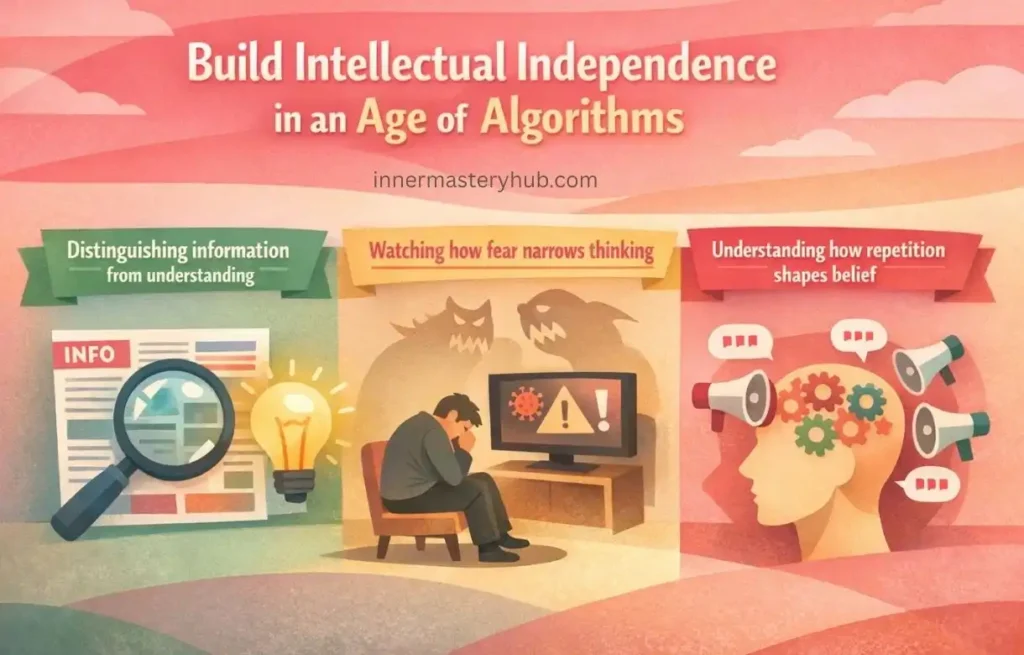
Developing intellectual independence means thinking clearly for yourself rather than relying on others’ opinions or social pressure. It involves questioning assumptions, regulating emotions, and forming judgments based on reasoning, evidence, and inner clarity rather than external validation.
You lose thirty minutes by opening your phone for a minute. Upon reading an article, you nod along but find it difficult to explain why you agree with it. Your opinions gradually become completely defined when you don’t feel really conscious, but you also don’t feel in control.
This is the issue with contemporary thought. Tools that offer freedom and choice are all around you, but they can gradually reduce the variety of ideas that can reach you. You can’t argue with algorithms because they don’t impose their beliefs on you. They figure out what keeps you interested.
It is not necessary to reject technology to develop intellectual independence in the modern world. It is about gaining control over your own thoughts and understanding how your inner world reacts to ongoing external shaping.
Many people assume intellectual independence means being “smart” or “well-informed.” But that’s the misunderstanding. The real issue is internal. It’s about how your mind reacts under pressure.
- A comment triggers doubt.
- That doubt turns into anxiety.
- Anxiety makes you seek approval.
- And slowly, your original thinking fades.
As Friedrich Nietzsche wrote,
“No price is too high to pay for the privilege of owning yourself.”
But owning your mind requires more than knowledge. It requires inner stability.
What Does It Really Mean to Develop Intellectual Independence?
To develop intellectual independence means forming your own conclusions through reasoning, self-awareness, and emotional control. It is the ability to think critically without being controlled by social influence, fear, or unconscious bias.
Intellectual independence is not rebellion. It’s clarity.
It means:
- You question ideas without fear
- You tolerate uncertainty
- You separate emotion from reasoning
- You don’t rush to agree to belong
Research from the American Psychological Association shows that cognitive autonomy is strongly linked to emotional regulation and self-efficacy1.
So the process is not just mental. It’s deeply psychological.
Why Do You Struggle to Think Independently?
You struggle because your brain prioritises emotional safety over truth. Social acceptance feels safer than uncertainty, so your mind adapts to external opinions without conscious awareness.
Here’s what actually happens internally:
- A situation challenges your belief.
- You interpret it as a threat to identity.
- That creates discomfort or anxiety.
- So you adjust your thinking to reduce that discomfort.
This is known as cognitive dissonance, studied by Leon Festinger2.
You’re not weak. Your brain is trying to protect you.
But protection becomes a limitation when it replaces truth.
What Is the Biggest Misunderstanding About Intellectual Independence?
The biggest misunderstanding is thinking it’s about rejecting others’ ideas. In reality, it’s about understanding your internal reactions before accepting or rejecting anything.
Many people try to “be independent” by opposing everything.
But that’s still reactive thinking.
True independence means:
- You pause before reacting
- You observe your thoughts
- You choose consciously
As Carl Jung emphasised, “Until you make the unconscious conscious, it will direct your life.”
So the real work is internal awareness.
How to Develop Intellectual Independence?
To develop intellectual independence, you must become aware of how your thoughts are shaped by emotions, repetition, and social influence, and begin to slow down your reactions so you can think with clarity rather than on impulse.
Developing intellectual independence is not about forcing new ideas into your mind. It is about noticing how ideas are already entering.
You don’t suddenly “start thinking independently.”
You begin by seeing what interferes with it.
A thought appears, but it is not neutral. It carries a feeling.
That feeling creates urgency or comfort.
And before you question it, it already feels true.
This is where most people lose independence.
Not because they lack intelligence, but because they don’t pause.
You start developing independence when:
- You notice emotional reactions before conclusions
- You question why something feels right, not just what feels right
- You allow uncertainty without rushing to resolve it
As your awareness deepens, thinking becomes slower, but also more precise.
And slowly, your mind shifts from reacting to choosing.
How Does Emotional Regulation Affect Independent Thinking?
Emotional regulation allows you to think clearly without being overwhelmed by fear, anxiety, or the need for validation. Without it, your thoughts become reactions instead of decisions.
When emotions rise, reasoning drops.
For example:
- Fear → You avoid challenging ideas
- Anxiety → You seek approval
- Excitement → You accept ideas too quickly
A study from Harvard University shows that emotion regulation improves decision-making and cognitive flexibility3.
So developing intellectual independence is also emotional work.
Why Intellectual Independence Matters?
Intellectual independence matters because it allows you to make decisions based on clarity rather than pressure, reducing confusion, emotional reactivity, and dependence on external validation.
Without intellectual independence, your thinking becomes situational.
You think differently depending on:
- Who are you around
- What content do you consume
- What feels emotionally safe
So your beliefs are not stable. They shift.
This creates an internal conflict you may not notice immediately.
You feel informed, but uncertain.
You feel confident, but only temporarily.
Because your thinking is not grounded.
When intellectual independence develops:
- Your decisions feel internally consistent
- You don’t need constant reassurance
- You tolerate disagreement without losing clarity
As Ralph Waldo Emerson suggested, self-trust is not loud; it is steady.
And that steadiness becomes the foundation of clear thinking.
What Are the Signs of Intellectual Independence?
Signs of intellectual independence include the ability to question your own beliefs, remain calm in the face of disagreement, tolerate uncertainty, and form opinions without relying on external validation.
Intellectual independence does not look dramatic.
It feels quiet and stable.
You begin to notice subtle changes:
- You no longer rush to agree or disagree
- You feel comfortable saying, “I need more time to think.”
- You question ideas even if they align with your beliefs
- You don’t feel threatened by opposing views
The most important sign is internal:
Your thoughts feel less reactive.
Earlier, disagreement triggered defensiveness.
Now, it creates curiosity.
This shift shows that your thinking is no longer controlled by emotion alone.
It is supported by awareness.
And that awareness creates space between stimulus and response.
How to develop intellectual independence in a distracted world?
1. Noticing emotional spikes before ideas settle
It begins with a trigger, as a headline appears in front of you that confirms something you already suspect. Your mind interprets this as confirmation. You feel a quick rush of satisfaction, and that emotion pushes the idea deeper in your memory. The consequence is that emotion-initiated has replaced evaluation. Over time, repeated emotional spikes train you to accept ideas based on how they feel rather than how true they are.
In real life, this shows up when you feel instantly sure about complex issues after reading just one post.
Emotion is not the enemy, but when it leads thought instead of following it, it is the real issue, when your self-autonomy quietly slips away.
Common advice is to “trust your gut,” but your gut can be easily trained through repetition.
Once you see this, you realise independence starts with slowing emotional reactions rather than suppressing them.
2. Recognising comfort as a signal, not a reward
The trigger is familiarity. You see the same viewpoints repeated in different forms. Your mind perceives repetition as consistency. You feel emotionally secure and validated, but as a result, odd ideas begin to feel wrong even before you investigate them.
This appears when opposing views feel annoying, and comfort feels like certainty, but it signals intellectual stagnation. To “follow what resonates,” but resonance is engineered nowadays. Understanding this shifts comfort from a goal into a warning sign.
3. Separating popularity from truth
When you come across an idea that has received thousands of likes and shares, your mind interprets numbers as proof. You feel emotionally connected to something greater. As a result, rationality is replaced by social proof.
This is evident when you are reluctant to challenge concepts that appear to be broadly accepted on the internet.
In reality, Engagement does not scale with truth. Reach is not accuracy, which is reflected in popularity.
To “see what others think” is unhelpful because it confuses conformity with accuracy.
When you wait to borrow certainty from the herd, you become more independent.
4. Seeing personalisation as a constraint
Customised content serves as the trigger for your feed to look accurate and relevant. You feel seen on an emotional level. A smaller mental landscape results.
This manifests when you lose sight of the fact that there are other realities beyond your feed.
When you curate your feed, it only reinforces this pattern.
Better filters are not the requirement for developing intellectual independence; deliberate friction is.
5. Understanding speed as a cognitive cost
When information comes in quickly, and your mind perceives speed as efficiency, you feel productive on an emotional level, but the result is Shallow processing. This is evident when you have a lot of information yet find it difficult to make connections.
It takes time to think. Volume is traded off against depth for speed. This internal trade-off is overlooked by advice that encourages continuous consumption. Clarity begins to return after you slow down your input.
6. Questioning the certainty that arrives too easily
The trigger is a confident, unambiguous explanation. Clarity is taken in as truth by your mind. You feel relieved on an emotional level. Intellectual closure is the result.
This explains what happens when you give up after discovering a satisfactory solution. Premature certainty ends inquiry, but confidence feels comforting. Popular wisdom praises confidence, but it is weak without investigation.

7. Distinguishing information from understanding
You’ve read a lot. Your mind interprets accumulation as mastery. You feel informed emotionally. The result is the appearance of depth. This happens when you can recall concepts but are unable to explain them clearly.
Integration is necessary for understanding that merely staying informed overlooks the importance of digestion.
Your independence grows as you concentrate more intently on fewer concepts.
8. Watching how fear narrows thinking
The news focuses on a crisis. Your mind sees urgency as significance. When you feel nervous. Reactive thinking results from this.
This is evident when stories based on fear take precedence over nuance. Fear reduces reality to binary thinking.
When you are told to “stay alert,” you tend to become tense.
Your ability to think rationally is restored when you acknowledge fear.
9. Noticing identity attachment to beliefs
An idea becomes part of who you are. Your mind interprets challenge as a threat. Emotionally, you feel defensive. The consequence is rigidity. This shows when disagreement feels personal.
Beliefs should serve understanding, not identity. Advice to “stand your ground” locks growth in, while letting go of identity-based beliefs creates freedom.
10. Understanding mental outsourcing
You rely on rankings, suggestions, and summaries. Your mind perceives delegation as efficiency. You feel relieved on an emotional level. Weakened judgment is the result.
This happens when you find it difficult to form your own opinions. Tools should support thought, not take its place. The recommendation to “use smarter tools” ignores the cost of dependency.
What Are Independent Thinking Skills?
Independent thinking skills are the mental abilities that help you analyse, question, and interpret information without relying on external opinions, including critical thinking, self-awareness, emotional regulation, and cognitive flexibility.
These skills are not separate.
They work together as a system.
Independent thinking begins when:
- Critical thinking helps you question assumptions
- Self-awareness shows you how your thoughts are formed
- Emotional regulation prevents reactive decisions
- Cognitive flexibility allows you to adapt without losing clarity
Without emotional regulation, critical thinking becomes biased. Without awareness, reasoning becomes unconscious.
So, independent thinking is not just logical.
It is psychological.
As research from the American Psychological Association suggests, autonomy in thinking is closely tied to emotional control and self-efficacy4.
Which means:
You don’t think independently just because you know more.
You think independently when you are less controlled by what you feel in the moment.
Implications
You feel informed after reading the same breaking news from five different sources, but weeks later, your opinion, which you never intentionally chose, nearly exactly matches the dominant narrative. As a result, you stop looking for the perfect sources once this is obvious.
Start observing your own thoughts and how concepts come to you, how they feel, and how they settle in your mind unwillingly. Long before you make conscious decisions, you will witness how these factors affect your choices when Intellectual independence becomes a daily practice of awareness.
What Are the Common Mistakes People Make?
People mistake information consumption for independent thinking. They also rely too much on authority, avoid discomfort, and confuse confidence with clarity.
Common mistakes include:
- Consuming content without questioning
- Following experts unthinkingly
- Avoiding conflicting ideas
- Seeking validation before forming opinions
You may feel informed, but internally, your thinking is borrowed.
As Bertrand Russell noted, “Most people would rather die than think.”
Not because thinking is hard, but because it feels uncomfortable.
How Does Social Influence Shape Your Thinking Without You Noticing?
Social influence shapes your thinking through subtle psychological pressures, such as the need to belong, the fear of rejection, and repeated exposure to ideas.
The process looks like this:
You hear an opinion repeatedly.
You assume it’s widely accepted.
You internalise it without questioning.
It becomes “your” belief.
This is called the illusory truth effect, supported by research from Stanford University5.
So your thoughts are not as original as they feel.
When Someone Finally Thinks for Themselves
A real shift happens when a person recognises that their thoughts are influenced by fear rather than by truth, and they begin to observe rather than react.
Consider a young professional who always agrees with colleagues.
Trigger: A meeting where their idea is dismissed
Interpretation: “Maybe I’m not capable.”
Emotion: Self-doubt
Consequence: Silence in future discussions
But one moment changes everything.
They pause and ask, “Is this belief true, or just emotional?“
That question creates space.
That space creates independence.
How Can You Tell If You’re Thinking Independently?
You are thinking independently when your opinions feel calm, grounded, and internally consistent, even when others disagree.
Signs include:
- You’re comfortable saying “I don’t know.”
- You don’t rush to conclusions.
- You question your own beliefs.
- You tolerate disagreement without anxiety.
Independence feels stable, not loud.
What Role Does Awareness Play in Intellectual Independence?
Awareness allows you to observe your thoughts rather than identify with them, creating space for intentional thinking.
Without awareness:
- Thoughts feel automatic
- Emotions drive decisions
- Beliefs go unquestioned
With awareness:
- You notice patterns
- You slow down reactions
- You choose your thinking
This aligns with mindfulness research from the National Institutes of Health, which shows improved cognitive control6.
Why Does Independent Thinking Feel Uncomfortable at First?
Independent thinking feels uncomfortable because it removes the safety of certainty and social approval, forcing you to confront ambiguity and personal responsibility.
You may feel:
- Doubt
- Isolation
- Uncertainty
But that discomfort is not a sign of failure.
It’s a sign of growth.
As Ralph Waldo Emerson said,
“To be yourself in a world that is constantly trying to make you something else is the greatest accomplishment.”
Conclusion
To develop intellectual independence, you don’t need more information. You need a deeper awareness of how your mind works.
Your thoughts are not just logical. They are emotional, reactive, and shaped by hidden patterns.
When you see that clearly, something shifts.
You stop chasing the “right” answer.
You start understanding your own thinking.
And in that understanding, independence quietly begins.
People Also Ask
What does it mean to develop intellectual independence?
Developing intellectual independence means developing the ability to think for yourself. It involves questioning ideas, evaluating evidence, and understanding how information influences your choices, rather than accepting opinions based on popularity, emotion, or repetition.
Why is developing intellectual independence important today?
Developing intellectual independence is important because algorithms and media shape what people see and believe. Without independent thinking, opinions are often formed by exposure and emotion rather than by understanding, thereby reducing personal agency and clarity.
How do algorithms affect intellectual independence?
Algorithms affect intellectual independence by filtering information based on past behaviour. This limits exposure to diverse ideas and reinforces familiar beliefs, quietly Influencing Your Choices without conscious awareness.
Can anyone learn to develop intellectual independence?
Yes, anyone can learn to build intellectual independence. It does not require high intelligence or formal education. It develops through awareness, reflection, and learning to slow down emotional reactions to information.
How does social media influence independent thinking?
Social media influences independent thinking by rewarding emotional and extreme content. This shapes beliefs through repetition and Engagement, subtly influencing choices and reducing thoughtful evaluation.
What are the signs of a lack of intellectual independence?
Signs of a lack of intellectual independence include repeating opinions without understanding them, feeling defensive when challenged, and avoiding unfamiliar ideas. These behaviours suggest beliefs are adopted rather than examined.
How long does it take to develop intellectual independence?
There is no fixed timeline to develop intellectual independence. It develops gradually through daily awareness, reflection, and intentional thinking habits.
What blocks independent thinking?
Fear of judgment, emotional discomfort, and social pressure are the main barriers. These factors lead you to rely on others’ opinions rather than trust your own reasoning.
How does emotional intelligence relate to independent thinking?
Emotional intelligence helps you manage reactions, making it easier to think clearly. Without it, emotions override logic, reducing your ability to think independently.
How do you know if your thoughts are influenced?
If your opinions change quickly in response to others’ input, or if you feel uncertain without validation, they may not be fully independent.
What is the first sign of intellectual independence?
The first sign is questioning your own thoughts without fear. This creates awareness, which is the foundation of independent thinking.
- Ryan, R. M., & Deci, E. L. (2000). Self-Determination Theory and the Facilitation of Intrinsic Motivation, Social Development, and Well-Being. American Psychologist. https://doi.org/10.1037/0003-066X.55.1.68 ↩︎
- Festinger, L. (1957). A Theory of Cognitive Dissonance. Stanford University Press.
Additional explanation: https://www.simplypsychology.org/cognitive-dissonance.html ↩︎ - Harvard Health Publishing. (2019). The Importance of Emotional Intelligence.
https://www.health.harvard.edu/mind-and-mood/the-importance-of-emotional-intelligence ↩︎ - American Psychological Association. (2023). Self-efficacy. https://www.apa.org/pi/aids/resources/education/self-efficacy ↩︎
- Fazio, L. K., Brashier, N. M., Payne, B. K., & Marsh, E. J. (2015). Knowledge does not protect against illusory truth. Journal of Experimental Psychology: General. https://doi.org/10.1037/xge0000098 ↩︎
- Tang, Y.-Y., Hölzel, B. K., & Posner, M. I. (2015). The neuroscience of mindfulness meditation. Nature Reviews Neuroscience. https://doi.org/10.1038/nrn3916
Additional reference: NIH. (2020). Mind-Body Approaches for Stress and Anxiety. ↩︎
Written By Mehwish Qurayshi
Mehwish Qurayshi is a Trauma-Informed Emotional Wellness Counsellor trained through NICABM’s Treating Trauma Master Series, which includes NBCC-approved education in Trauma Treatment and Emotional Wellness & Emotional Intelligence – Sourcecode Academia. She has over five years of experience providing emotional wellness counselling, helping individuals heal from trauma, regulate emotions, and build healthy relationships.