
People Who Grew Up Feeling Unseen Display 13 Behaviors as Adults

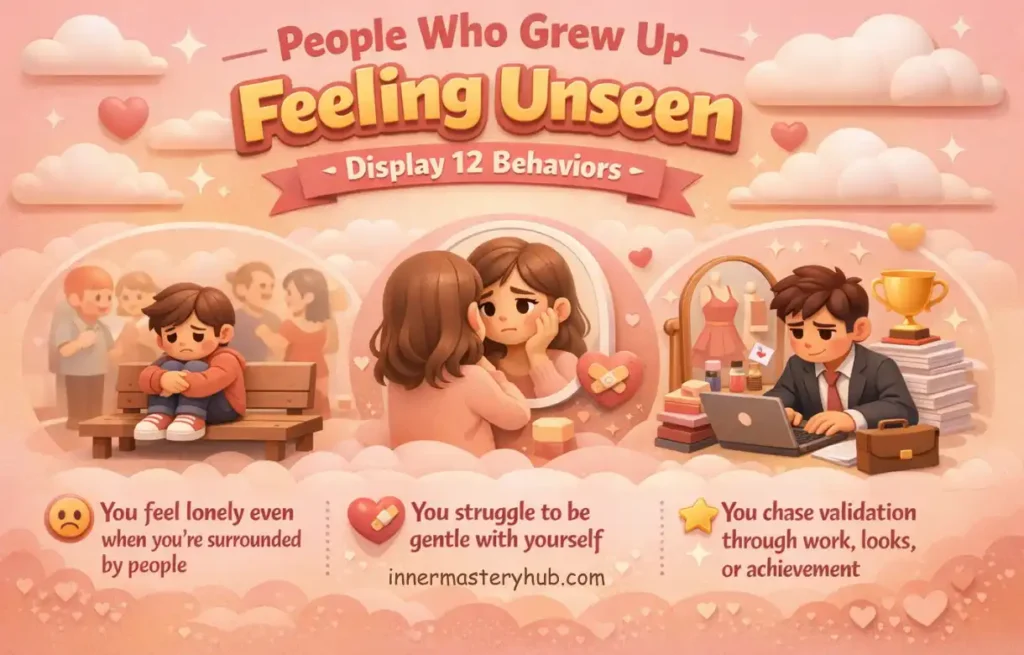
People Who Grew Up Feeling Unseen are those whose emotions, needs, or achievements were ignored during childhood. As adults, they struggle with self-worth, emotional expression, boundaries, and validation, feeling invisible in relationships while quietly craving acknowledgement, safety, and genuine connection.
If you’re one of the people who grew up feeling unseen, you may look “fine” on the outside while carrying a quiet ache on the inside. You learnt to read the room and make other people’s lives better when you were younger. It’s possible that your emotions were disregarded and viewed as a problem. It’s also likely that you were complimented on your “maturity” when, in reality, you were merely learning to conform.
When this occurs repeatedly, you begin to define your identity around being invisible rather than just feeling depressed at the time. This isn’t about perpetually reliving the past and blaming your parents. It’s about eventually understanding patterns that are currently confusing. Neglect, emotional invalidation, and long-term stress during infancy can influence relationships, emotional well-being, and even how your body reacts to stress in later life, according to research.
Childhood emotional neglect is also not rare; meta-analytic work has estimated emotional neglect prevalence around 184 per 1,000 people in the samples reviewed, which shows how many adults may be carrying similar stories.
What Does It Mean to Grow Up Feeling Unseen?
Growing up
When caregivers miss or dismiss your feelings, your brain adapts. You stop expressing. You start scanning for approval. You learn that being yourself doesn’t get a connection.
Emotional invisibility is a psychological state where an individual feels their inner experiences are unrecognised or invalidated by others, especially during formative years.
Research shows that emotional neglect, not abuse, is the most overlooked developmental trauma.
A study by Shipman et al. (2007) found that children lacking emotional validation struggle with emotional awareness and regulation later in life1.
Why Do People Who Grew Up Feeling Unseen Struggle With Emotional Regulation?
Because emotional regulation is learned through co-regulation, and without caregivers reflecting emotions, children fail to develop healthy ways to process feelings.
You were not born unable to regulate emotions. You were not taught.
When you felt sadness, no one named it.
When you felt fear, no one soothed it.
When you felt joy, no one amplified it.
So your brain had to improvise.
Psychological Flow
- A situation triggers emotion
- You don’t fully recognise it
- It feels overwhelming or confusing
- You suppress, avoid, or react strongly
This creates patterns like:
- Emotional numbness
- Overthinking
- Sudden emotional bursts
According to Gross (1998), emotional regulation depends heavily on early relational experiences, especially caregiver responsiveness2.
Why do people who grew up feeling unseen in their childhood still feel it years later?
Your nervous system and brain are still wiring themselves around what seems safe while you’re young. When you experience silence, criticism, or discomfort in your emotional world, you adjust as best you can by tuning in to behaviours that keep you connected and shutting down needs that aren’t met. That is not a flaw. It’s Survival.
The issue is that, even if you no longer want them, your childhood Survival techniques may end up shaping your adult personality. Long-term childhood stress can modify how you respond to conflict, intimacy, and uncertainty by keeping the stress-response system active.
Broader public health organisations also point out that maltreatment (including neglect) can have long-term mental and physical health effects, not because you’re “broken,” but because your system learned to function under threat or emotional deprivation.
Is Feeling Unseen the Same as Being Ignored?
No. Being unseen is deeper than being ignored; it means your internal experience wasn’t understood, even if your physical needs were met.
You may have had food, school, and structure. But inside, something was missing.
This is why many people say:
“I had a normal childhood… so why do I feel this way?”
Common Misunderstanding
People assume trauma must be dramatic.
But emotional neglect is quiet. It leaves no visible scars.
Psychologist Jonice Webb describes this as “the absence of something vital,” rather than the presence of harm.
How Does This Shape Your Adult Identity?
It leads to identity confusion, people-pleasing, and difficulty trusting your own emotions or needs.
If no one reflected who you were, how could you learn who you are?
Internal Pattern
- You look outward for validation
- You adapt to others constantly
- You feel disconnected from yourself
This often shows up as:
- Saying yes when you mean no
- Feeling guilty for having needs
- Struggling to make decisions
According to Erik Erikson’s developmental theory, identity formation depends on consistent recognition during early stages.
13 behaviours adults show when they’re among people who grew up feeling unseen
You downplay your needs even when they’re real.
You may convince yourself that you don’t need much, but when no one helps you, you get bitter. Because it feels awkward to ask, you can say “I’m okay” when you’re not. Sometimes your needs go unnoticed until they become fatigued. This may result from discovering that there wasn’t enough attention or that your desires created conflict. When you picture yourself asking for help, what fear comes to mind first: being rejected, burdened, or neglected once more?
You overthink whether your feelings are “valid.”
You search for evidence rather than just relying on your personal experience. You could practise your narrative a lot, or ask pals if you’re “overreacting,” in hopes that someone will reassure you that it’s okay to feel the way you do. Emotional inhibition, or suppressing emotions, has been connected to childhood invalidation and has been linked to adult suffering, including depression and anxiety. Do you view your emotions as proof in court rather than as a bodily signal?
You explain too much because you expect to be misunderstood.
To ensure no one misinterprets your message, you can soften your tone, add more details, and make it “perfect.” Long texts, meticulous language, and the belief that a single incorrect sentence can negate your message are some examples of this, when you grew up feeling unheard or unseen. Beneath it is frequently a straightforward belief: “I won’t be heard if I don’t defend myself well.” Ask yourself, who taught you that your initial “no” or “I feel” would not be sufficient?
You become “hyper-independent” and hate relying on anyone.ne
You might have decided to “do everything myself” if no one regularly supported you when you were younger, or if you grew up feeling unseen. You may be admirable, capable, and competent, and exhausted. While independence can be beneficial, hyper-independence conceals a fear of being let down. If someone came to you when you needed them, what would that imply about you?
You feel like a burden even when you’re not.
You may apologise for seeking comfort, taking up too much room, or chatting too much. You can be constantly conscious of “how much” time, attention, money, and patience you’re expending. Because intimacy requires the presence of wants, it can make closeness feel hazardous. What did it cost you to defend the comfort of others when you were a kid?
You avoid conflict, then feel invisible again.
To keep things going smoothly, you keep quiet, but later on, you feel invisible since you were false. Alternatively, you let things escalate until you shut them down. Avoidance becomes your primary strategy if you were raised in a household where emotions weren’t managed effectively. Are you afraid of confrontation per se, or are you fearful of what conflict might show, that your demands are essential?
You’re harsh with yourself and call it “being realistic.”
You may have a fierce inner critic that constantly pushes you to improve and never lets you relax. This criticism occasionally developed as a means of gaining attention or avoiding criticism from others. Numerous studies have linked emotional deprivation in childhood to behaviours like self-criticism in adulthood, who grew up feeling unheard and unseen, demonstrating how early emotional gaps can become internalised.
Perfectionism becomes your way of trying to be noticed.
You may think that to be loved, you must be exceptional. You might still pursue that emotion if you were only recognised for applauding your accomplishments. The sad thing is that perfectionism prevents you from achieving your goals of ease, connection, and being liked for who you are rather than for what you do, because of a past pattern of growing up feeling unheard.

You struggle to name what you feel.
Sometimes you know something is “off,” but you’re unable to identify it. Particularly during emotionally charged times, you feel numb and blank. Childhood maltreatment and adult alexithymia, difficulty recognising and characterising emotions, have been linked, according to research. When you were young, did anyone help you put words to feelings, or did you have to figure it out alone?
You’re highly sensitive to rejection, even minor signs.
Your body responds quickly to a brief message, a delayed response, or a shift in tone. Before you even realise why, you could experience feelings of shame, fear, rage, or the desire to retreat. This is the result of your nervous system learning that attention can quickly stop because of growing up feeling unheard. When this happens, ask yourself: Do you think the rejection reflects your value before exploring alternative possibilities?
You don’t trust praise, and you suspect people are being polite.
It can be unsettling to receive compliments because you feel vulnerable and brush them off. You could secretly think, “If they truly knew me, they wouldn’t say that.” Growing up without consistent emotional mirroring, someone who sees you warmly and clearly, is often the cause of this. The solution to this is to check the pattern after your response. Do you allow someone’s admiration to last for even ten seconds?
You chase validation through work, looks, or achievement.
You can be highly motivated to “prove” yourself. Grades, a career, money, fitness, or being the “helpful one” are all possible goals, but the underlying desire remains the same: “See me.” Select me. Do not overlook me.
Early hardship can be linked to later mental health issues, according to a public health study on adverse childhood experiences, and many people respond by over-functioning rather than slowing down to feel. What would happen if you just became yourself instead of trying to prove things?
You struggle to be gentle with yourself, even when you’re hurting
You might punish yourself when you fail. You might call yourself lazy when you’re exhausted. You might suppress your sadness. You may eventually grow up to be contemptuous of your inner world, much like the surroundings in which you were raised. What tone would you want to use going forward if you were your inner child’s parent?
Why Do You Overthink Everything Now?
Overthinking develops as a coping mechanism to compensate for the lack of emotional clarity in childhood.
When emotions weren’t explained, your brain turned to analysis.
Instead of feeling, you learned to think your way through everything.
Example
You send a message → no reply →
Instead of simply feeling disappointment, you think:
“Did I say something wrong?”
“Do they not like me?”
“I should have said it differently.”
This loop is your brain trying to regain control.
What Mistakes Do People Who Grew Up Feeling Unseen Commonly Make?
They suppress emotions, seek validation externally, and avoid vulnerability, believing their needs are unimportant.
Common Patterns
- Minimising your feelings (“It’s not a big deal”)
- Over-adapting to others
- Avoiding emotional conversations
- Chasing approval instead of connection
But these aren’t flaws. They are adaptations.
As Carl Rogers emphasised, humans need unconditional positive regard to develop a healthy self. Without it, the self becomes distorted.
How do you start healing when you’re one of the people who grew up feeling unseen?
Rewriting history is not necessary for healing. It involves changing your current relationship with yourself. Furthermore, there isn’t a single “breakthrough.” Your nervous system learns a new lesson through repeated, small decisions: “I am safe to exist, to feel, and to take up space.”
Try saying “I’m overwhelmed,” “I’m disappointed,” or “I’m lonely” in place of “I’m fine.” When early emotional support is lacking, many adults struggle to name emotions; therefore, it can seem complicated. Use simple tools, such as an emotion wheel: choose one emotion, then one requirement (rest, assurance, clarity, support).
Next, create “proof” by making tiny requests. Avoid starting with your greatest weakness. “Can you call me later?” is a safe place to start. “Can you assist me in selecting between these options?” “You have five minutes to listen?” Every time you ask and accept the response, whether it’s yes or no, you let go of the old notion that needing is harmful.
Then, set limits as a sign of kindness rather than punishment. “I can’t do that today” is a brief, composed barrier. “I’m not available for this discussion at this time.” “I need time to reflect.” Initially, your guilt will probably increase. The boundary is not incorrect because of this. It frequently indicates a new boundary.
You also need one place where you are consistently met. That might be therapy or a trusted friend. Finally, add honest self-reflection. Try prompts like: What did I need back then that I still avoid needing now? When do I disappear in relationships? What am I afraid will happen if I take up space? What would “being heard” look like in one small moment this week? Write your answers as if you’re talking to someone you care about, because that someone is you.
Suppose you’re among the people who grew up feeling unseen. Your mature behaviours are learnt responses rather than random faults. You developed the ability to handle emotionally challenging situations, which helped you get through the tough time. However, you don’t have to continue living as though you’re still waiting to be seen in that old room.
You may teach yourself a new normal with consistent practice, such as acknowledging your feelings, asking for small support, setting boundaries without apologising, and choosing connections where you are met. Let this serve as a reminder that you are now free to speak, to matter, and to be seen entirely if you identify with those who were raised feeling ignored.
Can You Be Successful and Still Feel Unseen?
Yes. External success does not resolve internal emotional invisibility.
You can achieve, perform, and be admired…
But still feel empty inside.
Because success gives recognition, not understanding.
This is why many high achievers secretly struggle with:
- Imposter syndrome
- Emotional numbness
- Chronic dissatisfaction
Case Study: A Quiet Pattern
A client once shared:
“I was always the ‘easy child.’ I never caused trouble. Everyone loved that about me.”
But underneath:
- She never expressed anger
- She avoided conflict
- She felt invisible in relationships
Her “strength” was actually adaptation.
This is common among people who grew up feeling unseen.
The Shift That Changes Everything
The truth is, you were not “too sensitive.”
You were not “overthinking.”
You were responding to something that was missing.
When you understand that your patterns came from not being seen, not from being broken, something changes.
You stop blaming yourself.
You start noticing your inner world differently.
And that shift matters more than any quick solution.
FAQs
What does it mean if you’re one of the people who grew up feeling unseen?
It indicates that your needs, feelings, and opinions weren’t acknowledged or addressed frequently enough. Even when you receive practical assistance, you can still feel emotionally isolated. You eventually learnt to be silent, helpful, or “easy” to avoid being disregarded once more.
Is growing up feeling unseen the same as childhood emotional neglect?
They often overlap. A standard definition of childhood emotional neglect is when a carer consistently fails to recognise, acknowledge, or address a child’s emotions. In hectic or stressful environments where emotions aren’t discussed, people can feel invisible. You can have this wound while yet loving your family.
What are the most significant adult signs of people who grew up feeling unseen?
People-pleasing, difficulty asking for help, fear of being a burden, excessive explanations, perfectionism, and loneliness, even in social situations, are common symptoms. Even though you appear strong and competent, you feel insignificant on the inside. Rather than personality “flaws,” these patterns are typically learnt defences.
Why do you people-please if you grew up feeling unseen?
Because you used to feel safe and connected by appeasing others, you learnt to gain intimacy by controlling other people’s emotions if attention only came when you behaved, performed, or kept silent. As an adult, you can reflexively answer “yes,” only to later feel exhausted, bitter, or invisible once more.
Why do you struggle to name what you feel when you grew up feeling unheard?
As a child, you might have learnt to distance yourself from emotions if no one taught you to identify them. According to some studies, alexithymia, the inability to recognise and articulate emotions, is linked to mistreatment during childhood. You’re frequently overwhelmed or unsure of what’s going on inside; you’re not “cold.”
Can growing up feeling unheard affect your relationships?
Because it feels familiar, you may shy away from conflict, fear intimacy, or accept less than you deserve. Early emotional neglect can mould attachment styles, which affect intimacy, comfort, communication, and trust. When someone gets too near or demands more from you, you may withdraw despite your desire for closeness.
How do you start healing when you’re one of the people who grew up feeling unheard?
Start small: practise one boundary without going into too much detail, name one emotion every day, and seek one tiny bit of help. Pick at least one person with whom you can be honest. Supportive relationships can mitigate stress impacts. Recurring evidence that your needs may be met securely is what healing is all about.
Do you need therapy for feeling unseen, and what kind helps?
If these behaviours negatively impact your relationships, sense of self-worth, or everyday tranquillity, therapy may be helpful. Seek therapy that is attachment-focused, emotion-focused, or trauma-informed. A skilled therapist assists you in recognising emotions, lowering shame, and establishing more positive limits. A great label is not necessary; all you need are reliable assistance and valuable instruments.
How do you set boundaries without guilt after growing up feeling unheard or unseen?
At first, feel guilty; this is a sign that your barrier is new, not incorrect. Use succinct phrases, such as “I need time,” “I can’t today,” or “That doesn’t work for me.” Don’t try to force your boundaries. Then, until your body learns that saying no does not mean losing love, endure the suffering.
How do you support someone who grew up feeling unseen?
At first, feel guilty; this is a sign that your barrier is new, not incorrect. Use succinct phrases, such as “I need time,” “I can’t today,” or “That doesn’t work for me.” Don’t try to force your boundaries. Then, until your body learns that saying no does not mean losing love, endure the suffering to drop off the patterns of growing up feeling unheard.
- Shipman, K. L., Edwards, A., Brown, A., Swisher, L., & Jennings, E. (2007). Managing emotion in a maltreating context. Child Abuse & Neglect, 31(3), 261–276. ↩︎
- Gross, J. J. (1998). The emerging field of emotion regulation: An integrative review. Review of General Psychology, 2(3), 271–299. https://doi.org/10.1037/1089-2680.2.3.271 ↩︎
Written By Mehwish Qurayshi
Mehwish Qurayshi is a Trauma-Informed Emotional Wellness Counsellor trained through NICABM’s Treating Trauma Master Series, which includes NBCC-approved education in Trauma Treatment and Emotional Wellness & Emotional Intelligence – Sourcecode Academia. She has over five years of experience providing emotional wellness counselling, helping individuals heal from trauma, regulate emotions, and build healthy relationships.