12 Phrases To Defend Yourself Without Sounding Defensive
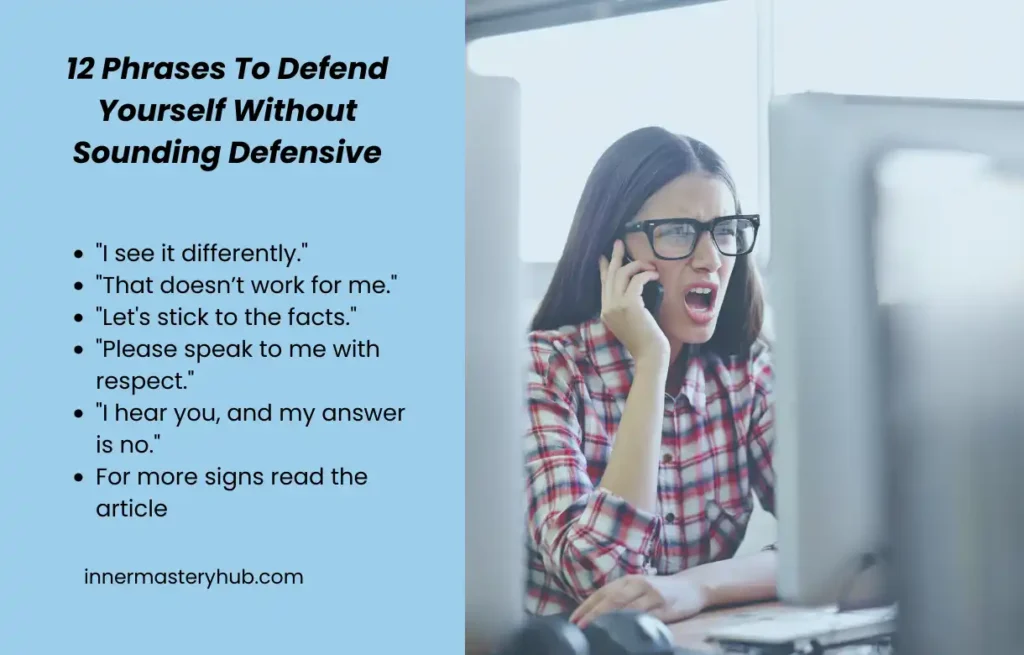
Phrases to defend yourself without sounding defensive are calm, respectful statements that protect your boundaries while keeping the conversation open. They reduce conflict, prevent escalation, and show emotional control. The key is acknowledging the other person’s view while clearly expressing your perspective without blame.
When a conversation takes an unexpected turn, most people either freeze or overreact. The voice tightens, the heart races, and the following sentence either escalates the argument or transfers authority to the other person. Search engines are brimming with advice, but you still need simple, real-world sentences to defend yourself that work under pressure.
Silence allows unfair claims to persist; counterattacks harm trust and reputation. Mistakes can even heighten the risk in heated public encounters. According to research, tailored assertiveness training reduces anxiety while improving communication and mental health, suggesting that effective phrasing enables you to think and act more effectively in a given situation1.
Randomised and systematic research has found that assertiveness and de-escalation skills can help you reduce stress, strengthen boundaries, and achieve safer outcomes in challenging interactions.
You can protect yourself with a modest set of statements that emphasise assertiveness, setting limits, and de-escalation. To maintain a calm and uncomplicated structure, each sentence begins with a subject (“I,” “we,” or “this”).
Phrases to defend yourself, listed below, have the context in which they should be used, their explanation, and a brief illustration. The strategy employs evidence-based principles, including assertive communication, de-escalation strategies, and message framing, to reduce defensiveness.
What Are Phrases to Defend Yourself?
Phrases to defend yourself are emotionally regulated responses that protect your boundaries while maintaining clarity and respect.
These phrases help to defend yourself and are calm, assertive statements used to protect your boundaries, express your truth, and stop disrespect without aggression. They help you respond clearly rather than react emotionally.
These phrases work because they shift you from reaction to intention.
Instead of attacking or withdrawing, you stay centered.
According to communication research from the American Psychological Association, assertive communication reduces stress and improves relationships by balancing self-respect with respect for others2.
Why Do You Struggle to Defend Yourself in the Moment?
You struggle because your brain prioritizes emotional safety over logical response. When triggered, your mind interprets the situation as a threat, leading to freezing, silence, or a delayed reaction.
Here’s what really happens inside you:
- Someone says something hurtful
- Your brain interprets it as rejection or attack
- Your body reacts with stress (fight, flight, freeze)
- Your thoughts slow down
- You stay silent or say something you regret
But here’s the misunderstanding:
You think you’re weak.
You’re not.
You’re overwhelmed.
Carl Rogers, a pioneer in humanistic psychology, believed that people struggle to express themselves not because they lack ability but because they fear judgment and rejection3.
Why do these phrases work to defend yourself?
Across a range of populations, including students and medical professionals, assertiveness training has been shown to improve assertive conduct and reduce anxiety and associated symptoms. In high-risk situations, de-escalation methods help workers manage aggression and reduce the need for forceful control tactics. Although effects can vary by situation, language that emphasizes I-language typically reduces defensiveness. Therefore, wording should link feeling declarations with standard criteria and a future step.
What Happens Inside You When You Don’t Speak Up?
When you don’t defend yourself, your mind stores the experience as unresolved. This leads to overthinking, self-doubt, and emotional tension because your internal truth was not expressed.
This creates a pattern:
- You stay silent to avoid conflict
- But your mind keeps replaying the situation
- You feel frustration and regret
- Your confidence slowly decreases
Over time, this affects how you see yourself.
You start believing:
“I can’t speak up.”
But the truth is:
You haven’t learned how to respond while emotional.
What Are the Most Effective Phrases to Defend Yourself?
The most effective phrases to defend yourself are simple, direct, and calm. They don’t attack the other person, but clearly protect their boundary.
Core Assertive Phrases
- “I’m not okay with that.”
- “Please don’t speak to me like that.”
- “Let’s keep this respectful.”
- “I see it differently.”
- “That doesn’t work for me.”
- “I need a moment to think about this.”
- “I won’t engage in this conversation if it continues this way.”
These phrases work because they:
- Focus on your boundary
- Avoid blame
- Stay emotionally neutral
The Calm Boundary Formula
You can structure your response like this:
Awareness → Boundary → Tone
Example:
“I understand your point, but I’m not comfortable with that tone.”
Why Do These Phrases Work So Well?
These phrases work because they regulate your emotional response and shift the conversation from conflict to clarity. They reduce escalation while maintaining authority.
They interrupt emotional chaos.
Instead of reacting, you respond.
According to research published in the Journal of Social and Personal Relationships, assertive communication increases perceived confidence and reduces interpersonal conflict.
(Source: https://journals.sagepub.com)
But more importantly, they change how you feel.
You move from:
- Powerless → grounded
- Reactive → intentional
- Silent → expressed
12 Phrases To Defend Yourself
12 Phrases to defend yourself are listed below:
- “No.”
Use this when a request, invitation, or demand does not fit within your time, energy, or priorities. A direct no works because it is straightforward and does not invite negotiation; over-explaining often allows people to push back. Maintain a calm, neutral tone. “Can you cover my shift tonight?” — “No.”
2. “I’m not comfortable with that.”
Say this when someone crosses a personal boundary—physical touch, private queries, edgy jokes, or duties that feel odd. Framing it around your comfort makes it more difficult to argue and sets a strong boundary without insulting the other person. This is an illustration: “Tell us what your manager said word-for-word.” – “I’m not comfortable with that.”
3. “That doesn’t work for me.“
Use this to decline without explaining the reason for schedules, jobs, or favours that don’t require a big narrative. The neutral phrase reduces defensiveness and helps you break out of repeated negotiation cycles. For example: “Let’s move the deadline to tomorrow morning.” – “That doesn’t work for me.”
4. “I hear you, and my answer is no.”
This is especially useful when the other person keeps repeating their point or thinks you haven’t listened. Acknowledge their point of view and then restate your decision; this shuts the door while maintaining respect. For instance, “But it’s important to me.” – “I hear you, and my answer is no.”
5. “Please speak to me with respect.”
Use this when the tone becomes unpleasant, dismissive, or degrading. Naming the behaviour maintains a standard without implying rivalry. If it persists, impose a consequence (such as walking away). For instance, “That’s a stupid idea.” – “Please speak to me with respect.”
6. “Let’s stick to the facts.”
Say this when the discourse turns to exaggeration, mind-reading, or drama. Bringing it back to specifics reduces emotion, prevents manipulation, and allows for problem-solving. Example: “You never help around here.” — “Let’s stick to the facts: I handled Tuesday and Thursday.”
7. “I see it differently.”
Use this when you disagree but want to keep it low-key. It indicates that you are not attempting to dominate; instead, you are merely expressing another point of view, which maintains connection and keeps the discourse open. Example: “This plan will fail.” – “I see it differently.”
8. “That’s your opinion; mine is this…”
This helps when someone presents their thoughts as facts. You accept their right to an opinion while asserting your own, preventing your point of view from being crushed. “Remote work is lazy.” — “That’s your opinion; mine is this: it’s efficient for our team.”
9. “I won’t discuss this right now; let’s revisit at ___.”
Use this when your emotions are high, your timing is off, or you require space or information. You’re not dodging; you’re pausing to preserve the conversation’s quality and come up with a clear next step. For example, “We must settle this now!” — “I won’t discuss this right now; let’s revisit at 3 pm.”

10. “I’m responsible for my actions, not your feelings.”
Say this when you’re being guilted for making a decent decision or feeling compelled to regulate someone’s reactions. It draws a clear distinction between healthy accountability and emotional control. Example: “If you cared, you’d do it.” — “I’m responsible for my actions, not your feelings.”
11. “What exactly do you mean by that?”
Use this when you detect a jab, an imprecise charge, or a deceptive comment. Asking for specifics requires clarity, which undermines deception and indicates whether there is a genuine problem to address. Like this one: “Interesting… for someone like you.” “What exactly do you mean by that?”
12. “If this continues, I’m ending the conversation.”
This applies to ongoing boundary violations, such as interruptions, insults, or pressure. State the consequence over which you have control, and if the behaviour persists, take prompt action; consistency develops credibility. Example: “You’re ridiculous.” — “If this continues, I’m ending the conversation.” (and then end it if necessary).
Say each self-protecting phrase slowly and only once (maximum twice), maintain a consistent body language, avoid justifying, and follow through on whatever consequences you set. Boundaries function best when they are peaceful, explicit, and constant.
Say them gently, once or twice at most; avoid justifying; maintain an open but steady body language; and, if the boundary is tested, follow through on the consequences you set.
What Mistakes Do People Make When Trying to Defend Themselves?
People either become aggressive or completely silent. Both stem from emotional overwhelm and fail to protect boundaries effectively.
Common Mistakes
1. Over-explaining
You try to justify yourself too much.
But the more you explain, the weaker your boundary feels.
2. Reacting emotionally
You raise your voice or attack back.
This escalates the situation instead of resolving it.
3. Staying silent
You avoid conflict but carry emotional weight afterward.
4. Using defensive language
Words like “You always…” or “You never…” create resistance.
How Can You Stay Calm While Defending Yourself?
You stay calm by pausing before responding and focusing on your breath. This slows your emotional reaction and allows your brain to process clearly.
This is where emotional regulation matters.
Simple internal shift:
- Notice your reaction
- Pause for 2–3 seconds
- Choose your response
Neuroscience research shows that even a short pause reduces emotional reactivity and activates logical thinking (4)4.
How to use these phrases to defend yourself under pressure
Retention can be developed by practice. When stress levels rise, repetition strengthens accessibility. Training in assertiveness and de-escalation improves your performance in real incidents because repetition reduces cognitive burden during conflicts.
Tone is regulated by structure. Sentences that begin with a subject maintain a consistent voice and easy language. The structure avoids an aggressive-sounding clipped imperative.
Body language backs up what is spoken. Maintain a firm eye line, a steady voice, and an open stance to help your message be heard. Deliberate pacing and a calm posture are key components of emergency services training to maintain situational control.
Boundaries preserve safety. If threats or insults keep coming, you can leave. Disengagement may be a legitimate first-line response in de-escalation frameworks when circumstances justify it.
How To Practice So The Words Show Up On Time
- Rehearse aloud. Say each phrase three times with a mirror.
- Pair with stance. Add the palm-out gesture and a half step back.
- Record and review. Listen for rising pitch or nervous laughter; flatten it.
- Drill triggers. Pick two personal hot buttons and script your go-to phrase for each.
- Add a witness plan. Decide who you would bring to a tough talk.
Research Snapshot. How to Speak Up and De-Escalate
Assertiveness training can help reduce anxiety and improve everyday communication. More assertive behaviour has been seen in recent RCTs.
Active listening, clear limits, choices, space, and a steady tone are some of the best ways to de-escalate a situation. These help people deal with aggression better, and disengagement is still a good option when the risk stays high. When used with shared standards or a clear next step, “I” language can make people less defensive.
People who teach public self-defence often use short, clear orders, such as “Stop,” “Get back,” and “Leave me alone,” to help individuals remember and warn others. As a way to prevent things from getting worse, rescuers emphasise a relaxed stance, slow pace, and even tone of voice.
The 12 Phrases to Defend Yourself At a Glance
- Stop.
- Back up.
- Please leave me alone.
- I’m willing to talk as long as we keep it respectful.
- I hear you. I disagree.
- I won’t accept personal remarks.
- That’s not what I said. Here is what I told…
- We may be talking about different things.
- My view is based on evidence.
- This conversation isn’t productive. I’m leaving now.
- I’m not discussing this.
- I will talk later with a third person present.
How Do Phrases to Defend Yourself Build Confidence Over Time?
Each time you express your boundary, your brain learns that you can handle conflict. This gradually builds confidence and reduces fear.
Confidence is not instant.
It grows through repeated experiences where:
- You speak
- You survive the moment
- You feel stronger afterward
As Brené Brown says, “Clear is kind.”
When you speak clearly, you respect both yourself and others.
Final word
Phrases to defend yourself are not just tools. They are reflections of how you see yourself.
At first, you think the problem is outside.
You think people are the issue.
But slowly, you realize:
The real struggle is inside.
It’s the gap between what you feel and what you say.
When that gap closes, everything changes.
You don’t become louder.
You become clearer.
And clarity is power.
FAQs
How do I refuse without sounding rude, using a simple self-protecting phrase?
Lead with acknowledgement: “I hear you.” Follow with a clear position: “I disagree,” or “I’m not discussing this.” Keep a steady tone. Avoid justifications that invite debate. Assertive refusals outperform passive or aggressive replies in harassment and moderation studies.
Should I explain my reasons when I set a boundary?
Usually not. One sentence is enough: “I’m willing to talk when we keep it respectful.” Over-explaining invites arguing. If the boundary is ignored, the program will exit. Research on assertiveness supports brief, clear statements tied to specific behaviours.
How to stop someone from twisting my words using a simple self-protecting phrase?
Use a neutral correction loop: “That’s not what I said. Here is what I said…” Repeat once. If the behaviour continues, end the talk. Elgin’s “computer Mode” protects you from emotional bait.
Can these phrases help defend yourself against public harassment?
Yes. Assertive, brief lines stop many behaviours and help bystanders know what’s happening. Add movement toward people or light. Keep hands visible. Document if safe. Studies suggest that assertive responses are effective in deterring harassers.
Are there phrases to defend yourself that I should never use?
Avoid threats (“I’ll hurt you”), insults, and taunts. These escalate danger and can be used against you legally. Stick to clear commands and boundaries.
What tone works best for these phrases to defend yourself?
Calm, even, and steady. Save volume for simple commands. Pair tone with open hands and a non-challenging posture. This combination communicates resolve without provocation and aligns with de-escalation guidance.
What’s a simple, firm self-protecting phrase to say “no”?
“No.” / “No, I’m not available for that.” / “That doesn’t work for me.”
How can I stop using disrespectful language in the moment by using a self-protecting phrase?
“I can’t continue this conversation if disrespectful language is used.” / “Let’s focus on resolving the issue without insults.
How can I ask for clarification without getting defensive by using a self-protecting phrase?
“What do you mean by that?” / “Can you explain your reasoning?”
What’s a quick self-protecting phrase that keeps me in control?
Say to yourself (silently): “How interesting.” It helps you analyse instead of react.
What self-protecting phrase ends a circular argument gracefully?
“Let’s agree to disagree at this point.”
How can I avoid passive-aggressive digs without a fight by using a simple self-protecting phrase?
“That comment felt off to me. Let’s keep it respectful.” / “I’m going to disengage if this continues.”
- Emotion Regulation and Its Role in Mental Health and Behavior (PMC Study)
https://pmc.ncbi.nlm.nih.gov/articles/PMC4752719/ ↩︎ - American Psychological Association. (n.d.). Communication and conflict.
https://www.apa.org/topics/communication ↩︎ - Rogers, C. R. (1961). On Becoming a Person: A Therapist’s View of Psychotherapy. Boston: Houghton Mifflin. ↩︎
- Sahdra, B. K., MacLean, K. A., Ferrer, E., Shaver, P. R., Rosenberg, E. L., Jacobs, T. L., Zanesco, A. P., King, B. G., Aichele, S. R., Bridwell, D. A., Lavy, S., Wallace, B. A., & Saron, C. D. (2016).
Enhanced response inhibition during intensive meditation training predicts improvements in self-reported adaptive socioemotional functioning.
https://www.ncbi.nlm.nih.gov/pmc/articles/PMC5579396/ ↩︎