
Healing from Childhood Criticism Can Transform Your Perspective on Life
Healing from childhood criticism means recognizing how early negative feedback shaped your inner voice, emotional responses, and self-worth, then gradually shifting how you interpret and respond to those internal patterns. It is less about fixing yourself and more about understanding what was never wrong with you.
You don’t always notice it at first.
But when you hesitate before speaking, doubt your decisions, or feel like you’re “never enough,” something deeper is happening.
Healing from childhood criticism starts when you realize this isn’t just insecurity, it’s a pattern your mind learned early.
You try to regulate your emotions, but small triggers feel bigger than they should. A simple comment feels like judgment. Silence feels like rejection.
And you wonder quietly:
“Why do I still feel this way, even when I know better?”
The connection is subtle but powerful. Childhood criticism doesn’t just hurt in the moment; it shapes how your brain interprets the world. It builds an internal system where your thoughts, emotions, and reactions follow a loop you didn’t choose.
As Carl Rogers once said,
“The curious paradox is that when I accept myself just as I am, then I can change.”
But here’s the misunderstanding:
You think the problem is low confidence.
But what’s really happening is a learned inner voice that never stopped evaluating you.
What is healing from childhood criticism, and why does it stay so long?
Healing from childhood criticism involves becoming aware of how early negative messages shaped your self-image and emotional reactions. It lingers because the brain encodes repeated Criticism as truth rather than opinion.
Childhood criticism is not just remembered; it is absorbed.
When a child hears repeated judgments like “you’re not good enough” or “why can’t you do better,” the brain doesn’t question it. It stores it as identity.
This creates a pattern:
- A situation happens
- Your mind interprets it through past Criticism
- You feel anxiety or shame
- You react by withdrawing or overcompensating
Over time, this becomes automatic.
Research from the American Psychological Association shows that early emotional experiences strongly shape adult self-perception and stress responses1.
So you’re not “too sensitive.”
Your system is just repeating what it learned.
Why do I still hear my inner critic even as an adult?
You still hear your inner critic because your brain internalized external Criticism as a Survival mechanism. It tries to protect you from rejection by constantly evaluating your behavior.
Your inner critic is not random; it is trained.
As Aaron T. Beck explained, negative core beliefs formed in childhood give rise to automatic thoughts that shape adult emotions2.
Here’s how it works naturally:
- You make a small mistake
- Your brain recalls past Criticism
- It interprets the mistake as a failure
- You feel shame or fear
- You either avoid or overwork
The critic believes it’s helping you avoid pain.
But instead, it keeps you stuck in it.
What is the biggest misunderstanding about childhood criticism?
The biggest misunderstanding is thinking childhood criticism only affects confidence. In reality, it rewires how you interpret reality, relationships, and your own worth.
Most people believe:
“I just need to be more confident.”
But confidence is not the root.
The real issue is perception.
Childhood criticism teaches you:
- Love is conditional
- Mistakes equal rejection
- Approval must be earned
So even when life improves, your interpretation stays the same.
As Brené Brown notes,
“Shame derives its power from being unspeakable.”
You don’t just feel criticized, you expect it.
How does childhood criticism affect emotional regulation?
Childhood criticism disrupts emotional regulation by making your nervous system more reactive to perceived judgment, leading to heightened anxiety, overthinking, or emotional shutdown.
Your emotional system becomes hyper-aware.
Even neutral situations feel intense because your brain learned:
“Criticism = danger”
This creates patterns like:
- Overthinking simple conversations
- Feeling triggered by tone or feedback
- Avoiding risks to prevent judgment
- Seeking constant validation
A study published in Development and Psychopathology (2013) shows that early Criticism increases emotional reactivity and stress sensitivity in adulthood3.
So your reactions are not exaggerated.
They are conditioned.
What mistakes do people make while trying to heal?
People often try to silence their inner critic, force positivity, or “fix” themselves quickly, which ignores the deeper emotional patterns created by childhood criticism.
Common mistakes include:
- Fighting the inner critic aggressively
This creates more internal conflict - Using affirmations without belief
Your mind rejects what feels untrue - Avoiding emotional discomfort
Healing requires feeling, not escaping - Comparing healing progress
This reinforces the same criticism loop
You don’t heal by arguing with your mind.
You heal by understanding why it speaks that way.
How does healing from childhood criticism actually begin?
Healing begins when you shift from believing your inner voice to observing it, recognizing it as learned rather than true.
This is where awareness changes everything.
Instead of:
“I am not good enough.”
You begin to notice:
“I learned to think I’m not good enough.”
That small shift breaks identification.
As Daniel Siegel explains,
“Name it to tame it.”
When you observe the pattern:
- Trigger → Interpretation → Emotion → Reaction
You create space between you and the pattern.
And in that space, something new becomes possible.
When have you faced Constant Criticism in Childhood?
Parents and caregivers occasionally say hurtful words without meaning to. Criticism in those early years included continuous corrections for minor mistakes or comparisons to more accomplished individuals.
Early brain development in the first seven years makes every comment stick to children like glue. PMC research on praise and criticism4 in young children shows that Criticism lowers self-esteem and increases rebellion.
A client who grew up hearing she never accomplished enough hesitated on simple choices as an adult, fearing Criticism. This atmosphere makes kids question their worth from the very beginning.
Because Criticism is camouflaged as an incentive or harsh love, society overlooks this. Parents repeat their experiences due to a lack of support, and early emotional neglect increases self-criticism later in life, according to a report.
Children in these environments may achieve in school or athletics to escape Criticism, but they build walls against self-esteem. No one identifying the pattern leaves the youngster to internalize it as who they are, which gets worse.
The Psychological Effects of Constant Criticism in Childhood
Constant Criticism leaves lasting impressions on the mind. Low self-esteem becomes normal, and people doubt their talents everywhere. Perfectionism becomes a defense mechanism, causing overwork to feel good.
Studies from the National Center for Biotechnology Information show that parental Criticism lowers reward-related brain responses, causing anxiety and depression5. In my life, minor failures caused massive emotional collapse, bringing back older voices that suggested I wasn’t good enough.
Trust becomes difficult when you expect Criticism from everyone, which can cause relationship issues. People who fear abandonment may push those away or clutch too tightly. Children hide their vulnerabilities, which can lead to adult isolation. If the cycle repeats, it passes the burden to the next generation without breaking free.
The Physical Toll of Constant Criticism in Childhood
Negative thinking increases stress hormones like cortisol, which weigh the body down. Psychosomatic symptoms often cause stomach problems or headaches that doctors can’t explain. Childhood trauma wires the nervous system for hypersensitivity, according to research 66. Addressing those fundamental memories relieved my shoulder strain. Poor sleep and energy levels make daily duties burdensome.
Chronic stress can damage the immune system and cause heart problems. Childhood trauma to adult behavior changes that harm health. People ignore body signals because Criticism has taught them to endure pain. This gap causes burnout when mind and body demand alignment.
The Lasting Impact of Being Criticized During Childhood
Those early experiences shape a person’s profession, friendships, and self-perception for decades. PMC research links developmental trauma to social cognition issues. Psychological problems are rising, with Nature citing constant Criticism in childhood as a risk factor7. Remembering how much life they’ve missed in unchosen routines agitates them.
Why the Scars Last So Long
Trauma changes how the brain receives feedback and failure. Trauma affects emotional intelligence, making Criticism feel fresh, according to research published in Frontiers. The inner child stays attentive and reacts strongly to old wounds. The child feels hypersensitive in discussions, as even small comments can generate defensiveness, a trait that persists into adulthood.
Without healing, these scars deepen, preventing intimacy and success. Learn from the past to improve the future. Why wonder why they ruin excellent things, not realizing that early lessons told them they didn’t deserve them.
What are the types of childhood criticism?
Childhood criticism can take several forms:
Verbal Criticism – harsh words, insults, or constant correction.
Comparative Criticism – being compared unfavorably to siblings or peers.
Emotional Criticism – withdrawal of love, coldness, or disapproval.
Perfectionism Pressure – expecting flawless behavior or achievements.
Public Criticism – shaming in front of others.
The Roots of the Wound Shapes Your Perception
Constant Criticism distorts reality, making neutral events dangerous. Trauma research shows complex instant responses linked to past experiences. In wiring for protection, backfires in safety. I covered this when compliments seemed suspect, having never received genuine praise.

What does Criticism do to a child?
Criticism can make a child feel unsafe, unworthy, or afraid of making mistakes. At times, it may damage self-esteem, create anxiety, and teach the child to judge themselves harshly. Children often internalize Criticism, shaping how they see their value and abilities.
How to overcome childhood criticism?
Overcoming childhood criticism starts with self-awareness and self-compassion. Challenge negative self-beliefs, practice positive self-talk, set healthy boundaries, and seek supportive relationships. Therapy, journaling, and affirmations help heal old wounds and build confidence and inner strength.
Understanding Our ‘Raw Spots’
Raw spots are tender places that result from unfulfilled demands and can be easily aroused. Marriage and Family PLLC explores how Criticism shapes them. You overreact in maturity, such as by getting angry at minimal feedback. It revolved around achievement, and no amount of work ever seemed to be enough.
These areas disrupt everyday living, making peace difficult to find. Without awareness, they influence behavior, trapping someone in Survival Mode. The nerdy child may act out or retreat to get attention.
Beginning the Healing from Childhood Criticism
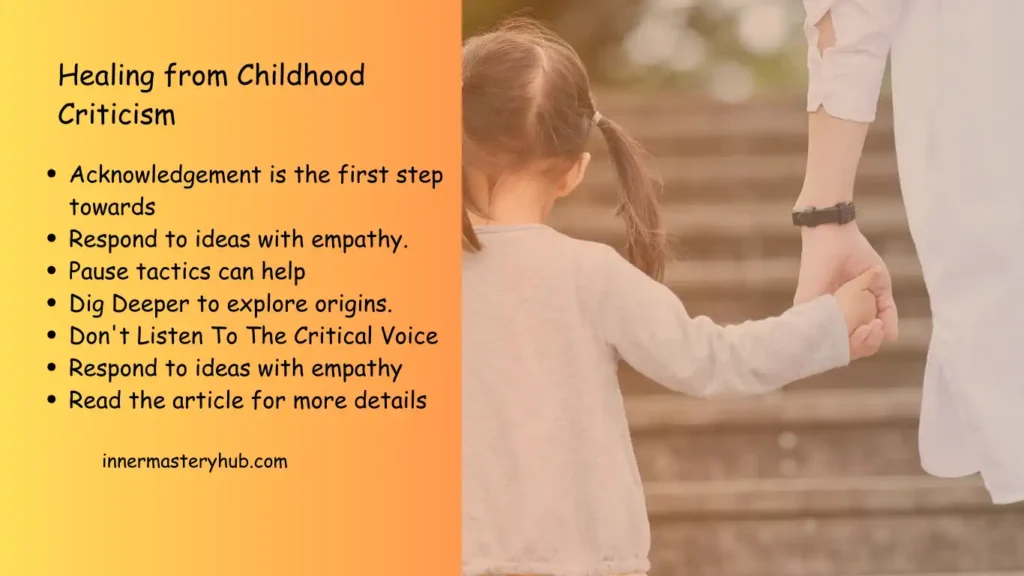
Acknowledgement is the first step towards healing. started by writing down old experiences and quickly recognising patterns. nselling is beneficial because formal assessment is recommended by the RACGP guidelines for adult survivors, which replaces Harsh inner dialogue with self-compassion exercises.
- Visualization helps you reconnect. Journaling uncovers hidden feelings. Play activities lighten the load. I tried drawing what my inner child needed, finding release.
- Observe your feelings without passing judgment and use evidence to challenge your beliefs. Find out new skills that support self-compassion and growth-oriented thinking, like reframing Criticism as other people’s problems, not yours.
- Pause tactics can help. Tim Fletcher’s three-step technique scans the body, assesses reality, and determines a reaction. I followed the 10-minute rule for cooling down.
- Respond to ideas with empathy. You can shift focus by gratitude. I created morning affirmations and other rituals.
- Therapy can reveal roots. Trauma can be processed with hypnotherapy or EMDR. I discovered that somatic work helped to relieve buried tension.
- Integration heals. Kasia Kolek discusses mind-body-spirit harmonisation to embrace authenticity and find joy.
- Dig Deeper to explore origins. LIC suggests understanding projection. Empathy for parents aids forgiveness.
- Allow Yourself to Be Angry; It Signals Your Needs. Process it safely with exercise to release it.
- Don’t Listen To The Critical Voice In Your Head and replace it with truth. Become Aware of How You Talk to Yourself
- Recognize the Signs of an Angry Inner Child by Watching for Triggers.
Why does healing from childhood criticism feel slow?
Healing feels slow because you are not changing behaviors; you are reshaping deeply ingrained emotional patterns formed over the years.
Your brain prefers familiar patterns, even painful ones.
Because familiar = safe.
So when you start changing:
- Your mind resists
- Old thoughts return
- Progress feels invisible
But something is happening underneath:
- Awareness increases
- Reactions soften
- Emotional recovery becomes faster
Healing is not dramatic.
It is quiet and cumulative.
What changes when you truly understand your inner patterns?
When you understand your inner patterns, you stop reacting automatically and begin responding consciously, reducing emotional intensity and self-judgment.
The shift is subtle but powerful:
- You pause instead of reacting
- You question your thoughts
- You feel emotions without being overwhelmed
You don’t eliminate the inner critic.
You stop believing it unquestioningly.
And that changes everything.
Healing from Childhood Criticism Is Not What You Think
Healing from childhood criticism is not about becoming confident overnight.
It is about seeing clearly.
Seeing that the voice in your head is not who you are.
It is something you learned.
And once you see that, something shifts quietly:
You stop fighting yourself.
You start understanding yourself.
And that understanding creates the kind of change that doesn’t need force.
FAQs
What are the signs that childhood criticism is affecting my adult life?
Signs include low self-esteem, perfectionism, relationship anxiety, and hypersensitivity to feedback. You may shun risks or sabotage your successes, reinforcing old, negative voices. According to a study conducted at Binghamton University, this is associated with reduced emotional processing, leading to chronic doubt and isolation in daily interactions.
How can I start healing from childhood criticism?
Begin by admitting your pain by journaling past recollections. Every day, practise self-compassion by replacing negative thoughts with positive ones. Cognitive behavioural therapy, to reframe beliefs. Research suggests that early intervention can reduce disobedience and increase self-esteem, laying the groundwork for progressive emotional development.
What therapy is best for healing from childhood criticism?
Cognitive Behavioural Therapy (CBT) aims to rewire negative thought patterns, whereas EMDR analyses trauma memories. static experience addresses body-held tension. According to NCBI studies, mother criticism influences reward responses, making emotionally regulated therapy helpful in restoring confidence and lowering anxiety.
Does being criticised in childhood cause low self-esteem in adults?
Yes, frequent Criticism can lower self-esteem, leading to continual doubt and increased perfectionism. According to research published in Frontiers, it affects emotional intelligence, leading to increased reactivity to feedback. LTS frequently internalise it as fact, damaging their professions and relationships; nevertheless, healing through awareness can restore a good self-image.
How does healing from childhood criticism improve relationships?
It increases trust by reducing defensiveness and fear of judgment and helps people learn to express their wants without becoming angry. udy found that increased response to Criticism reduces social happiness, but mending builds empathy, resulting in deeper connections and reduced isolation in personal bonds.
Is forgiveness necessary for healing from childhood criticism?
Forgiveness aids release, although it is not required; knowing parents’ shortcomings is beneficial. First and foremost, practise self-compassion. Today, emphasises confronting past scars for growth, minimising resentment, and freeing up energy for personal development without carrying unresolved anger.
What are the top 5 childhood traumas?
The top 5 childhood traumas often include:
Physical Abuse – being hit, shaken, or physically harmed.
Emotional Abuse – constant Criticism, humiliation, or neglect of feelings.
Sexual Abuse – unwanted sexual contact or exploitation.
Neglect – lack of care, attention, or basic needs.
Witnessing Domestic Violence – seeing violence between caregivers or family members.
These experiences can deeply impact emotional, mental, and social development.
What are the symptoms of childhood humiliation trauma?
Childhood humiliation trauma can cause low self-esteem, anxiety, shame, and fear of judgment. op may avoid social situations, struggle with trust, become perfectionistic, or self-criticize constantly. These include sensitivity, anger, or depression, which may also appear.
What happens when you are constantly criticized as a child?
Constant Criticism in childhood can lead to low self-esteem, chronic self-doubt, and fear of failure. may cause anxiety, perfectionism, difficulty trusting others, and harsh self-judgment. Every time, it can affect relationships, emotional health, and overall confidence.
How to heal from childhood criticism?
Healing from childhood criticism involves recognizing and challenging negative self-beliefs, practicing self-compassion, and replacing harsh self-talk with positive affirmations. Therapy, counseling, and supportive relationships help rebuild confidence.
- American Psychological Association. (n.d.). The impact of early childhood experiences on development. Retrieved from https://www.apa.org/monitor/nov01/childhood ↩︎
- Beck, A. T. (1979). Cognitive Therapy of Depression ↩︎
- Development and Psychopathology Journal (2013 Study) ↩︎
- Center on the Developing Child, Harvard University. (n.d.). In Brief: The Science of Early Childhood Development.
https://developingchild.harvard.edu ↩︎ - Tan, P. Z., et al. (2014). Maternal Criticism and neural markers of reward processing in children. Biological Psychology, 100, 98–104.
https://pmc.ncbi.nlm.nih.gov/articles/PMC4054587/ ↩︎ - McEwen, B. S. (2007). Physiology and neurobiology of stress and adaptation. Physiological Reviews, 87(3), 873–904.
https://www.ncbi.nlm.nih.gov/pmc/articles/PMC2907136/ ↩︎ - McLaughlin, K. A., et al. (2019). Childhood adversity and neural development. Nature Reviews Neuroscience, 20, 697–714.
https://www.nature.com/articles/s41583-019-0209-8 ↩︎