18 Behaviours Show You’re Confusing Comfort With Contentment
Life may appear fine on the outside, but feel strangely flat on the inside if you’ve been confusing comfort with contentment. You’re not unhappy, but you’re also not completely fulfilled. You manage your days well, steer clear of major mishaps, and keep yourself occupied enough to prevent overthinking. But something inside of you murmurs, “Is this it?” as the sound ends. True contentment is vibrant rather than loud.
Why confusing comfort with contentment feels so normal
Seeking comfort is not a bad thing. The problem arises when comfort becomes your primary objective, coping mechanism, and success metric. When that occurs, you begin to prefer your routines over your values. Instead of doing what may be right, you start doing what feels safe. Even if your days are devoid of meaning or connection, you come to regard “no problems today” as a wonderful life.
This misconception arises for a deeper reason as well: satisfaction is more than just “less stress.” According to a substantial body of research on self-determination theory, three fundamental needs are intimately linked to well-being: relatedness (you feel connected), competence (you feel capable and improving), and autonomy (you think you have choice).
For a while, comfort can help you feel less stressed, but it won’t feel like peace if it gradually takes away your independence, competence, or relationships. It will seem like numbness disguised as steadiness.
18 behaviours that show you’re confusing comfort with contentment
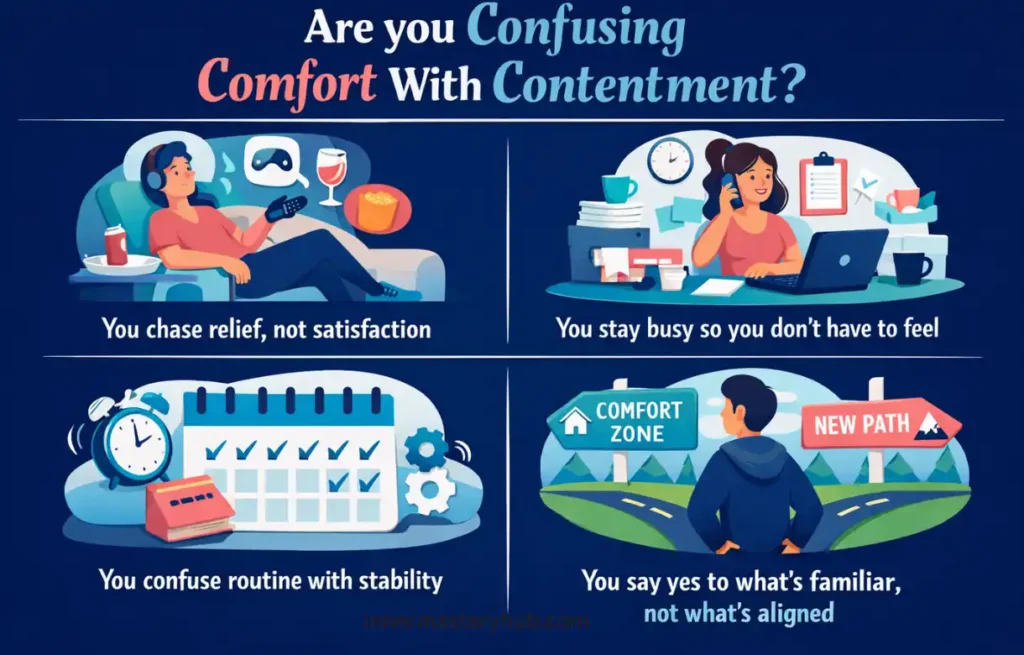
You chase relief, not satisfaction
You organise your life according to what will help you relax the fastest. When you’re uncomfortable, you turn to quick fixes like browsing, snacking, buying, or dozing off. Relief isn’t always undesirable, but if you depend on it every time you’re feeling stressed, you’ll develop a phobia of effort. When was the last time you finished a day feeling proud rather than just at ease?
You call “no conflict” a healthy relationship
Because you want things to go smoothly, you steer clear of difficult conversations. You reduce your desires to maintain calm, and you confuse silence with closeness. You may eventually experience loneliness despite being surrounded by people.
Despite their imperfections, strong relationships are sincere and repaired. Long-running research has emphasized that good relationships support both happiness and health. If your connection depends on avoiding truth, you are confusing comfort with contentment.
You delay decisions so you can’t fail
It’s not that you’re adaptable; it’s that you’re afraid to commit. You convince yourself that you’re “thinking it through,” yet months go by and nothing changes. Although this appears responsible on the outside, it feels stuck on the inside. When you make a decision and stick with it, despite its flaws, contentment increases.
You stay busy, so you don’t have to feel
Your mind is racing, your schedule is crowded, and you have a lot of distractions during your free time. It could even be called productivity. However, you are secretly aware that you are avoiding questions you don’t want to respond to. Finally, sitting in quiet makes you feel agitated. This restlessness is often a sign that your life is moving aimlessly.
You avoid being a beginner
You stick to what you already know because you want to become competent at things fast. You don’t pursue new interests, enroll in classes, or challenge your abilities. You may tell yourself that you’re too busy or too old, but the real reason is typically a fear of appearing uncomfortable. The serene assurance that you can develop and learn at your own speed is part of contentment.
You treat your dreams like “nice ideas.”
You express your desires, but you don’t act upon them. You store your dreams in a glass box that is protected from testing. While living the same week over and over, you might think, “One day.” Because “someday” never asks you to take a chance today, comfort loves “someday.”
You overvalue convenience in every choice
You pick the most leisurely meal, the easiest exercise (or none at all), the easiest superficial conversation, and the easiest entertainment. Convenience is fine, but your life becomes less meaningful if it becomes your primary filter. Asking yourself if you’re creating a life that feels genuine or easy is a worthwhile exercise.
You keep your standards low to avoid disappointment
You tell yourself you don’t need much, but it’s protective rather than modest. To prevent the agony of desiring more, you have lower expectations. This
You confuse routine with stability
Although your habits keep you going, they also prevent you from evolving. You see the same people, act in the same ways, and think the same things. While routine can be calming, too much repetition can cause mental dullness. Your spirit feels undernourished, but your neurological system feels secure.
You say yes to what’s familiar, not what’s aligned
You choose the position, role, or duty that best suits the narrative that people anticipate from you. Even though you’re skilled at it, you don’t feel like yourself doing it. You eventually start to feel like you’re living your own life. When your decisions reflect your values rather than merely your skills, contentment usually manifests.

You numb stress instead of reducing it
Instead of addressing the root reason, you search for coping mechanisms that numb emotions. Substances, screens, and never-ending work can all be the cause. Chronic stress is more than just a mood; it can have long-term effects on the body through processes such as inflammation and deterioration of the healing systems. Your “comfort habits” won’t truly bring you serenity if they harm your health.
You avoid movement because rest feels earned only after exhaustion
You tell yourself you’ll “get back to it” later, only to sit for extended periods. But then continues to move. According to studies from around the world, a significant portion of adults do not engage in the required amounts of physical activity, and this is associated with an increased risk of illness. Energy is typically necessary for contentment, and it isn’t easy to develop if your days don’t involve fundamental activity.
You keep your life “managed” but not enjoyed
Tasks are completed, bills are paid, and obligations are managed. However, happiness seems uncommon. Because you’ve been living in duty Mode, you might not even know what you enjoy anymore. This is a typical comfort trap: you don’t feel alive since nothing is being constructed, but you feel safe because nothing is collapsing.
You wait for motivation before taking action
You promise yourself that when you’re ready, you’ll begin. But rather than being a prerequisite for action, readiness frequently follows from it. Behavioural activation in mental health research is predicated on the notion that engaging in worthwhile activities can elevate mood and lessen symptoms even when you don’t feel like it. You can learn from it without being depressed: sentiments can follow action.
You keep friendships that are comfortable but shallow
You can chat to anyone, but you don’t have somebody you can really rely on. To avoid being seen, you have light discussions. You may eventually feel “social” but remain isolated. Real connection, which necessitates being known rather than merely liked, is necessary for contentment.
You treat anxiety as a stop sign instead of a signal
Any discomfort seems to be evidence that the action is wrong. You swiftly withdraw and refer to it as “listening to your gut.” That may be insightful at times, but it’s usually fear disguised as wisdom.
According to several performance models, there is a medium ground where a little stress can help you concentrate, but too much stress can overwhelm you, and too little stress can cause boredom—the Healthline. You might choose the lowest-growth life if you consistently select the least stressful alternative.
You keep consuming information, but don’t apply it
You bookmark posts, watch movies, read books, and get advice. It keeps you in your thoughts, yet it feels useful. Knowledge can act as a safety net, providing you with a sense of advancement without the threat of change. You’re probably safeguarding comfort if you have ten tabs open with instructions on “how to start” and no action taken.
You feel safe, but you don’t feel proud
Even if your life is steady, you hardly ever experience the subtle pride that comes with standing up for yourself. Pride doesn’t require outstanding accomplishments. It might result from fulfilling commitments to oneself, being truthful in interpersonal interactions, completing essential tasks, or routinely taking tiny risks. Comfort is probably in charge if you can’t recall the last time you were pleased with your way of life.
How to stop confusing comfort with contentment
Examine your own definition of contentment compared with what social media suggests. Although contentment varies from person to person, it typically consists of the following elements: a sense of belonging, utility, autonomy, and personal growth. These closely align with relatedness, competence, and independence, all of which are linked to well-being. Therefore, ask yourself, “What helps me feel more connected, capable, and true?” rather than, “How do I get more comfortable?”
Next, increase the integrity of your decisions. You’ll probably return to your previous patterns if you attempt to go from stuck to transformed. However, your nervous system learns that growth is safe as long as you make small, consistent movements.
Next, develop “real rest,” not flight. Sleep you guard, movement you don’t overthink, and time spent with others who don’t need you to perform are all components of proper rest. Your recovery habits matter, as long-term stress can accumulate in the body and negatively impact health.
By keeping your phone out of reach during meals, setting a nighttime alarm, leaving your walking shoes by the door, and making the easier option the better option, you may make comfort less automatic.
Additionally, you must engage in a straightforward self-reflection exercise that avoids self-attack. Take a seat once a week and honestly respond to the following questions in a notebook: “Where did I prioritise ease over morality?” “Despite the discomfort, where did I choose growth?” “What did I gain from that discomfort?” “What did I pay for that comfort?”
Guilt is not the purpose. Clarity is the goal. It’s more difficult to deceive yourself when you see the pattern on paper, and it’s simpler to make changes without causing any drama.
Because your brain learns by doing, meaningful action is essential. Take a cue from behavioural activation if you’ve been waiting to feel inspired: do one little activity that aligns with your beliefs today, and let your mood catch up later.
Choose contentment on purpose, not comfort by default.
Because comfort shields you from both discomfort and personal development, you may lead a seemingly peaceful but hollow existence if you confuse comfort with contentment. The change is not to forsake comfort completely.
The change is to cease making decisions based solely on comfort. You can be thankful without shrinking, you may rest without running away, and you can create a life that is both solid and purposeful. Start small, be truthful, and keep choosing what makes you feel genuine, competent, and connected. That’s where contentment resides, and it’s much more fulfilling than just being comfortable.
FAQs about confusing comfort with contentment
What does “confusing comfort with contentment” mean?
This indicates that you are confusing “life feels easy and familiar” with “life feels truly satisfying.” You could feel empty or bored on the inside, even though you have routines, stability, and fewer risks. Now, comfort lessens discomfort; satisfaction is a lasting sense of inner calm and sufficiency.
What’s the difference between comfort and contentment?
Ease is generally associated with comfort: fewer issues, less stress, and greater convenience. Contentment is more internal; even in the face of imperfect circumstances, you feel at ease. Even when you are at ease, you may not feel satisfied. You can be happy yet wanting to develop and do better.
How do you know you’re confusing comfort with contentment?
You consistently choose “safe” over “right.” To avoid thinking, you stay busy, put off making decisions, and avoid difficult conversations. When nothing goes wrong, you’re relieved, but you don’t feel happy, connected, or proud. You don’t feel calm during quiet times; instead, you get agitated.
Why do you feel empty even when life is comfortable?
Because comfort can relieve stress without imparting significance, your mind detects the void if your days lack genuine connection, education, or purpose. Over time, “fine” may start to feel flat because you are attending to fundamental needs while neglecting deeper ones, such as growth and belonging.
Is contentment the same as complacency?
Don’t. Accepting where you are without detesting your circumstances is contentment. Staying put and opposing change because it seems safer is complacency. You can take bold actions and still be happy. The main distinction is whether you are opting for progress or avoiding it to preserve comfort.
Can you be ambitious and still be content?
Sure. When you feel stable on the inside and are grateful for what you have, you are happy. When you keep developing and getting better, you are ambitious. In other words, you pursue your goals with a purpose rather than out of fear or self-proving. You don’t grow because you feel “not enough,” but instead because you choose to.
How do you move from comfort to contentment without blowing up your life?
There is no need for a major reset. Small daily acts that align with your principles are what you need. Start with one courageous decision: one open discussion, one practice of a skill, one stroll, one boundary, or one chore you’ve shunned. When your life begins to feel purposeful again, comfort wanes.
What are quick self-reflection questions to check if you’re settling?
Consider this: “What am I avoiding?” “Where am I sacrificing the truth for ease?” “If I trusted myself more, what would I do?” “What do I miss about the attempt-making version of myself?” Write your responses. If you are sincere, patterns become clear very quickly.
How do you stop using distractions as comfort?
First, identify your trigger: fear, loneliness, boredom, or tension. Next, take a two-minute break before browsing, eating, or shopping. Replace the habit with a more restorative “reset,” such as drinking water, taking a little stroll, writing in a diary, or contacting a trusted person.
How long does it take to feel real contentment?
It’s not a one-time event. As you consistently fulfil your self-promises—even small ones matter—contentment increases. When they add meaningful activities, cut back on numbing behaviours, and get better sleep, many people see a change in just a few weeks. Over months of regular decisions, the underlying sensation gets stronger.
Why is confusing comfort with contentment a problem?
Confusing comfort with contentment can limit personal growth. When routines feel pleasant, you may stop challenging yourself. The idea of confusing comfort with contentment explains why people stay in stagnant jobs or relationships. Comfort reduces stress temporarily, while contentment supports long term fulfillment, purpose, resilience, and intentional life choices daily.
How can I avoid confusing comfort with contentment?
To avoid confusing comfort with contentment, reflect on your goals regularly. Ask whether your comfort supports growth or hides fear. Remember the phrase confusing comfort with contentment as a mental check. Choose actions aligned with values, learning, and progress, even when they feel uncomfortable, uncertain, or challenging, for long-term fulfillment.
What does confusing comfort with contentment mean?
Confusing comfort with contentment happens when safety feels like happiness. You may feel calm but unfulfilled. Using the exact keyword, confusing comfort with contentment, reminds people that growth often requires discomfort. True contentment includes meaning, progress, and alignment, not just ease, routine, or familiarity over time and deeper personal satisfaction.