
Circle of Control Worksheet for Emotional Regulation
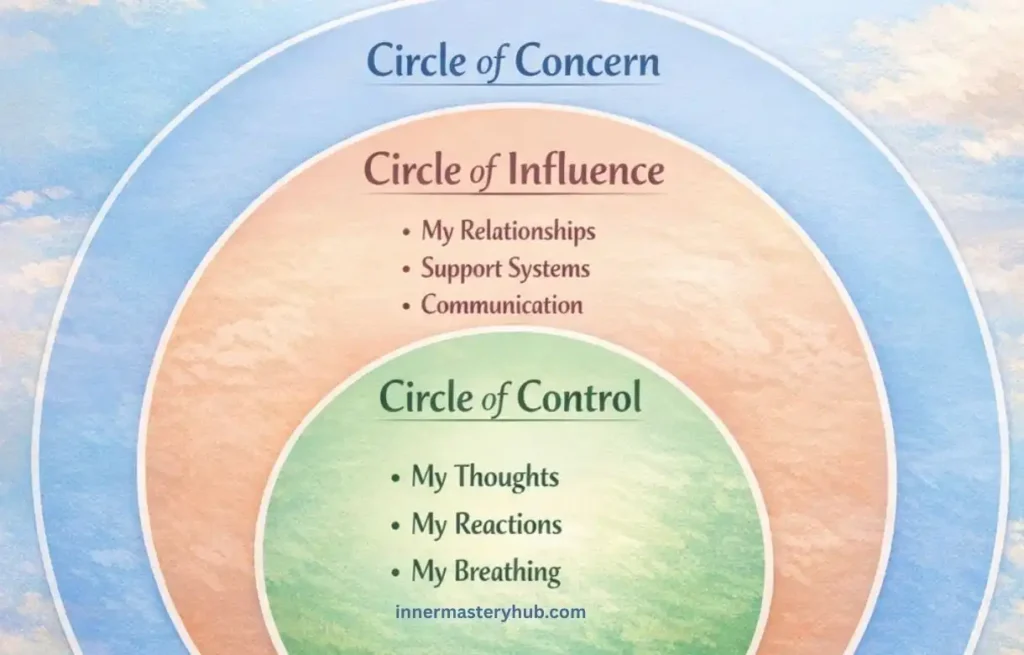
A Circle of Control worksheet helps you separate what you can do from what you cannot decide for someone else. If you’re worried about a reply, an argument, a work decision, or an uncertain outcome, writing each part in the appropriate circle can make the next step easier to see.
What is a Circle of Control Worksheet?
A Circle of Control worksheet is a visual exercise that separates a stressful situation into three areas:
Control: What you can directly choose or do.
Influence: What you may affect but cannot completely decide.
Concern: What matters to you but is outside your control.
Suppose you have a job interview tomorrow.
You can control how you prepare, when you arrive, what you wear, and how you answer the questions.
You may influence the interviewer’s impression through your preparation and communication.
You cannot control who else applies, what the interviewer thinks privately, or who gets the job.
If you want a fuller explanation of the three circles before completing the worksheet, read our guide to Circle of Control vs. Circle of Influence.
Why use a Circle of Control Worksheet for emotional regulation?
Stressful situations often contain a mixture of things you can and cannot change.
You might spend an evening thinking:
“What if they don’t reply?”
“What if I don’t get the job?”
“What if they misunderstood me?”
The worksheet puts those concerns on paper and separates them from actions available to you.
Instead of repeatedly checking your phone, for example, you might identify one action:
“I’ll send one follow-up tomorrow afternoon.”
The situation is still uncertain. The worksheet has simply helped you identify what requires an action from you and what does not.
The worksheet can help you:
- separate actions from outcomes
- identify a practical next step
- notice what you keep worrying about
- organise a stressful situation on paper
- distinguish your choices from another person’s choices
How to use the Circle of Control Worksheet
Start with one specific situation rather than trying to sort out everything that is worrying you at once.
Step 1: Write down the situation
Be specific.
Instead of:
“My relationship is stressful.”
write:
“My partner hasn’t replied since our argument this morning.”
Step 2: Separate the situation into three circles
Ask:
What can I directly do or choose?
Put those answers in Control.
Then ask:
What might I influence without being able to decide the outcome?
Put those answers in Influence.
Finally ask:
What matters to me but depends on another person, circumstances, or an outcome I cannot decide?
Put those answers in Concern.
Step 3: Choose one action from your Control circle
Look only at the items you can act on.
Ask:
“Which one of these can I do today?”
You do not have to solve the entire situation.
Choose one next action.
Circle of Control Worksheet Example
Situation: Someone didn’t reply to your message.
Circle of Control
- whether you send a follow-up
- what you write
- whether your message is respectful
- how many times you contact them
- what you do while waiting
Circle of Influence
- you can explain yourself clearly
- you can ask whether they have time to talk
- you can clarify your meaning if there was a misunderstanding
Circle of Concern
- whether they reply
- when they reply
- what they think about you
- what mood they are in
- what they eventually decide
After filling out the worksheet, your next action might be:
“I’ll wait until tomorrow afternoon. If I still haven’t heard from them, I’ll send one follow-up.”
You still do not know whether they will answer. But you now know what you are going to do.
Using a Circle of Control Worksheet for Anxiety
Imagine you have an important presentation tomorrow.
You keep thinking:
“What if I make a mistake?”
“What if they don’t like my presentation?”
“What if someone asks a question I can’t answer?”
Put those concerns into the worksheet.
You can control:
- how much time you spend preparing
- whether you practise beforehand
- whether you bring your notes
- what time you arrive
- whether you ask for clarification when you don’t understand a question
You may influence:
- how clearly the audience understands your presentation
- the impression you make
- how the discussion develops
You cannot control:
- every question someone asks
- another person’s opinion
- whether somebody disagrees
- every unexpected problem
A Circle of Control worksheet does not guarantee that anxiety will disappear. It gives you a way to separate preparation from prediction.
Using the Circle of Control Worksheet for Overthinking
Overthinking can become especially noticeable when you are waiting for another person’s reaction.
You send:
“I was upset by what happened yesterday. Can we talk?”
Ten minutes later, you reread the message.
Then you read it again.
You wonder whether it sounded rude.
You imagine what the other person might be thinking.
You consider sending another message to explain the first one.
This is a useful time to complete the worksheet.
You can check whether your message says what you intended. You can clarify something if necessary. You can decide whether another message is useful.
You cannot decide how the other person interprets every word or force them to respond in a particular way.
Writing those things separately can help you decide whether there is actually another action to take.
Using the Circle of Control Worksheet for Emotional Awareness
After completing the worksheet, look at what you wrote rather than immediately starting another one.
Ask yourself:
Are most of my worries about what another person might think?
Am I waiting for an outcome I cannot decide?
Am I trying to change somebody else’s reaction?
Is there one action in my Circle of Control that I have been avoiding?
For example, you might realise that you have spent two days wondering whether your manager is unhappy with you while avoiding the one thing you can do:
Ask for feedback.
The Circle of Control exercise is related to the broader psychological concept of locus of control, which concerns how people understand the relationship between their actions and outcomes. Rotter’s work helped establish locus of control as a psychological construct.[1]
Research has also examined associations between locus of control, self-control, and health outcomes.[2] This research should not be taken to mean that completing a Circle of Control worksheet will automatically reduce anxiety or improve health.
Common Mistakes When Using a Circle of Control Worksheet
Putting another person’s behaviour in your Control circle
You can control what you say.
You cannot control whether another person agrees.
Confusing influence with control
Preparing carefully may influence the result of an interview.
It does not guarantee that you will get the job.
Filling the worksheet with vague problems
“Everything is going wrong” is difficult to sort.
Start with something specific:
“I’m waiting to hear whether my application was accepted.”
Spending more time on the Concern circle than the Control circle
If you write ten things you cannot control and then spend another hour thinking about them, the worksheet has not helped you identify your next action.
Return to the Control circle and choose one thing you can actually do.
When Should You Use a Circle of Control Worksheet?
You might use the worksheet when:
- you are waiting for someone’s reply
- you are worried about an upcoming event
- an argument keeps replaying in your mind
- you are waiting for test, application, or interview results
- You keep thinking about another person’s opinion
- You have several possible actions and do not know where to start
You do not need to complete it for every uncomfortable feeling. It is most useful when a situation contains a clear mixture of your actions and uncertain outcomes.
Download the Printable Circle of Control worksheet
The worksheet includes
- Three-circle template
- Reflection prompts
- Anxiety check-in
- Daily practice page
- Emotional regulation questions
Key Takeaways
- Control means what you can directly choose or do.
- Influence means you may affect something without deciding the result.
- Concern includes outcomes and other people’s choices.
- Start with one specific situation.
- Finish by choosing one action you can take.
People Also Ask
What is a circle of control worksheet?
A Circle of Control worksheet separates a situation into what you can control, what you may influence, and what is outside your control. It can help you identify what action is available to you.
What goes in the Circle of Control?
Put actions and choices you can make directly in the Circle of Control. Examples include what you say, whether you send a message, how you prepare for something, and what you decide to do next.
What is the difference between control, influence, and concern?
Control includes your own choices and actions. Influence includes things you may affect but cannot completely decide. Concern includes things that matter to you but depend on other people, circumstances, or outcomes.
Can a Circle of Control worksheet help with anxiety?
It may help you organise worries by separating actions you can take from outcomes you cannot decide. It should not be treated as a guaranteed way to reduce anxiety or as a replacement for professional care when anxiety is persistent or significantly affects daily life.
Can children use a Circle of Control worksheet?
Yes, a simplified worksheet can be used with guidance from a parent, teacher, counsellor, or other appropriate adult. Concrete examples such as “I can control what I say, but I can’t control what my friend says” can make the three circles easier to understand.
- Rotter, J. B. (1966). Generalized expectancies for internal versus external control of reinforcement. Psychological Monographs: General and Applied, 80(1), 1–28. https://doi.org/10.1037/h0092976 ↩︎
- Botha, F. (2023). Locus of control, self-control, and health outcomes. IZA World of Labor, 500. https://doi.org/10.15185/izawol.500 ↩︎
Written By Mehwish Qurayshi
Mehwish Qurayshi is a Trauma-Informed Emotional Wellness Counsellor trained through NICABM’s Treating Trauma Master Series, which includes NBCC-approved education in Trauma Treatment and Emotional Wellness & Emotional Intelligence – Sourcecode Academia. She has over five years of experience providing emotional wellness counselling, helping individuals heal from trauma, regulate emotions, and build healthy relationships.