16 Signs You Are Living a Life of Mediocrity
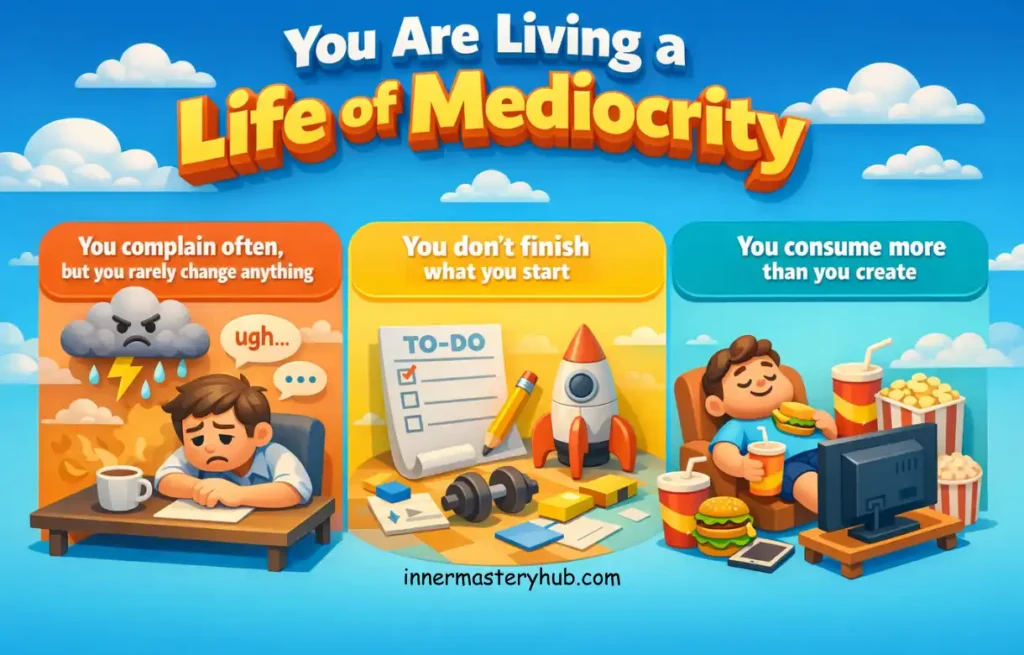
If the phrase living a life of mediocrity hits a nerve, you’re not alone. Most people don’t wake up and decide to play small. It usually happens quietly: you get busy, you get tired, you get used to “fine,” and one day you realise weeks have slipped by without anything that truly mattered to you. You still function, you still show up, and from the outside you may even look “stable.” But inside, you feel flat, like you’re watching your own life instead of living it.
You procrastinate on the things that would change your life.
Even when you’re busy, you put off the tasks that really develop you, including the application, the exercise regimen, the tough chat, and the necessary expertise. In addition to being a time issue, procrastination can often be linked with increased stress, which can trap you in a cycle of avoidance and guilt. You tell yourself that your future isn’t worth the effort you’re putting in when you consistently put off important tasks. Set the “start bar”, promise yourself five minutes, and it is a workable solution. Momentum generally follows, but starting is the real win.
You settle for “good enough” at work and call it realistic.
You rarely strive for excellence, but you do what you have to. You can secretly feel cut off from your job, your function, or your purpose. That detachment is not uncommon. According to Gallup’s global research, a comparatively tiny percentage of workers say they are actively disengaged or not engaged at work. It’s challenging to create a life that feels alive when you spend most of your waking hours in a state of numbness. Quitting isn’t always the answer. Sometimes it’s picking one area to focus on: one project to enhance, one challenge to address with pride, or one ability to polish.
You complain often, but you rarely change anything.
When complaining takes the place of taking action, it can be a trap. After venting and feeling a little validated, nothing changes. Your brain eventually learns to concentrate on problems rather than possibilities. That way of thinking subtly shapes your identity: you become someone who “has reasons,” not someone who has outcomes. Following up on every complaint with a single action, no matter how tiny, is an innovative approach. It’s a pattern, not a complaint, if you can’t think of what to do next.
You don’t finish what you start.
You get excited at first, then you run out of energy, and then you keep going. “I never follow through” is the painful narrative that is created in your mind as a result. Self-trust is the foundation of any meaningful existence, and the longer that story remains inside of you, the less you trust yourself. You need fewer open cycles, not more drive. Choose one unfinished task that would have a significant impact and close it. Confidence is built more quickly by completion than by beginning.
You produce less than you consume.
Instead of creating your own life, you spend a lot of your leisure time scrolling through, watching, or reading other people’s. Your life remains empty, but your mind remains full when consumerism becomes your primary pastime. Time-use data regularly show how leisure can become largely passive, as in the time spent watching TV on a typical day.
Being an online creator is not a must. “Create” can refer to writing a single page, preparing an authentic meal, picking up a skill, mending something around the house, or creating and carrying out a plan. For two weeks, make something tiny each day and observe how your self-respect returns.
Your relationships are shallow, or you keep people at arm’s length.
You don’t feel well-known despite having contacts, chats, and casual conversations. Or you shy away from intimacy because it seems dangerous. The problem is that a fulfilling existence requires genuine connection. Strong social ties are also associated with higher chances of Survival.
Connection impacts the body as well as the mind. A major social makeover is not the best course of action if you’re socially drifting. It’s one sincere outreach: one phone call, one stroll with a buddy, one thoughtful question, one attempt to be present rather than perform.
You stop learning new skills because you’re “too busy.”
You stop growing when you stop learning. Your world shrinks even though you continue to work hard. Learning is beneficial for long-term mental health and career advancement. Lifelong mental challenges may be associated with a lower incidence of dementia and more brain resilience, according to research on education and cognitive reserve. A new degree is not required. One book chapter per day, one course module per week, and one skill practice session per weekend are all necessary for a consistent learning schedule.
You run on poor sleep and act like it’s a personality trait.
It’s “just your schedule,” so you keep staying up late and wake up exhausted. Not only does sleep deprivation make you drowsy, but it also impairs your mood, concentration, and self-control, all of which are necessary for you to quit daydreaming. Adults should obtain at least 7 hours of sleep every night, according to the CDC.
Sleep is essential, and you should safeguard it if you want to quit living a mediocre lifestyle. A regular wake-up time and a screen-free wind-down window are two minor solutions that many people find effective.
You compare your life to others and feel behind.
You lose sight of your own path when you compare. You assess your behind-the-scenes work after viewing someone else’s highlight reel. This can be increased by social media, particularly if it becomes a habit of continual monitoring and scrolling.
Reviews of the literature have shown links between poor social media use and outcomes related to mental health, such as mood and sleep. The answer is to utilise social media responsibly, not to dislike it. Set time limits, stop following things that make you feel unworthy, and swap out one daily scroll for something that improves your actual life.
You don’t know your values, so you borrow other people’s goals.
You pursue what seems impressive, such as a lifestyle, a work title, or a “safe” plan. However, even after you have it, you still feel empty since it wasn’t yours. People become successful on paper but miserable in real life. This can be resolved with honest, non-dramatic self-reflection. What qualities in other people do you respect? Why do you feel alive? When no one is looking, what type of person do you want to be? Your decisions become more apparent when you identify your values.
You don’t plan your money, so you live with quiet fear.
Financial instability reduces your possibilities and causes stress, even if you make a good living. You wind yourself saying “no” to possibilities you truly want when you don’t keep track of your expenditures, save intentionally, or make growth plans. Because of the anxiety, you play it safe, which can become insignificant. Start small: list your income, expenses, and one crucial financial objective. Being calm allows you to make better decisions.
When You Talk About People More Than Ideas
You’re living a life of mediocrity if the majority of your conversations are about who did what, who is failing, and who is rude. Though it doesn’t create anything, gossip feels social. They do. Concepts result in abilities, initiatives, wiser choices, and real progress. Talking about individuals keeps you in the audience and prevents you from becoming a player by passing judgment on them.
Take note of the issue the next time you’re among friends. Are you talking about development, plans, problems to resolve, or just drama? “What are you working on?” is a simple shift that may take your life from a small discussion to a significant transformation.
If You’re Using Yesterday’s Solutions, You’re Living on Repeat
Recycled problem-solving looks like this: same excuses, same tactics, same outcomes. Even when it’s obviously not working, you deal with stress, time, and people in the same way. Routines that don’t push you are preferred over those who live a life of mediocrity.
Growth requires new strategies, and your “solution” may be the problem if your work, income, or health isn’t improving. Perhaps you don’t need motivation, but rather a plan of action, or you need boundaries rather than hope. Change your surroundings, try a new tool, or keep track of the things you avoid. New outcomes are produced by new input.
When Your Days Drain You, Your Life Needs a Redesign
If most days leave you tired, irritated, and empty, don’t ignore it. That’s not “adult life,” that’s a warning. Living a life of mediocrity feels like living on a low battery: too many obligations, too little meaning. You wake up, push through, distract yourself, sleep, repeat. The fix isn’t always a significant, dramatic change.
Sometimes it’s redesigning the basics: better sleep, cleaner food, less scrolling, more sunlight, a short walk, one honest conversation, one hobby that makes you feel alive. Pay attention to what drains you and what energises you. Your energy is a compass; follow it.
Average Is Addictive, And That’s the Problem
Average is cosy. It makes no requests. It enables you to fit in. You gain safety with no effort, which is why it’s addictive. However, at first, the price is invisible: fewer options, less self-assurance, and fewer memorable events. Being “bad” is not the definition of living a life of mediocrity. It’s about avoiding the unpleasant tasks that improve you.
Raising the bar in one area is a small but bold antidote. Practice a skill every day, speak up once, train a little more, and quit putting up with “meh” friendships. It’s not necessary to be severe. Quit using “fine” as your benchmark.

Routine Feels “Safe” but Stagnant
Up until it turns into a cage, a steady schedule might be beneficial. Your brain ceases to expand when every day is the same. You stop recognising fresh opportunities, learning new skills, and interacting with new people. Because it protects you from danger, mediocrity enjoys predictable comfort. However, “safe” can eventually become “stuck.” You don’t have to ruin your life.
Take a class, begin a side project, alter your exercise routine, go to a new location, make a pitch, volunteer, or pick up a tool to add one growth component to your week. The straightforward objective is to give your life fresh experiences to react to.
You don’t have to stay stuck in a life of mediocrity
If you saw yourself in several signs, that doesn’t mean you’re broken. It means you’re human, and you’ve been surviving on autopilot. But the autopilot can be turned off. You can choose one small change and repeat it until it becomes part of you. That’s how confidence is built: not through big speeches, but through small promises kept.
Living a life of mediocrity ends the moment you decide your days deserve intention. Pick one area, set one clear plan, and take one step today. A year from now, you won’t remember the scrolling you did or the excuses you made, but you will remember the moment you finally started showing up for yourself.
FAQs about Living A Life Of Mediocrity
What does living a life of mediocrity mean?
It indicates that you are in the okay zone, but seldom feel pushed, proud, or really alive. You don’t develop much, but your fundamental needs are met. In essence, mediocrity is “living a life of mediocrity in terms of effort, quality, or outcomes.
How do you know you’re living a life of mediocrity?
You avoid difficult decisions, put off important tasks, feel trapped, and your days seem the same. On the exterior, you may appear OK, but on the inside, you may feel disengaged, bored, or restless. “There must be more than this,” you can’t stop thinking.
Why do people settle for a life of mediocrity?
Most people don’t intentionally pick it. You settle because you’re worn out, fearful of being judged, scared of failing, or accustomed to being cautious. Growth is more difficult than comfort. You eventually lose sight of your desires and begin to live according to others’ expectations.
Is living a life of mediocrity bad?
Not at all. “Simple” might be a good existence if you feel content and healthy. When you are depressed, apathetic, or filled with regret, it becomes an issue. Losing your sense of autonomy, purpose, and self-worth is the actual problem, not mediocre outcomes.
How do you stop living a life of mediocrity?
Choose one most important area, such as relationships, money, work, or health, and make one tiny change every day. Please make it easy to repeat. Limit distractions, establish a weekly objective, and monitor your progress. Small victories boost confidence. Regularity outweighs impulsive motivation.
How do you find purpose when you feel average?
Start by identifying what energises and depletes you. Consider your priorities, the issues you wish to resolve, and the things you want to be recognised for. Try little things, like volunteering, picking up a skill, or accepting a challenge, until something works.
Can fear of mediocrity cause anxiety?
You could overthink things, compare yourself to others, and feel pressured to “prove” your value if you are always concerned about wasting your life. Anxiety may result from that mental strain. Staying on the process. What you can accomplish today, rather than perfection or praise, is the solution.
How do you avoid living a life of mediocrity in your career?
Don’t wait to “feel ready.” Select a helpful skill, practise it once a week, and get feedback. Take responsibility for one issue at work and establish a reputation for finding a solution. Create a portfolio of accomplishments rather than just a record of time invested. As your competence grows, so does your confidence.
How do you break out of living a life of mediocrity ot average habits and routines?
Not just your emotions, but also your surroundings. Give one new habit a specific time slot, make it simple, and eliminate time-wasting triggers. One high-value routine (walking, reading, planning, practising) should be replaced with one low-value routine.
What if you feel stuck but don’t know what you want?
That’s more common than you think. Start by deciding what you don’t want: stress, debt, toxic people, poor health. Then pick one direction for 30 days and test it. Action creates clarity. You don’t think your way into a new life, you move into it.
Written By Mehwish Qurayshi
Mehwish Qurayshi is a Trauma-Informed Emotional Wellness Counsellor trained through NICABM’s Treating Trauma Master Series, which includes NBCC-approved education in Trauma Treatment and Emotional Wellness & Emotional Intelligence – Sourcecode Academia. She has over five years of experience providing emotional wellness counselling, helping individuals heal from trauma, regulate emotions, and build healthy relationships.