11 Signs That Show You Are Carrying Too Many Burdens
You are carrying too many burdens, not because life is too heavy, but because unprocessed emotions and internal pressure have accumulated over time, leading to emotional overload and mental fatigue.
You wake up tired, even after sleeping, and feel heavy, even when nothing obvious is wrong. Somewhere inside, a quiet question keeps repeating:
“Why does everything feel so much… even when I can handle it?”
You are carrying too many burdens, but not all of them are visible.
This is where emotional regulation becomes important. Because what you’re experiencing isn’t just stress. It’s the accumulation of unprocessed thoughts, silent expectations, and emotional weight that never found release.
There is a connection between your inner struggle and your daily exhaustion. It’s not just about what’s happening around you. It’s about what’s happening inside you.
As Carl Jung once said, “Until you make the unconscious conscious, it will direct your life, and you will call it fate.”
And right now, something inside you is trying to be seen.
What Does “You Are Carrying Too Many Burdens” Really Mean?
It means you are holding emotional, mental, or psychological weight that hasn’t been processed properly. These burdens include responsibilities, expectations, suppressed feelings, or unresolved past experiences.
When people hear this phrase, they think of responsibilities like work, family, and duties.
But that’s not the real burden.
The real burden is:
- The pressure to always stay strong
- The fear of disappointing others
- The habit of ignoring your own needs
- The emotional load you never expressed
Psychologically, this aligns with cognitive load theory, in which excessive mental processing reduces clarity and increases stress1.
So while your life may look “manageable,” your internal system is overloaded.
What Are the Signs You Are Carrying Too Many Burdens?
Common signs include constant fatigue, overthinking, emotional numbness, irritability, and feeling overwhelmed without a clear reason.
You might notice:
- You feel tired even after rest
- Small things feel overwhelming
- You overthink simple decisions
- You feel emotionally distant
- You struggle to relax
These are not personality traits.
They are signals.
Your system is saying:
“There is too much inside.”
Why Do You Feel Emotionally Heavy All the Time?
You feel emotionally heavy because your brain is processing more than it can release. Suppressed emotions, constant thinking, and lack of emotional expression create a buildup that feels like a weight.
Here’s how it unfolds naturally:
- Something happens (a trigger)
- You interpret it (often negatively or deeply)
- You feel an emotion (stress, guilt, pressure)
- You don’t express it fully
- It stays inside
Over time, this loop repeats.
And slowly, your system becomes full.
Research shows that emotional suppression increases physiological stress responses2.
So the weight you feel is not imagined, it’s accumulated.
Is Stress the Problem, or Is Something Deeper Happening?
Stress is not the real problem. The deeper issue is unprocessed emotional experiences and internal pressure that continue to build over time.
Most people say, “I’m stressed.”
But stress is just the surface.
Underneath, there is:
- Fear of losing control
- Need for validation
- Habit of overthinking
- Emotional neglect of self
As Brené Brown explains, “We cannot selectively numb emotions. When we numb the painful emotions, we also numb the positive ones.”
So when you try to ignore your burden, you don’t remove it, you carry it silently.
What Happens When You Are Carrying Too Many Burdens
1. You feel constantly tired, but not because of hard work
Even if you haven’t done anything physically taxing, you may feel exhausted if you have too much on your plate. According to research, mental and emotional strains can cause exhaustion similar to that of physical labor. Emotional exhaustion increases when the mental load is overwhelming. It can be more about how much you carried than how much you accomplished if you wake up exhausted and struggle to get through the day.
Things to think about, “What am I carrying that I didn’t sign up for?” you ask yourself. When did this begin? The shift starts with identifying the burden.
2. Your mind is always racing with “what-if” thoughts or worry loops
Anxiety becomes an unwanted companion when you take on too many responsibilities. You may picture the worst-case scenario, relive previous interactions, or feel compelled to find solutions to every minor issue. Looping over the same ideas is one indication of carrying unnecessary weight. A warning sign is when your thoughts resemble a hamster wheel.
Pay attention to when your anxiety arises. Could you take a moment to question yourself, “Is this my responsibility or is it someone else’s?”
3. You often feel guilty or afraid of asking for help
You could think you have to handle everything on your own when you’re carrying too much of a burden. You might put off asking for help because you don’t want to burden someone else or because you think you’re not strong enough. Ironically, though, such a belief carries a significant responsibility of its own. One person’s excessive responsibilities may cause stress and health problems.
Imagine what it would be like to beg for help. Would it be less expensive than continuing to struggle on your own?
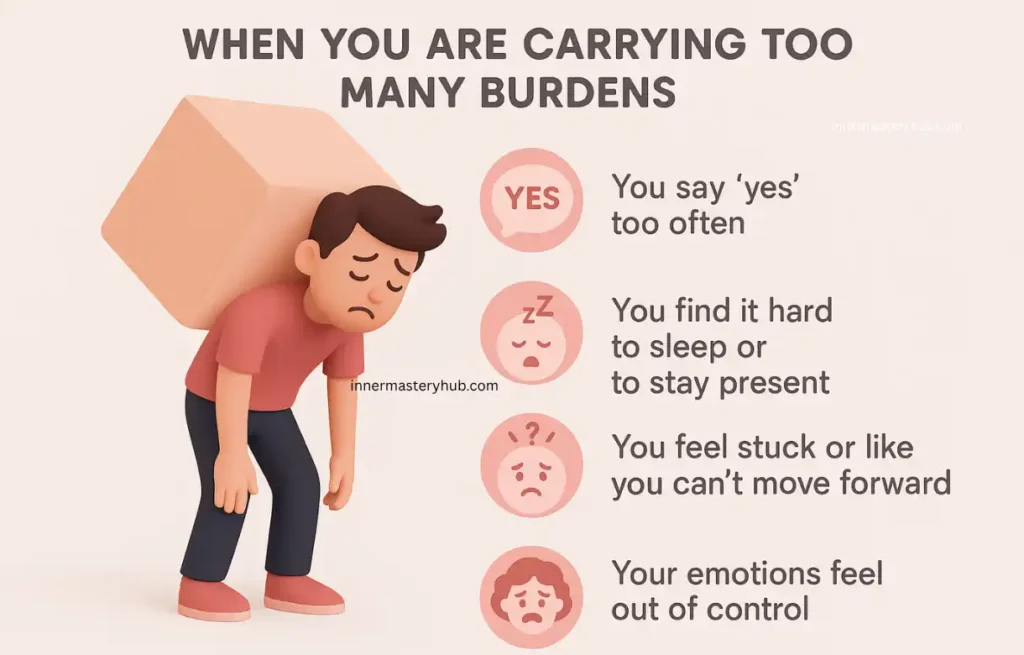
4. Your emotions feel out of control or more intense than usual
Your emotional reactions may seem heightened when you are overburdened; minor triggers may seem huge, you may cry readily, or you may become irritable or angry quickly. Your internal capacity is already taxed, which explains why. Your ability to withstand daily stresses decreases as you carry more.
What to think about? Is it possible to link an emotional outburst to something you’ve been clinging to instead of the current situation?
5. You withdraw from others even though you crave connection
You may find that you withdraw from relationships even when you want help. You may believe that nobody understands you or that you are not deserving of attention. Wanting connection yet avoiding it is a conundrum that often signals you have too much on your plate. You carry your burden by yourself if you conceal it.
Ask yourself, “Who could I trust with a part of what I’m carrying? What small piece could I share today?”
6. You neglect your own needs consistently
Your own needs are neglected when you are primarily focused on carrying obligations. You may put off getting enough sleep, neglect self-care, eat poorly, or ignore discomfort. However, the burdens increase when self-care is neglected. This is explained by the stress research hypothesis of “resource loss,” which states that stress increases when your physical and emotional resources are depleted and not replenished.
What have I been saying “later” to when it comes to my own needs? How can I give myself a small “yes” today?

7. You feel stuck or like you can’t move forward
Progress slows down when you are overburdened. You feel stuck, even when you want to change, perhaps because you don’t know where to begin or because your burdens weigh you down. “I should be moving, but I’m not” is a sign that you are carrying too much of a burden to move with ease.
What one burden could I let go of or lighten this week? What tiny step forward can I take now?
8. Physical symptoms show up, such as headaches, aches, and digestive issues
Your mind and body are intertwined. Not only can carrying too much weight make you feel weighed down, but it also affects your overall physique. Physical health problems, elevated cortisol levels, and weakened immunity are all associated with long-term stress. If your physical problems continue to be severe and unbearable, think about whether you’ve overworked yourself mentally and emotionally.
9. You find it hard to sleep or to stay present
Overworked minds either refuse to shut down or continually bring you back to chores, anxieties, and regrets. Dreamless repose disappears; sleep worsens, and you wake up fatigued once more. Additionally, you may find yourself in a “what needs to get done” mentality for half the day. A basic indication of having too much on your plate is fragmented focus.
What’s the last thought you remember before sleep? What’s the first thought when you wake? Could that burden be influencing both?
10. You say “yes” too often, even when you mean “no.”
Taking on things you don’t truly need or want is one of the simplest ways to accumulate burdens. More weight is added when someone says “yes” out of duty, guilt, or fear. You are carrying too many burdens for other people in addition to your own. Overload results from this.
Today, when you automatically say “yes,” pause and ask: “Do I want this? Can I say no and still be okay?”
11. You believe that this is just how life is, and there’s no way out
Finally, when you’re carrying too many burdens, you may resign yourself to the idea that “this is just my lot.” You may stop believing change is possible. That belief itself is heavy; it keeps you in place and blocks the pathway to relief. Research indicates that a sense of hopelessness is associated with carrying too many burdens and poorer outcomes.
Reflect on whether there is a small area of your life where you believe you could lighten your burden. What tells you “it’s not possible” and is that telling the truth?
Why Do You Keep Carrying More Instead of Letting Go?
You keep carrying burdens because letting go feels unsafe, unfamiliar, or guilt-inducing. Your identity may be tied to being strong or responsible.
This is where misunderstanding happens.
You think:
- “If I stop, things will fall apart.”
- “I should be able to handle this.”
- “Others have it worse.”
But internally, something else is happening.
You learned that:
- Being strong means not expressing
- Being responsible means carrying everything
- Being good means not prioritizing yourself
According to research on self-sacrifice schemas in psychology, people often overburden themselves due to learned patterns from early life3.
So you’re not choosing this consciously.
You were conditioned into it.
How Does Emotional Overload Actually Build Inside You?
Emotional overload builds when repeated experiences are processed mentally but not emotionally. The brain keeps storing unresolved feelings, leading to overwhelm.
Let’s break it down in a simple flow:
- You experience something difficult
- You analyze it logically
- You avoid feeling it deeply
- The emotion stays unresolved
- It adds to previous unresolved emotions
This creates what psychologists call emotional accumulation.
A study in Psychological Science found that unprocessed emotions increase rumination and mental fatigue4.
So the issue isn’t that you feel too much.
It’s that you never got to release what you felt.
What Mistakes Do People Make When Feeling Overwhelmed?
People often try to cope with emotional overload by doing more, distracting themselves, or ignoring their feelings rather than addressing the root cause.
Common mistakes include:
- Staying busy to avoid thinking
- Seeking constant distraction (phone, work)
- Trying to “fix” everything logically
- Comparing struggles with others
- Ignoring emotional needs
But here’s the truth:
You cannot solve an emotional problem with mental effort alone.
As Daniel Goleman highlights in emotional intelligence research, awareness and regulation, not suppression, are key to well-being5.
The Silent Weight of “Being Strong”
Many people who appear strong externally carry deep emotional burdens internally because they suppress vulnerability.
A 32-year-old professional reported constant fatigue despite success.
Outwardly:
- Stable job
- Good relationships
- No major issues
Internally:
- Fear of failure
- Need to meet expectations
- No emotional expression
Over time:
- Sleep issues developed
- Anxiety increased
- Motivation dropped
After therapy, the realization was simple:
He wasn’t tired from life. He was tired from carrying everything alone.
This aligns with findings in the Journal of Health Psychology, which show that emotional suppression leads to long-term burnout6.
How Is Emotional Regulation Connected to Carrying Too Many Burdens?
Emotional regulation helps you process, understand, and release emotions rather than store them, reducing internal burden.
Without regulation:
- Emotions stay inside
- Stress accumulates
- Overthinking increases
With regulation:
- Emotions are acknowledged
- Internal pressure reduces
- Mental clarity improves
This is not about controlling emotions.
It’s about allowing them to move through you.
What Is the Real Shift You Need to Understand?
The real shift is realizing that your burden is not just what you carry, but what you never allowed yourself to feel and release.
You don’t feel heavy because life is too much.
You feel heavy because:
- You processed everything mentally
- But carried everything emotionally
And that changes everything.
As Viktor Frankl wrote, “When we are no longer able to change a situation, we are challenged to change ourselves.”
Not by doing more.
But by understanding what’s happening within you.
Conclusion
You are carrying too many burdens, but not in the way you think.
It’s not just responsibilities. It’s the silent weight of unspoken emotions, internal pressure, and the belief that you must handle everything alone.
And while you keep moving forward, something inside you keeps asking for attention.
The shift begins when you stop asking,
“How do I handle more?”
and start asking,
“What have I been holding onto for too long?”
That question changes everything.
What you can do to lighten the load when you’re carrying too many burdens
You can start making changes now that you are aware of the
Next, develop a basic daily routine to take care of yourself, such as resting, eating, moving, and talking to someone. Third, permit yourself to let go of something, not because you’re failing, but rather because you’re a person and you deserve comfort.
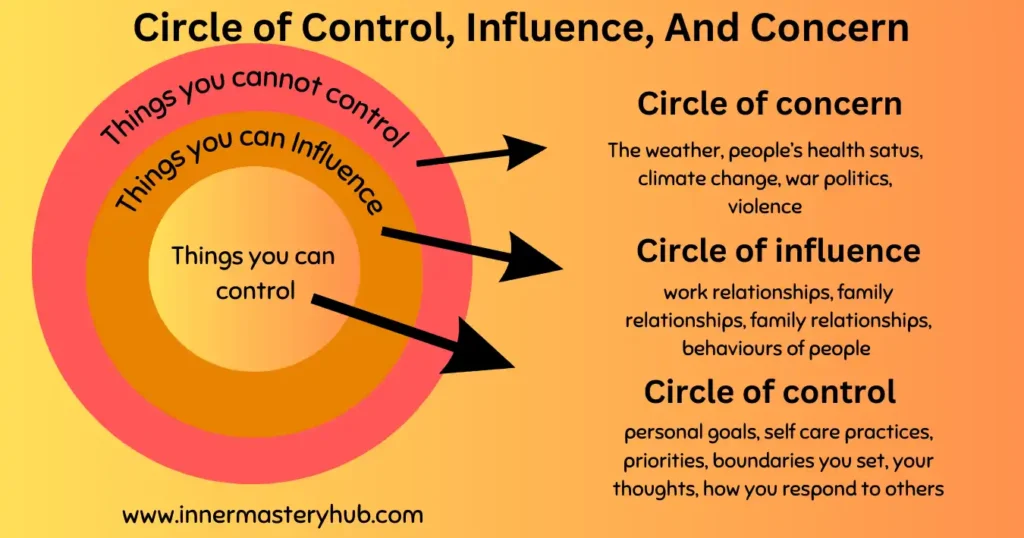
The concept of releasing your baggage can also be applied by writing down everything that’s on your mind, categorizing what belongs to you and what you don’t need to carry, and marking off things that are not within your control.
Practicing mindfulness or simply taking a few minutes to breathe and notice your body can reduce the load. One expert recommends deliberately carrying a burden in your mind for a few seconds, then releasing it.
FAQs on “carrying too many burdens.”
What does it mean to be carrying too many burdens psychologically and emotionally?
It means you’re holding on to excessive stress, guilt, or responsibility. Your mind feels cluttered, emotions become overwhelming, and you struggle to relax or find joy. You may constantly feel anxious, tired, or pressured to meet everyone’s expectations, leaving little room for yourself.
How can I tell if I am carrying too many burdens rather than just being busy?
Being busy is about doing many tasks; carrying burdens is about emotional weight. If you feel mentally exhausted, irritable, or hopeless even after resting, it’s more than busyness—it’s emotional overload that drains your energy and peace.
What are the common signs and symptoms of carrying too many burdens?
You may feel constant fatigue, worry, guilt, or sadness. Physical symptoms, such as headaches or poor sleep, may appear. Emotionally, you feel overwhelmed, disconnected, or resentful. You might struggle to focus or enjoy things you once loved.
What are the health impacts of carrying too many burdens (physical, mental)?
Carrying heavy emotional loads increases stress hormones like cortisol, leading to fatigue, tension, anxiety, and depression. Over time, it can weaken your immune system, cause high blood pressure, digestive problems, and affect your overall well-being.
How do I start to lighten the load when I realize I’m carrying too many burdens?
Start by acknowledging what’s weighing on you. Write it down, talk to someone you trust, and focus on what you can control. Let go of unnecessary responsibilities and practice self-care through daily rest, movement, and mindfulness.
How can I establish boundaries to prevent carrying too many burdens?
Learn to say “no” without guilt. Respect your limits and prioritize your mental space. Communicate clearly about what you can and cannot do. Setting boundaries protects your energy and helps you give your best to what truly matters.
When should I seek professional help because I’m carrying too many burdens?
Seek help if you feel constantly overwhelmed, anxious, or depressed for more than a few weeks. If daily tasks or relationships become difficult, a counselor or therapist can help you understand your emotions and develop healthy coping strategies.
How does carrying too many burdens affect my relationships?
Emotional overload can cause you to become distant, irritable, or unavailable. You might struggle to communicate or enjoy time with loved ones. Over time, relationships may feel strained because you’re emotionally drained and unable to connect fully.
What role do self-care and rest play when you are carrying too many burdens?
Self-care and rest restore balance. They give your mind and body time to recover from stress. Simple acts, like sleep, relaxation, or hobbies, help release emotional weight and bring clarity, making you more resilient and peaceful.
Can spirituality or belief systems help when you feel you’re carrying too many burdens?
Yes, spirituality can offer comfort and perspective. Believing in something greater than yourself, through prayer, meditation, or gratitude, helps you release control, find peace, and trust that you don’t have to carry everything alone.
- Cognitive load during problem solving: Effects on learning.
Cognitive Science, 12(2), 257–285.
https://doi.org/10.1207/s15516709cog1202_4 ↩︎ - Gross, J. J., & Levenson, R. W. (1997).
Hiding feelings: The acute effects of inhibiting negative and positive emotion.
Journal of Abnormal Psychology, 106(1), 95–103.
https://doi.org/10.1037/0021-843X.106.1.95 ↩︎ - Young, J. E., Klosko, J. S., & Weishaar, M. E. (2003).
Schema therapy: A practitioner’s guide.
New York: Guilford Press. ↩︎ - Nolen-Hoeksema, S., Wisco, B. E., & Lyubomirsky, S. (2008).
Rethinking rumination.
Perspectives on Psychological Science, 3(5), 400–424.
https://doi.org/10.1111/j.1745-6924.2008.00088.x ↩︎ - Goleman, D. (1995).
Emotional intelligence: Why it can matter more than IQ.
New York: Bantam Books. ↩︎ - Chapman, B. P., Fiscella, K., Kawachi, I., & Duberstein, P. (2013).
Emotion suppression and mortality risk over a 12-year follow-up.
Journal of Psychosomatic Research, 75(4), 381–385.
https://www.sciencedirect.com/science/article/abs/pii/S0022399913003036?via%3Dihub ↩︎