
Constantly Pouring Into Others’ Cups but Running on Empty
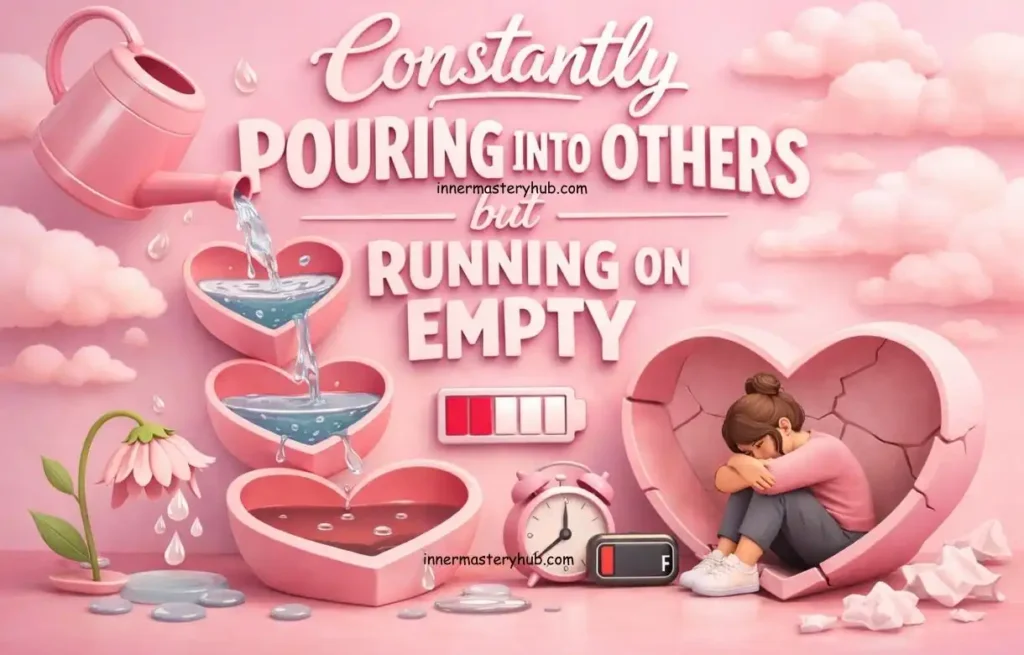
If you’re constantly pouring into others’ cups, it means you keep giving your time, care, and energy while ignoring your own needs. You may look strong, but inside you feel drained and guilty when you rest, and you slowly lose joy, patience, and your sense of self.
Because you’ve taught yourself that it’s safer to be needed than to be seen, you continue to show up even when you’re exhausted because someone needs you. You respond to the message, maintain the surroundings, resolve the issue, retain the details, bear the emotional burden, and, although you appear “fine” on the outside, you are gradually dissolving on the inside.
“Why do I feel so drained when I’m doing what I’m supposed to do?” is a question you’ve undoubtedly asked a hundred times if you’re constantly pouring into others’ cups.
What does it mean when you’re constantly pouring into others’ cups but running on empty?
Constantly pouring into others’ cups means always giving your time, energy, and emotional support to others while ignoring your own needs. Over time, this can leave you feeling drained, emotionally exhausted, and burned out, which can negatively affect your overall mental and emotional well-being.
When you’re constantly pouring into others’ cups but running on empty, you’re repeatedly giving emotional energy, time, and attention without receiving enough in return. Your nervous system treats helping as a Survival job, so you stay “on” even when you’re depleted, which can trigger burnout-like exhaustion, emotional numbness, and disconnection.
Research shows that chronic emotional labor can significantly increase stress and burnout1.
Why does helping everyone start to feel heavy instead of meaningful?
Helping becomes burdensome when it stops being a choice and becomes a Survival response. Giving is no longer motivated by feelings of fullness; alternatively, it is motivated by fear of getting replaced. Support becomes emotional labor as a result of that internal strain, and emotional labor is closely associated with fatigue and long-term detrimental effects on mental health.
Many “helpers” are unaware of the change. You initially helped someone because you cared about them, but eventually it became your identity and the only thing that made you feel secure in relationships. Your generosity is genuine, but it also carries a secret agreement: “I won’t be abandoned if I’m needed.”
The trigger is that.
Then your interpretation becomes: “Their need is more important than my limit.”
Then the emotion follows: pressure, guilt, and a constant low-level alarm.
Then the consequence shows up: exhaustion that doesn’t resolve itself with one good night’s sleep.
Why Do Some People Feel Responsible for Everyone’s Emotions?
People feel responsible for others’ emotions because of learned emotional roles during childhood, social conditioning, or attachment patterns that associate care with safety and belonging.
The Psychological Pattern
The cycle typically develops like this:
- Trigger → Someone expresses distress
- Interpretation → “It’s my responsibility to help.”
- Emotion → Empathy mixed with anxiety
- Consequence → Immediate emotional giving
Over time, this pattern becomes automatic.
According to attachment theory research, individuals with an anxious attachment style often prioritize others’ needs and seek closeness and reassurance in relationships to maintain emotional connection2.
Emotional Regulation Connection
Helping others can become a coping strategy. Instead of facing your own emotional discomfort, you regulate feelings by focusing on someone else’s problems.
This can feel meaningful at first. But emotionally, it creates an imbalance.
Why Does Constant Giving Eventually Lead to Emotional Exhaustion?
Constant giving leads to emotional exhaustion because emotional energy is finite. When people continuously support others without replenishing their own emotional resources, burnout becomes inevitable.
The Hidden Energy Cost
Emotional energy works similarly to cognitive energy.
Every time you:
- Listen deeply
- Solve problems
- Provide reassurance
- Regulate others’ emotions
Your brain uses psychological resources.
Research on emotional labor shows that continuous emotional caregiving significantly increases fatigue and stress levels3.
Emotional Consequences
Over time, people who constantly pour into others’ cups may experience:
- Compassion fatigue
- Quiet resentment
- Emotional numbness
- Identity confusion
Yet they hide these feelings because their identity is built around being the supportive one.
What are the 7 emotional consequences you’ll likely face?
1) Why do you feel emotionally numb even though you care?
When your mind attempts to shield you from too much, emotional numbness results, and empathy starts to feel more like suffering than a connection. This can gradually reflect compassion fatigue, a state of emotional exhaustion brought on by constant demands for care; you still care, but you are unable to feel it as strongly.
Typically, it begins with a trigger, such as a crisis, disappointment, or conflict with another person.
“I have to hold this,” is how you understand it.
You start to feel a sense of responsibility and quiet pressure.
Your consequence becomes a shutdown response because your system is trying to reduce the incoming load.
So you may notice you’re less moved by things that used to touch you, and you feel guilty about that numbness, which then pushes you to “try harder,” which makes the numbness worse.
2) Why does resentment creep in when you’re the one who chose to help?
Giving more than you can afford, or constantly pouring into others’ cups, especially when it’s not entirely voluntary, creates resentment. You can respond “yes” out of habit, fear, or guilt, but a part of you knows the injustice. Anger you don’t feel comfortable expressing stems from that internal division and shows up as impatience and distancing.
Resentment indicates that you’re going beyond your own boundaries rather than being evidence of selfishness.
3) Why do you feel anxious when you try to rest or pull back?
When your nervous system interprets stillness as a threat, anxiety during rest results. Stopping feels like you’re going to lose something if you’ve discovered that stability. Stress can be reduced by social support, but when support is lacking, stress looks more intense.
Distance, quiet, or rest are the triggers.
“I’m falling behind, letting people down, or becoming irrelevant” is your new interpretation.
Anxiety, guilt, and mental spinning are the resulting emotions.
As a result, you soon start helping again because it reduces your fear, rather than because you want to.

4) Why do you start feeling lonely even when people surround you?
When your relationships rely more on what you offer than on who you are, loneliness develops. People do not learn how to help you if you are the one who is always there for them. You also seldom express your own needs. Relationships become hollow instead of nourishing.
“No one knows me here” conveys a feeling of loneliness more than “no one is around.”
Because being held would require you to soften, receive, and admit need, all of which can seem uncomfortable if your identity is based on strength.
5) Why does your self-worth start depending on being needed?
When being needed is the only thing that makes you valuable, your mind begins to consider usefulness as evidence of belonging. Requests are interpreted as confirmation, and their absence as denial. Because you will continue to provide help even if it hurts you, that habit leaves you open to overgiving and emotional labor.
From the outside, this appears to be “good character,” making it one of the most subdued effects.
However, on the inside, it produces a brittle sense of value that is always in need of others’ validation. Because you can’t stand feeling like you’re replaceable, you seek positions where you’re indispensable because you’re uncomfortable not being able to contribute.
6) Why do you feel more irritable, emotional, or easily triggered lately?
Emotional exhaustion, not a negative attitude, is indicated by irritation. Chronic stress reduces your system’s ability to be patient, nuanced, and empathetic, making seemingly insignificant things seem more significant. According to research on chronic stress, recurrent strain can lead to cumulative wear and tear, which can impair resilience and mood control and make you more reactive than you were previously.
A minor request could serve as the trigger for this.
“Not again” is how you perceive it.
Frustration, helplessness, and guilt for feeling frustrated become your feelings.
As a result, you may shut down or withdraw in silence, feel guilty, and then want to “make up for it” by giving more.
You are locked in that cycle.
7) Why do you start losing your sense of self when constantly pouring into others?
Chronically concentrating on the outside world can cause you to lose your sense of self. Overgiving teaches you to look at other people first and think about yourself last, which gradually blurs your boundaries. Long-term giving without refueling leads to this emotional endpoint: you help and function, but you feel cut off from your true desires.
What’s really happening inside when you can’t stop constantly pouring into others’ cups?
Your brain interprets other people’s feelings as a priority signal, as it links “being available” to “being safe.” When support isn’t returned, your stress system remains active, eventually resulting in accumulated strain. Both mental and physical resilience can be weakened by recurrent stress activation, according to research on allostatic load and chronic stress.
What Is the Common Misunderstanding About Being “Too Giving”?
The common misunderstanding is believing that constant giving is purely kindness. In reality, it may reflect unmet emotional needs, fear of rejection, or learned Survival patterns.
The Internal Misinterpretation
Many helpers believe:
“I’m just a caring person.”
But psychological reality may include:
- Fear of disappointing others
- Need for validation
- Difficulty expressing personal needs
As author Brené Brown explains:
“Daring to set boundaries is about having the courage to love ourselves even when we risk disappointing others4.”
True compassion includes self-compassion.
What Mistakes Do People Make When They Realize This Pattern?
When people recognize they constantly pour into others’ cups, they often swing to extremes, either continuing self-sacrifice or abruptly withdrawing from relationships.
1. Suppressing the realization
They ignore exhaustion and keep helping.
2. Sudden emotional withdrawal
Instead of gradually adjusting boundaries, they isolate themselves.
3. Feeling guilty for needing space
The mind interprets self-care as selfishness.
But emotional balance is not abandonment. It is a sustainable connection.
When Helping Becomes Identity
Many caregivers develop their identity around helping others, which can lead to emotional imbalance when their own needs remain unaddressed.
Real-Life Scenario
A teacher named Sara became known as the “person everyone could talk to.”
Students relied on her. Friends called her constantly. Colleagues trusted her emotional support.
For years, this role felt meaningful.
But slowly she noticed:
- She avoided discussing her own struggles
- She felt anxious saying no
- She felt exhausted but kept helping
Her emotional system had learned that being needed meant being valued.
Recognizing this pattern helped her reconnect with her own emotional needs.
How Can You Understand the Inner Shift Instead of Forcing Change?
Understand that compassion and self-care are not opposites. Emotional sustainability requires both giving and receiving support.
Instead of asking:
“How can I stop helping people?”
A deeper question appears:
“Why do I feel responsible for everyone else’s emotional well-being?”
That question opens awareness.
And awareness changes patterns naturally.
Takeaway
If you’re constantly pouring into others’ cups and you feel like you’re slowly disappearing, you don’t need another lecture about boundaries that makes you feel guilty for having needs. You need an accurate explanation of what’s happening inside you, because your pattern isn’t random, and your exhaustion isn’t weakness; it’s the predictable result of carrying emotional weight without enough reciprocity.
The symptoms, numbness, bitterness, anxiety, loneliness, worth tied to being needed, impatience, and loss of self are indicators that your inner system has been overgiving to protect connection, not that you’re broken. The change is that it allows you to be true and shame-free because you stop battling yourself and begin creating space for genuine support once you get the mechanism.
Share this with someone who always supports everyone if it struck a painful chord with you. Then, pick one person you can trust and tell them straight out, “I’ve been running on empty.” You don’t have to collapse to get care.
People also ask
What does it mean to be “constantly pouring into others’ cups from an empty cup”?
It suggests that you are providing emotional support, care, and energy without receiving enough healing or support. Even while you’re still able to function, you feel exhausted and less like yourself. The strain may eventually resemble chronic stress overload, which a study defines as cumulative wear on resilience.
Why do I feel guilty when I stop helping people or Constantly Pour into Others’ Cups?
When your mind links belonging with helping, guilt frequently arises. Pulling back, even when you’re fatigued, can feel like you’re doing something wrong if you’ve discovered that connections are maintained by being helpful. Guilt isn’t always moral; it’s usually a covert form of protective anxiety.
Is overgiving or constantly pouring into others’ cups a trauma response?
Sometimes it can be, especially if you learned early that keeping others calm kept you safe, or that love came with conditions. Not every helper has trauma, but many have learned Survival patterns around approval, conflict avoidance, or being “the responsible one,” which can drive chronic overfunctioning.
Why does helping others sometimes make me feel angry?
Anger signals a crossed limit. You may be saying yes when you mean no, giving more than you can afford, or carrying responsibility that isn’t yours. When you don’t feel allowed to express that boundary directly, anger leaks out as irritability, resentment, or emotional shutdown.
Why do I feel lonely even though people are always around me?
Because being surrounded isn’t the same as being supported. If people mostly come to you for help, they may not see you as someone who also needs care. Social support is known to buffer stress, so when it’s one-sided, you can feel emotionally isolated even in a full room.
How do I stop being the person everyone depends on?
It starts by noticing what you believe will happen if you don’t. Many people try to change behavior first, but the deeper shift is changing the interpretation that says, “I’m only safe or loved when I’m useful.” When that belief loosens, new choices become possible.
What are the signs I’m emotionally exhausted from helping too much?
Common signs include numbness, irritability, dread at the thought of asking for help, difficulty resting without guilt, feeling detached from yourself, and a sense that you can’t “refill.” These can overlap with chronic stress overload and compassion fatigue patterns described in research on helping demands.
What does constantly pouring into others’ cups in psychology refer to?
Constantly “pouring into others’ cups” means always giving time, care, or energy to others while ignoring your own needs. Psychologically, it can come from people-pleasing, low self-worth, guilt, or fear of rejection. It often leads to burnout, resentment, and weak boundaries.
Stop constantly pouring into others’ cups quotes
“Stop pouring into others’ cups that never pour back.”
“You can’t fill others if you’re empty.”
“Choose reciprocity, not exhaustion.”
“Your needs are not optional.”
“Boundaries are self-respect in action.”
- Hülsheger, U. R., & Schewe, A. F. (2011). On the costs and benefits of emotional labor: A meta-analysis of three decades of research. Journal of Occupational Health Psychology, 16(3), 361–389. https://doi.org/10.1037/a0022876 ↩︎
- Mikulincer, M., & Shaver, P. R. (2016). Attachment in adulthood: Structure, dynamics, and change (2nd ed.). The Guilford Press. ↩︎
- Hülsheger, U. R., & Schewe, A. F. (2011). On the costs and benefits of emotional labor: A meta-analysis of three decades of research. Journal of Occupational Health Psychology, 16(3), 361–389. https://doi.org/10.1037/a0022876 ↩︎
- Brown, B. (2018). Dare to lead: Brave work, tough conversations, whole hearts. Random House. https://www.scirp.org/reference/referencespapers?referenceid=2890735. ↩︎
Written By Mehwish Qurayshi
Mehwish Qurayshi is a Trauma-Informed Emotional Wellness Counsellor trained through NICABM’s Treating Trauma Master Series, which includes NBCC-approved education in Trauma Treatment and Emotional Wellness & Emotional Intelligence – Sourcecode Academia. She has over five years of experience providing emotional wellness counselling, helping individuals heal from trauma, regulate emotions, and build healthy relationships.