People Stuck in the Survival Mode Repeat These 11 Daily Patterns
People stuck in Survival Mode live in constant stress, with the brain focusing on safety rather than growth. They feel tense, reactive, and emotionally drained. The nervous system stays on high alert, making it hard to relax, trust, plan for the long term, or feel truly safe.
When you’re one of many people stuck in Survival Mode, daily life doesn’t feel like living; it feels like getting through. You wake up already tense, your mind is scanning for what could go wrong, and your body never fully powers down.
People stuck in the Survival Mode are not merely “being stressed.” It’s a state in which your nervous system is stuck on high alert (fight-or-flight) or in a state of shutdown (frozen), after prolonged periods of pressure, stress, or uncertainty. Researchers define it as a dysregulated state in which the body’s stress systems remain activated far longer than they should.
At first, it seems like anxiety or overthinking. But the truth runs deeper. Your body is not trying to hurt you. It is trying to protect you.
This is where emotional regulation comes in. When your nervous system cannot regulate emotions properly, it stays in defense mode. That’s why small problems feel big, and silence feels uncomfortable.
As Bessel van der Kolk, author of The Body Keeps the Score, explains:
“Being able to feel safe with other people is probably the single most important aspect of mental health.”
But when safety feels missing inside, your system stays on high alert.
The connection becomes clear:
Your past experiences shape how your brain interprets the present.
And that internal struggle?
It’s not a weakness. It’s a pattern your mind learned to survive.
Why do people get stuck in survival mode?
People get stuck in survival mode because their brains adapt to prolonged stress or emotional threat. Over time, the nervous system becomes conditioned to expect danger, even in safe situations, leading to chronic anxiety, hypervigilance, and emotional exhaustion.
Your brain has one main job: to keep you safe.
But here’s what happens quietly:
- A stressful event happens (trigger)
- Your brain interprets it as danger
- You feel fear, anxiety, or urgency
- Your body reacts (fight, flight, freeze)
Over time, this loop becomes automatic.
Even when life improves, your system doesn’t update immediately. It keeps running the same pattern.
This is linked to:
- Chronic stress
- Childhood trauma
- Emotional neglect
- Burnout
Research from the American Psychological Association1 shows that prolonged stress rewires the brain, especially the amygdala, increasing fear responses.
How do you know if you are stuck in Survival Mode?
You may be stuck in Survival Mode if you constantly feel tense, struggle to relax, overreact to small issues, and find it hard to feel safe even in calm situations.
Signs
- Chronic anxiety or overthinking
- Emotional numbness
- Difficulty resting
- Feeling “on edge” often
What does Survival Mode feel like emotionally?
Survival Mode feels like constant tension, emotional numbness, irritability, and an inability to relax fully. You may feel disconnected from joy, while your mind remains busy scanning for problems or threats.
Emotional Experience Breakdown
You might notice:
- You overthink simple decisions
- You feel restless even during calm moments
- You struggle to feel joy or presence
- You react quickly, then regret it
This is because your nervous system is prioritizing safety over happiness.
As Stephen Porges (Polyvagal Theory) explains:
“When the nervous system detects danger, it shifts away from connection and into protection.”
What is the biggest misunderstanding about Survival Mode?
The biggest misunderstanding is thinking Survival Mode is a mindset problem, when it is actually a nervous system state. It’s not about thinking differently, it’s about how your body processes safety and threat.
You might try:
- Positive thinking
- Motivation
- Productivity hacks
But they don’t work long-term.
Because the issue is not your thoughts.
It’s your internal state.
Your body asks first:
“Am I safe?”
If the answer is no, growth shuts down.
How does Survival Mode affect daily life?
Survival Mode affects daily life by limiting emotional capacity, reducing focus, and increasing stress reactions. It makes relationships harder, decisions more overwhelming, and rest feel unnatural.
Real-Life Consequences
- You stay busy but feel unfulfilled
- You avoid risks or new opportunities
- You feel drained after social interactions
- You struggle with sleep or rest
This creates a cycle:
Stress → Reactivity → Regret → More stress
What mistakes do people make when stuck in survival mode?
People try to fix Survival Mode through productivity, avoidance, or self-criticism. These approaches ignore the root issue and keep the nervous system in a state of threat.
Common Mistakes
- Pushing harder instead of slowing down
- Ignoring emotional needs
- Judging themselves as “lazy” or “broken.”
- Avoiding discomfort instead of understanding it
But here’s the truth:
You cannot force yourself out of Survival Mode.
Because force itself feels like pressure, and pressure feels like danger.
How is emotional regulation connected to Survival Mode?
Emotional regulation helps shift the nervous system from Survival Mode to a state of safety. When emotions are processed instead of suppressed, the brain learns that the environment is no longer threatening.
The Inner Process
When something happens:
- You interpret it based on past experiences
- Your body reacts emotionally
- If not regulated, the emotion stays active
This is why emotional awareness matters.
As research from Harvard Health shows, emotional regulation reduces stress response and improves brain function2.
11 Signs You Are Stuck in Survival Mode
1. People stuck in Survival Mode constantly scan for danger
You wake up, and your thoughts start running: What did I forget? Who might be upset? What might go wrong today? You may go over previous conversations, expect criticism, or make plans for every eventuality. On the outside, you look “responsible” or “ready.” Inside, you’re exhausted.
This continual scanning is an indicator that your nervous system has learnt to value threat over safety. Polyvagal theory, which investigates how the nervous system responds to danger, says that when your body senses danger, your “Survival circuits” activate first. Your brain develops, primed to perceive danger everywhere, including emails, facial expressions, and quiet, when they remain on for an extended period.
Over time, that continuous alertness raises stress hormones such as cortisol and adrenaline. Chronic elevation of these hormones can suppress immunity, disturb sleep, and increase fatigue. You might notice you get sick more often, feel wired at night, and struggle to relax even when nothing is obviously wrong.
A realistic way forward is to give your nervous system repeated experiences of “nothing bad happened.” You can try simple check-ins during the day: pause, feel your feet on the ground, look around the room, and name three neutral things you can see. This helps your brain map the present moment as safe enough, not an emergency. Over time, that repeated practice starts to weaken the grip of constant threat monitoring.
2. You stay busy all the time because slowing down feels unsafe
On paper, you can look extremely productive: constantly doing, always helping, always taking on one more task. When you sit still, though, you feel guilty, as if pausing means you’re slipping behind. Maybe you even think it’s physically uncomfortable as you try to rest.
This is typically a Survival technique your body learnt: if you keep moving, maybe nothing awful will catch up with you. The purpose of the stress reaction is to push you into action. While it’s stuck “on,” you can find yourself living in a condition of perpetual doing, even as your body asks for rest.
The tricky part is that chronic busyness doesn’t just make you tired; studies link ongoing stress with high blood pressure, digestive issues, immune changes, and a higher risk of long-term health problems. You might notice tension headaches, stomach upsets, or sleep that never feels refreshing.
Incorporating brief periods of purposeful slowness into your day is a more beneficial approach than trying to make yourself “relax.” For example, you might stroll without your phone for 10 minutes, stretch between jobs, or consume your tea without multitasking. “This pause helps me do the rest better,” you should tell yourself. A brain accustomed to linking safety with continuous effort sees leisure time as less dangerous as a result of this reframing.
3. You feel emotionally numb or disconnected from your own life
Not everyone feels “hyper” when stuck in Survival Mode. Even while you appear composed and functional—going to work, paying bills, and interacting with others—you may feel oddly flat on the inside. Sadness seems far away, happiness doesn’t come easily, and you define yourself as “on autopilot” or “just going through the routines.”
This can be a variant of the freeze or shutdown reaction. When fight-or-flight hasn’t succeeded or sustained stress has occurred, then the nervous system can shift into a more collapsed state as a last-ditch effort to survive. It prevents you from experiencing too much, but it also blocks you from feeling fully alive.
Research on chronic stress shows that this state is linked with fatigue, low mood, and difficulty concentrating. You might notice you forget things, zone out in conversations, or feel like life is happening behind glass.
A gentle technique to start altering this is through modest, safe experiences of feeling and emotion. That can include noticing the warmth of the shower, the taste of your food. You’re not forcing large emotions; instead, you’re welcoming your body back into the present moment. Over time, you can add somewhat more emotionally impactful moments, like fully listening to a song you like or letting yourself get moved by a film scene. Each tiny reconnection informs your nervous system that it is safe to reconnect.
4. You say “yes” to keep the peace, even when everything in you wants to say “no.”
You might be employing people-pleasing as a Survival habit if you frequently consent to things you are incapable of doing, apologise even when you did nothing wrong, or get anxious at the thought of upsetting someone.
In many circumstances, especially if you grew up around unpredictable adults or conflict, your body learnt that staying safe meant smoothing things over and reducing the likelihood of wrath. This behaviour is dubbed the “fawn” response, a way your nervous system tries to live, seeking approval and avoiding rejection.
The cost is abandoning your own needs. Over time, such self-betrayal morphs into bitterness. When your stress system gets triggered by ongoing social conflict, it can intensify anxiety and affect your sleep, appetite, and mood.
A practical next step would be to try small acts of truth rather than abruptly turning confrontational. For example, “I’d like to help, but I can only do X, not Y,” or “I need to think about that and get back to you.” You can practise these lines in your brain before you use them.
5. You procrastinate, freeze, and then hate yourself for it
Being stuck in Survival Mode isn’t always speedy and productive. Even when you know a task is essential, it sometimes seems like you’re staring at it for hours on end and are unable to begin at all. Then you panic at the last minute, or avoid it altogether, and end up drowning in regret and self-criticism.
From the outside, this may appear to be sloth, but the science of stress reveals a different narrative. When your brain is overwhelmed by stress hormones for too long, the regions responsible for planning, decision-making, and flexible thinking fail to function correctly.
You might notice your mind goes blank, your chest tightens, or you suddenly feel so fatigued that you ‘just check your phone for a second’ and miss an hour. Your neurological system feels more threatened the more you condemn yourself for this, and the cycle keeps on.
Reducing the task until it no longer feels dangerous is a more compassionate approach. Instead of “finish the entire project,” you strive for “open the document and write one messy paragraph,” or “set a 10-minute timer and do whatever I can.” You can even remind yourself, “I’m not finishing this right now; I’m just starting it improperly.”

6. Your body’s basic needs are always at the bottom of your list
When you’re stuck in Survival Mode, you could skip meals, eat whatever is closest, sleep at irregular hours, ignore thirst, and push through discomfort or illness because you “don’t have time” to deal with it. It may feel like your body is an obstacle you have to drag about, not something you’re living inside.
Research from groups such as the World Health Organisation and the American Psychological Association demonstrates that chronic stress commonly shows up as headaches, muscle tension, stomach troubles, changes in appetite, and sleep problems.
Taking care of oneself does not feel natural if you’ve spent years ignoring your body’s signals. A more reasonable beginning point is to pick one non-negotiable. For example, “I drink water with every meal,” or “I go to bed 20 minutes earlier than usual,” or “I eat something within two hours of waking.” You’re creating a new identity where your body matters; you don’t have to change your entire way of life.
7. You overreact to small things and feel ashamed afterward
You promise yourself you will remain composed, but a slight comment, a delay, a mess in the kitchen, or an insignificant mistake upsets you. You then ask yourself, “Why did I behave that way? It wasn’t all that significant.
Your response makes logical sense from the standpoint of the nervous system. When you’re stuck in Survival Mode, your body is already prepped for danger. In other words, tiny pressures add to a complete stress bucket.
You’re not choosing to “overreact”; your body is reacting to the accumulated load of the last months or years. Still, you’re the one who has to live with the consequences, and that can damage relationships and self-trust.
Developing curiosity about your early warning indicators is a helpful first step. Maybe your jaw tightens, your shoulders raise, or your thoughts speed up. When you see those signals, you can halt, literally step away if possible, and take a few slower breaths with a longer exhale.
Techniques that activate the parasympathetic nervous system – the “rest and digest” branch – assist your body in switching out of emergency Mode and back towards a more grounded condition. You won’t catch it every time, but even a few “saved” moments will start to influence how you feel about yourself.
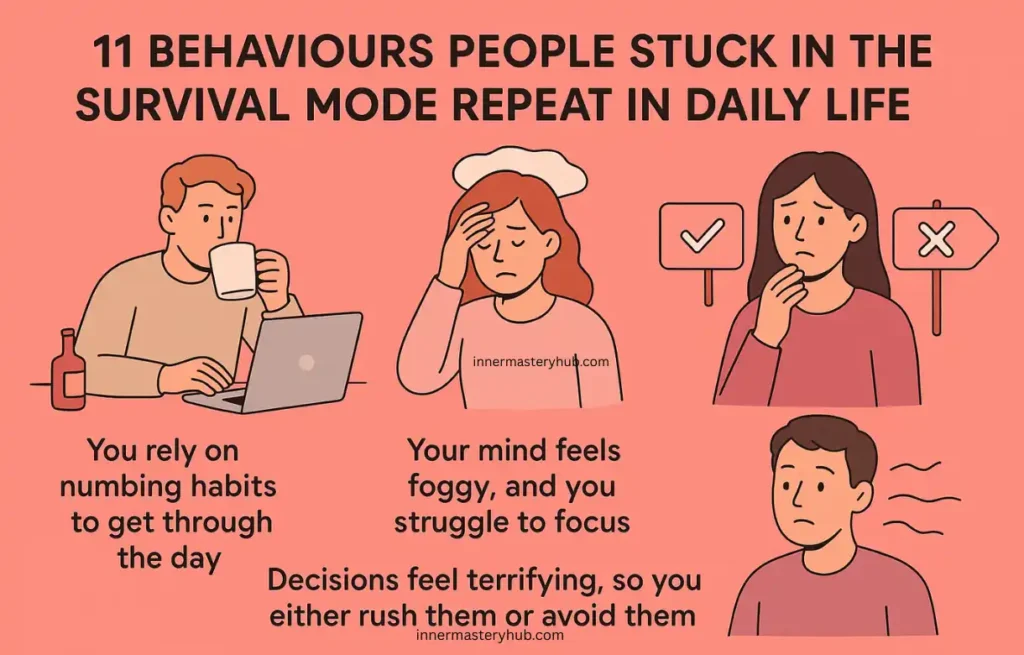
8. Decisions feel terrifying, so you either rush them or avoid them
When your nervous system is trapped in Survival Mode, practically every option might feel like a test you might fail. You may swing between making rash decisions to get the discomfort over with or continually delaying choices because the concern of doing it wrong feels overwhelming.
Chronic stress narrows your thoughts. Your brain tends to think in black-and-white: “If I choose wrong, everything will fall apart,” rather than being able to assess possibilities calmly. High levels of extended stress can affect working memory and flexible problem-solving, which are precisely the abilities required for sound decision-making.
A kind way forward is to lower the “stakes” of everyday choices in your own mind. start telling yourself, “Very few decisions are truly irreversible; I’m allowed to adjust later.” It can also help to pre-decide some small routines.
9. Your mind feels foggy, and you struggle to focus or remember things
Many people stuck in Survival Mode criticise themselves for “being scattered” or “not smart enough,” when, in truth, their brains are doing their best under stress. Chronic stress has been proven to alter brain areas involved in memory, learning, and attention. You may repeatedly read the same passage, forget appointments, or have a persistent loss of focus.
This creates an unpleasant narrative about oneself, such as “I can’t handle life as other people can,” which is not only annoying but also unhelpful. The loop is then fuelled by that belief, which turns into yet another stressor.
It is helpful to view focus as a capacity issue rather than a character issue. Your attention is a finite resource, particularly when you’re under a lot of stress. You may support it by limiting extraneous input: fewer active tabs, silenced non-essential notifications, and a basic to-do list with just three vital tasks for the day. Your nervous system has one fewer thing to keep an eye on when you write things down rather than trying to recall everything.
10. You rely on numbing habits to get through the day
When you’re stuck in Survival Mode, you can find yourself continually browsing, binge-watching, overeating, drinking more than you’d want, or utilising other habits to avoid how you feel. You convince yourself you’ll “just check for a minute,” and suddenly an hour has gone by.
From a stress perspective, these behaviours are attempts at self-control. They quickly modify your condition, even if the impact is fleeting and occasionally damaging. Research on stress and coping shows3 that when people lack many skills for healthy regulation, they’re more inclined to seek short-term relief that may increase long-term stress. These behaviours may have helped you survive more difficult periods of your life. Now, they’re just not giving you the kind of support you need.
A more sustainable approach is to expand your self-regulation toolkit. These include deep breathing exercises, stretching, journaling, listening to calming music, stepping outside for fresh air, or texting a loved one. You don’t have to eliminate your numbing habits overnight; you can start by inserting one healthier action before or after them.
11. You withdraw from people or feel lonely even when you’re not alone
Another behaviour common among those stuck in Survival Mode is pulling away from others. You can be physically present but emotionally detached, cancel arrangements, or neglect to respond to messages. Ironically, this typically happens at the same time as feeling extremely misunderstood.
Polyvagal theory highlights that feeling comfortable in connection is one of the key ways our nervous system settles down after threat. However, if you’ve been stuck in Survival Mode for a long time, people may begin to feel like an additional threat; they may criticise you, make demands of you, or reflect on aspects of your life that you’re not proud of. Thus, your body decides that solitude is the “safer” alternative.
Unfortunately, isolation tends to increase stress, anxiety, and low mood over time. You lose access to one of the most potent regulators of the nervous system: a supportive, non-demanding connection.
To proceed softly on a different path, you don’t need to become instantaneously outgoing. You can start by choosing one or two “safe enough” people and being a little more honest with them. That can sound like, “I’m ok, but more tired than usual,” or, I’m trying to look after myself better; I might be slower replying.” However, actual exchanges like these can give your nervous system the sense that connection is possible without being overpowering.
Can Survival Mode become a long-term identity?
Yes, Survival Mode can become an identity when someone adapts to constant stress for a long time. They begin to see anxiety, overworking, or emotional detachment as part of who they are.
Why This Happens
You adapt to survive.
So you might think:
- “I’m just an anxious person.”
- “I can’t relax.”
- “This is how I am.”
But this is learned, not fixed.
A Quiet Pattern
Ali, a 32-year-old professional, always felt restless.
Even on vacation, he checked emails constantly.
He believed he was just “driven.”
But deeper inside:
- His childhood involved unpredictability
- His brain learned to stay alert
- Rest started to feel unsafe
So even success didn’t bring peace.
This is how Survival Mode hides behind productivity.
Moving from being trapped in Survival Mode toward a life you can actually enjoy
If you see yourself in many of these actions, know this: being one of the people trapped in the Survival Mode doesn’t simply make you broken. It means your body and mind adapted to situations that felt risky, and those adaptations remained operating past their expiry date.
Chronic stress undoubtedly affects your relationships, health, emotions, and thinking, but your system is flexible. Your nervous system can gradually transition from a state of perpetual threat to one of balance when you give persistent signals of safety, such as improved sleep, softer self-talk, modest boundaries, regular activity, calming breathing, and supportive connections.
You don’t have to fix everything at once. Start with one behaviour that stood out to you. Maybe it’s staying busy all the time, or saying yes when you mean no, or numbing out at night. Ask yourself:
- What is this behaviour trying to protect me from?
- What is it costing me now?
- What is one small, kinder action I can experiment with instead?
As someone who has walked many people through this process, I can tell you that change rarely comes from dramatic overnight decisions. It comes from small, repeated signals to your body that things are different now, that you are allowed to be safe, to rest, to take up space, to ask for help.
You may still have days when the old patterns come back. That doesn’t mean you’ve failed; it means you’re human and your nervous system is practising something new after years of training in Survival. Each time you identify a typical Survival behaviour and respond with even a slightly kinder decision, you’re writing the story of how you live.
And if you feel like you can’t do this alone, reaching out to a therapist, counsellor, or support group is itself a big move out of Survival Mode. You’re not supposed to handle everything on your own. You deserve more than just getting through the day; you deserve a life that feels like yours again.
Conclusion
Being people stuck in Survival Mode is not a sign of weakness.
It is about adaptation.
Your system learned to protect you, even if it now feels exhausting.
But here is the shift:
You are not broken.
You are patterned.
And patterns can change, but not through force.
Only through understanding.
FAQs
What does it mean when people are stuck in Survival Mode?
People’s bodies and minds remain extremely vigilant when they are trapped in Survival Mode. You’re anxious, tense, and constantly on edge because you think something negative may happen. Instead of appreciating the day or making peaceful plans for the future, daily life becomes about getting by.
How do you know if you are one of the people stuck in Survival Mode?
You feel numb, nervous, or exhausted all the time. You overthink, struggle to relax, and react aggressively to tiny issues. You might be busy all the time, avoid decisions, or rely on numbing habits. If this feels like your regular existence, you could be trapped in Survival Mode.
What causes people to get stuck in Survival Mode?
You can get stuck in Survival Mode after long periods of stress, trauma, burnout, money pressure, or unstable relationships. Your nervous system learns to protect you by staying on guard. Over time, this “al” ays ready” s” ate becomes your default, even when you’re technically safe.
Can people stuck in Survival Mode still function normally?
You may appear to be doing well on the outside: you work, take care of people, respond to communications, and carry on. You feel stiff, hollow, or exhausted on the inside. You are not thriving, but you are functioning. Instead of feeling creative, in the moment, and connected to what truly matters to you, you get by.
How can you calm your nervous system if you are stuck in Survival Mode?
You may quiet your nervous system with little, steady steps: regular sleep, moderate movement, slow breathing, grounding exercises, and basic routines. Take brief pauses from devices and spend time with safe people. Significant adjustments don’t need to be made all at once; your system can be gradually reset by repeatedly sending out tiny safety signals.
How long does it take to get out of Survival Mode?
There isn’t a set time. Your past and present stress levels, support network, and routines all play a role. While some people recover in a matter of weeks, others may need months or more. What matters is consistency: little everyday behaviours that convince your body, “I’m safe now.”
Can therapy help people stuck in Survival Mode?
You can explore stress, trauma, and old habits in an atmosphere of safety with therapy. A competent therapist teaches you healthy coping mechanisms, boundaries, and how to manage your nervous system. One of the best ways to transition out of Survival Mode is to feel safe.
Do people stuck in Survival Mode always feel anxious?
Not always. Some people feel anxious and wired. Others feel flat, numb, or disconnected, like they are on autopilot. Both are forms of being trapped in Survival Mode. Your body is either braced for action or shutting down to cope. Either way, you don’t feel fully present or relaxed in your own life.
What first step should you take if you realise you are stuck in Survival Mode?
Start by noticing your patterns without judging yourself. Pick one small area to support yourself better, like sleep, food, water, or a short daily walk. You can also talk to a trusted person or therapist. The first key step is admitting you deserve more than to survive.
Is Survival Mode the same as anxiety?
Not exactly. Survival Mode is a broader nervous system state, while anxiety is one of its symptoms. Survival Mode includes hypervigilance, emotional shutdown, and stress responses that extend beyond anxious thoughts.
Can Survival Mode affect physical health?
Yes. Long-term Survival Mode can lead to fatigue, sleep issues, digestive problems, and a weakened immune system due to the constant activation of the stress response system.
How long does Survival Mode last?
It can last months or even years if the underlying patterns are not addressed. The nervous system needs consistent signals of safety to shift out of Survival Mode.
Is Survival Mode linked to trauma?
Yes. Trauma, especially unresolved emotional experiences, is one of the main reasons people remain stuck in Survival Mode.
- American Psychological Association. (2018). Stress effects on the body.
https://www.apa.org/topics/stress/body ↩︎ - Harvard Health Publishing. (1 June 2020). Managing your emotions can improve your health. Harvard Medical School.
https://www.health.harvard.edu/mind-and-mood/managing-your-emotions-can-improve-your-health ↩︎ - American Psychological Association. (225 October 2019. Won’t go away? Maybe you are suffering from chronic stress. https://www.apa.org/topics/stress/chronic ↩︎