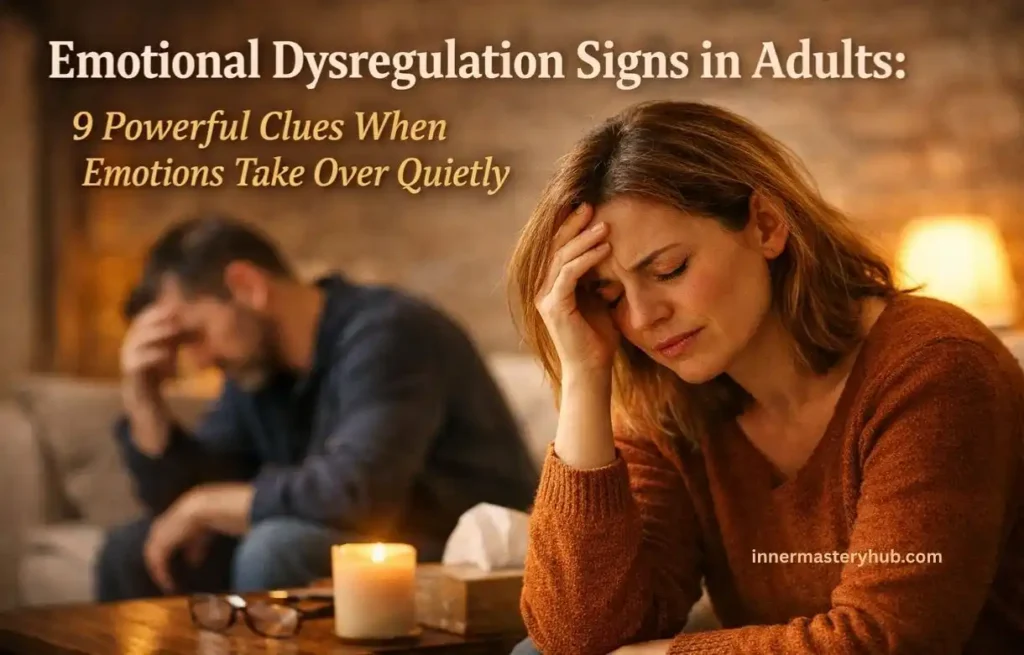
Emotional Dysregulation Signs in Adults: 9 Powerful Clues When Emotions Take Over Quietly
Title
Emotional dysregulation signs in adults are patterns where emotions feel intense, hard to manage, or disconnected. These include emotional overwhelm, shutdown, impulsive reactions, validation seeking, emotional flooding, and difficulty calming down. These reactions usually happen because the nervous system shifts into Survival Mode, not because you’re “too emotional.”
When emotions take over quietly
You tell yourself you should handle things better. But a small comment from someone lingers longer than usual. Silence feels heavy. You either react quickly or go completely numb. You try to stay calm, but inside, something feels louder than you can control.
Quiet internal tension is the first sign of emotional dysregulation in adults. You shut down, overthink, or become emotionally exhausted. Your neurological system acts more quickly than your brain, despite your best efforts to control it.
Maintaining composure is only one aspect of emotional management. It has to do with how your body responds to cues, how your mind interprets them, and how your behavior follows. Emotional regulation issues are similar to personality features. However, they are actually dysregulation of the neurological system, emotional flooding, and emotional reactivity.
Psychologist Daniel Goleman explained that emotional self-regulation is the foundation of emotional intelligence1. When regulation weakens, emotions don’t disappear. They intensify, avoid, or shut down.
This creates a loop: There is a trigger. You interpret it in your own way. Feelings surge. Reaction comes next. The pattern then becomes strong because of the consequences.
The internal question turns into:
“Why do I lose emotional control even when I understand what’s happening?”
The misconception is that this is a vulnerability. However, emotional overload coupled with survival-mode processing is actually what’s taking place.
9 Emotional Dysregulation Signs in Adults When Emotions Take Over Quietly
1. Why do small things trigger big reactions?
One of the main signs of emotional dysregulation in adults is small stimuli that cause intense feelings. Little things are perceived as dangers by the nervous system. Because the brain anticipates danger, emotional sensitivity rises.
Your mind rapidly fills in meaning when emotional triggers are triggered. A delayed response is perceived as rejection. A tone sounds judgmental. Distance results from silence.
This happens because the amygdala processes emotional threats faster than the prefrontal cortex processes logic2.
Common emotional dysregulation behaviors adults show:
- Sudden irritation
- Overthinking interactions
- Feeling rejected quickly
- Emotional overwhelm
Example:
Your friend cancels plans. You know they’re busy. But your body reacts first. You feel hurt, then distant. The reaction came before reasoning.
This is emotional reactivity, not over-sensitivity.
2. Why do adults suddenly shut down emotionally?
When emotions become too strong, adults experience emotional shutdown. You withdraw rather than respond.
This is the dysregulation of the nervous system into frozen Mode.
Many times, a shutdown is confused with peacefulness. On the inside, however, there is withdrawal, cerebral fog, and emotional apathy.
This is caused by the processing ability being overwhelmed by emotional overload. To cope, the brain suppresses emotions.
Signs include:
- Going silent during conflict
- Feeling blank or numb
- Avoiding conversations
- Emotional avoidance in adults shows
Psychologist Bessel van der Kolk explains that trauma-related dysregulation leads to emotional numbing and disconnection3.
This is not indifference. It’s an overload.
3. Why do emotions feel overwhelming without a clear reason?
Adults regularly experience emotional overload in the absence of clear triggers. where Stress builds up in the neurological system. Emotions eventually spill over without warning.
This is an influx of emotions. Thoughts rush, tension in the body rises. You feel as though you cannot understand everything.
Emotional dysregulation symptoms adults experience:
- Feeling mentally overloaded
- Difficulty calming down
- Racing thoughts
- Irritability
Example:
Nothing major happens. But multiple small stressors pile up. Your body reaches capacity. Suddenly, you feel exhausted, emotional, or reactive.
This is the Survival Mode that adults enter when the regulatory capacity drops.
4. Why do adults struggle to calm down after conflict?
One of the main signs of emotional dysregulation is difficulty going back to baseline. The nervous system remains active for a longer period. Adults’ emotional instability continues long after the incident.
Emotions can rise and fall with healthy management. The emotional system becomes trapped due to dysregulation.
This leads to:
- Replay conversations
- Lingering anger
- Emotional dependency
- Validation-seeking behavior
Research shows that dysregulated people show slower emotional recovery after Stress4.
This is not holding grudges. It’s delayed emotional processing.

5. Why do adults become overly dependent on reassurance?
Adults with emotional dysregulation frequently have validation-seeking behavior.
When safety on an emotional level feels external.
It’s hard to self-soothe.
You keep looking for assurance. Regulation fades rapidly, not because you don’t believe it.
Emotional dysregulation in relationships looks like:
- Asking “are we okay?” often
- Overanalyzing tone
- Fear of emotional distance
- Emotional dependency
Example:
You receive reassurance. You feel calm. But later, the anxiety returns. The emotional system resets to uncertainty.
This reflects unstable internal regulation.
6. Why do adults swing between emotional intensity and numbness?
Adults with emotional instability move between numbness and overwhelm.
The neurological system swings between freezing and fighting.
Emotional reactions become erratic as a result.
This pattern includes:
- Strong emotions one day
- Emotional numbness that adults feel next
- Withdrawal after intensity
- Emotional avoidance
This happens because the system cannot maintain balance. It compensates by switching states.
This is common in trauma emotional dysregulation.
7. Why do adults overreact in relationships?
Perceived risks in relationships are frequently amplified by emotional instability. Attachment anxieties come on fast, and emotional cues increase reactivity.
You may:
- React strongly to tone
- Feel rejected easily
- Withdraw quickly
- Over-explain emotions
Research links emotional dysregulation with relationship instability5.
This is not drama. It’s emotional threat detection.
8. Why do adults emotionally dump after holding things in?
Emotional dumping happens when suppression builds pressure.
Feelings accumulate silently. Eventually, they release intensely.
This looks like:
- Long emotional messages
- Sudden venting
- Intense sharing
- Overexplaining feelings
Emotional avoidance practiced by adults leads to this. Suppressed emotions do not disappear. They intensify.
Example:
You stay calm for weeks. Then a small disagreement triggers everything stored.
This is an emotional backlog release.
9. Why do adults feel stuck in Survival Mode emotionally?
Survival Mode adults experience keeps the nervous system alert. Emotions prioritize safety over logic. Regulation becomes harder.
Signs include:
- Hypervigilance
- Emotional reactivity
- Difficulty relaxing
- Overthinking
This happens because the brain prioritizes protection.
Research shows that chronic Stress affects emotional regulation networks6.
This explains the loss of emotional control adults experience.
Emotional Dysregulation Psychology Adults Miss
Emotional dysregulation is not about emotions being too strong. It’s about the regulation capacity being overloaded.
The internal process follows this pattern:
A situation appears.
Your mind interprets it emotionally.
Your nervous system activates.
Emotion intensifies.
Behavior follows automatically.
This happens quickly. Often before awareness.
People assume they need more discipline. But regulation is physiological and psychological.
Common mistakes adults make:
- Suppressing emotions
- Ignoring emotional triggers
- Overanalyzing instead of processing
- Seeking constant reassurance
- Avoiding emotional conversations
These behaviors increase emotional dysregulation.
Emotional Dysregulation Example: Adults Experience
Katherine, my client, normally feels calm. But during disagreements, she shuts down. Later, she sends long emotional messages.
Trigger: partner’s neutral tone
Interpretation: “They’re upset with me.”
Emotion: anxiety + fear
Consequence: shutdown → emotional dumping
She thought she was overreacting. But actually, she was experiencing emotional flooding followed by freeze.
This is a common example of emotional dysregulation that adults face.
Conclusion
Emotional dysregulation signs in adults appear quietly, not as chaos, but as subtle reactions. You overthink, shut down, seek reassurance, or feel overwhelmed. You believe you should control it better. But emotional regulation is not about suppressing emotions. It’s about how your mind and nervous system process experience.
When emotional control is lost, it’s not weakness. It’s a signal that the system is overloaded, not broken. Understanding this shifts everything. Instead of judging reactions, you begin noticing patterns. And in that awareness, emotional responses start making sense.
FAQs
What are the emotional dysregulation symptoms adults experience?
Adults may experience emotional overwhelm, shutdown, irritability, emotional flooding, validation seeking, and difficulty calming down. These symptoms happen when emotional regulation capacity is reduced, and the nervous system reacts strongly to triggers.
Is emotional dysregulation common in adults?
Yes, emotional dysregulation in adults is common, especially during stress, trauma, or relationship challenges. Many adults experience emotional reactivity, emotional avoidance, or emotional numbness without realizing it’s dysregulation.
What causes emotional dysregulation in adults?
Causes include chronic Stress, trauma, emotional dysregulation, attachment issues, anxiety, and nervous system dysregulation. These factors reduce emotional processing capacity and increase emotional instability.
What does emotional shutdown look like in adults?
The emotional shutdown adults experience includes silence, numbness, withdrawal, avoiding conversations, and difficulty expressing feelings. This happens when emotions become overwhelming, and the brain shifts into freeze Mode.
Is losing emotional control normal for adults?
Yes, losing emotional control is normal under stress. It reflects emotional overload rather than weakness. Dysregulation happens when the nervous system processes a threat quickly.
How does emotional dysregulation affect relationships?
Emotional dysregulation in relationships leads to overreacting, reassurance seeking, emotional dependency, and misinterpreting signals. This increases conflict and emotional distance.
What is emotional flooding in adults?
Emotional flooding is when emotions become intense quickly, making thinking difficult. Adults may feel overwhelmed, reactive, or unable to calm down until the intensity decreases.
Can trauma cause emotional dysregulation?
Yes, trauma emotional dysregulation is common. Trauma sensitizes the nervous system, increasing emotional reactivity, shutdown, and emotional instability.
What is emotional avoidance in adults?
Emotional avoidance adults use includes ignoring feelings, withdrawing, distracting, or suppressing emotions. This leads to emotional dumping later.
How do I know if I have emotional dysregulation?
You may notice strong reactions, shutdown, emotional overwhelm, validation seeking, or difficulty calming down. These patterns suggest emotional regulation problems.
- Goleman, D. (1995). Emotional intelligence: Why it can matter more than IQ. New York: Bantam Books. ↩︎
- LeDoux, J. E. (1996). The Emotional Brain: The Mysterious Underpinnings of Emotional Life. New York: Simon & Schuster. ↩︎
- van der Kolk, B. A., Roth, S., Pelcovitz, D., Sunday, S., & Spinazzola, J. (2005).
Disorders of stress: The empirical foundation of a complex adaptation to trauma.
Journal of Traumatic Stress, 18(5), 389–399. ↩︎ - Kring, A. M., & Levenson, R. W. (1993).
Emotional suppression and cardiovascular response to emotion-eliciting films.
Journal of Personality and Social Psychology, 64(6), 970–986.
https://doi.org/10.1037/0022-3514.64.6.970 ↩︎ - Gross, J. J., & Levenson, R. W. (1997).
Hiding feelings: The acute effects of inhibiting positive and negative emotion.
Journal of Abnormal Psychology, 106(1), 95–103.
https://doi.org/10.1037/0021-843X.106.1.95 ↩︎ - Sinha, R. (2008).
Chronic stress, drug use, and vulnerability to addiction.
Annals of the New York Academy of Sciences, 1141(1), 105–130.
https://doi.org/10.1196/annals.1441.030 ↩︎